
The World’s Oldest Botanical Art Reveals How Humans Were Doing Math 8,000 Years Ago
Long before numbers were written down or equations etched into clay tablets, early farming communities may have been doing math — with flowers.
A new study, published in the Journal of World Psychology, suggests that some of humanity’s earliest artistic depictions of plants were not merely decorative but deeply structured, reflecting sophisticated ways of organizing space and symmetry more than 8,000 years ago.
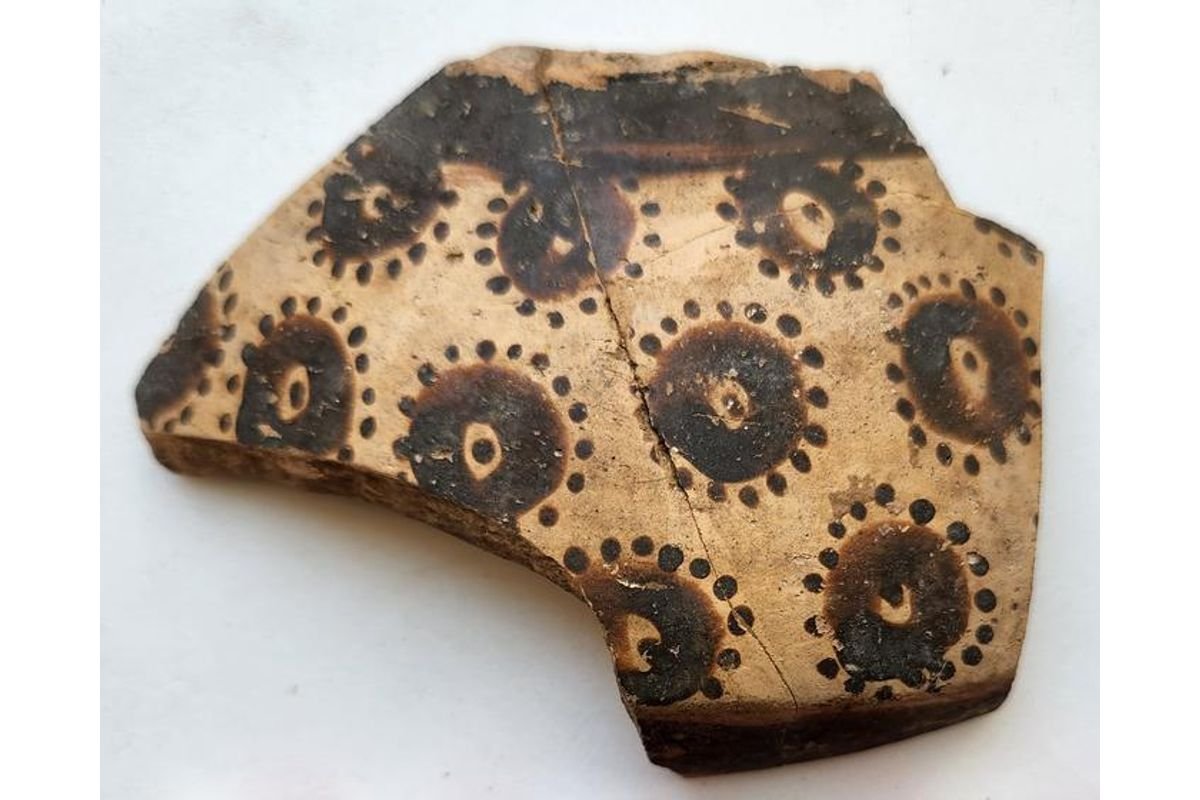
Researchers analyzing ancient pottery from Northern Mesopotamia have identified what may be the world’s earliest botanical art. These finely painted vessels, produced by the Halafian culture, feature flowers, shrubs, branches, and trees arranged with striking regularity.
According to the study, the designs use clear numeral patterns, offering rare insight into how prehistoric people thought about order, division, and balance long before formal mathematics existed.
Read More: Ancient Dirty Dishes May Be Misleading Archaeologists and Rewriting History
The World’s Earliest Botanical Art

(Image Credit: Yosef Garfinkel)
The findings come from an extensive survey of pottery recovered from 29 archaeological sites across northern Mesopotamia, a region associated with some of the world’s earliest agricultural villages. Hundreds of pottery vessels were analyzed and revealed a surprisingly rich visual vocabulary of plant life.
Unlike earlier prehistoric art, which overwhelmingly focused on animals or human figures, Halafian pottery marks a significant shift. Instead of humans and animals, Halafian pottery showcases flowers, as well as seedlings, shrubs, branches, and towering trees. Some images appear more naturalistic, while others are abstracted into repeated forms; all exhibit deliberate artistic planning.
“These vessels represent the first moment in history when people chose to portray the botanical world as a subject worthy of artistic attention. It reflects a cognitive shift tied to village life and a growing awareness of symmetry and aesthetics,” said the authors of the study in a press release.
Notably, none of the plant images depict edible crops. That absence suggests that the art was not instructional or agricultural, but was an aesthetic choice — possibly because flowers were known to evoke positive emotional responses and visual pleasure.
How These Designs Reveal Early Mathematical Thinking
This research contributes to ethnomathematics, a field that examines how mathematical reasoning emerges through cultural practices rather than formal writing.
What sets these images apart is not just what they depict, but how these depictions are arranged. Many bowls display flowers with petal counts that follow precise numerical sequences. In some cases, entire surfaces are divided into evenly spaced floral units, demonstrating consistent geometric progression.
The researchers argue that these patterns are intentional rather than accidental. They reflect a capacity to divide space evenly and to think in repeated, scalable units, which are mathematical skills that likely correspond to the villagers’ everyday duties.
“The ability to divide space evenly, reflected in these floral motifs, likely had practical roots in daily life, such as sharing harvests or allocating communal fields,” said Yosef Garfinkel.
What This Discovery Tells Us About Art and Math
Written mathematical systems would not appear in Sumer for thousands of years after the pottery examined in this study. This makes the Halafian’s botanical art incredibly important for human history.
“These patterns show that mathematical thinking began long before writing. People visualized divisions, sequences, and balance through their art,” explained Sarah Krulwich.
By documenting the earliest known botanical imagery and uncovering its mathematical foundations, the study reframes how we understand early village life. These communities were not only farming and settling; they were also observing nature, organizing their world, and expressing complex ideas through art.
In the beautiful geometry of painted flowers, the roots of mathematics were already taking shape.
Read More: An 800-Year-Old Design Reveals a Lost Trojan Tale in a Roman Mosaic
Article Sources
Our writers at Discovermagazine.com use peer-reviewed studies and high-quality sources for our articles, and our editors review for scientific accuracy and editorial standards. Review the sources used below for this article: