
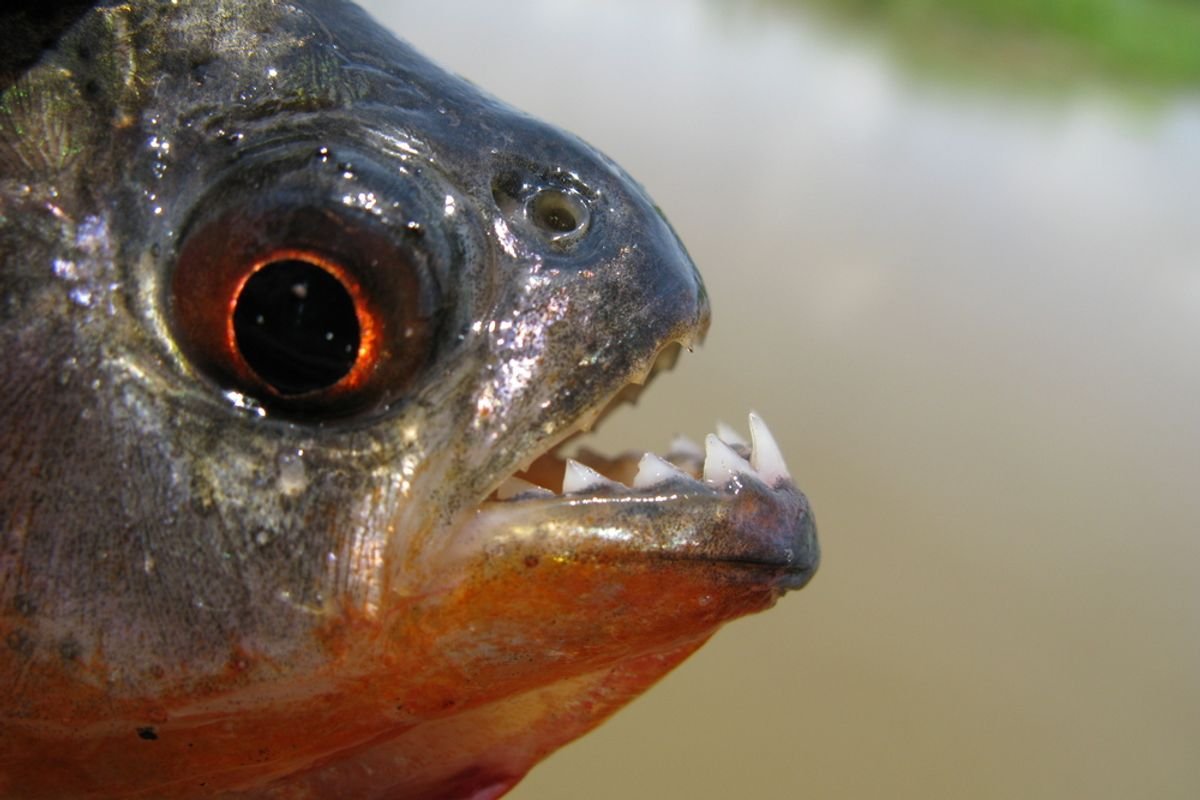
The Tiny Black Piranha Has a Bite Force of 70 Pounds — How Is This Possible?

In 1914, former U.S. president Theodore Roosevelt was traveling in Brazil when locals set up a demonstration of sorts. They had barricaded a shoal of piranhas in part of a river and then starved the fish for days. While Roosevelt watched from the riverbank, they pushed a cow into the water to show how quickly the piranhas devoured it.
Roosevelt recounted the story in a book and also claimed that piranhas attacked helpless humans. Readers were horrified, and piranhas have long been considered man-eating monsters.
In recent years, scientists have analyzed the mechanics behind the piranha’s fierce bite and determined what parts of Roosevelt’s claims were fact or fiction.
Read More: 5 Dangerous Animals That Call The Amazon Rainforest Home
Piranha Jaw Force
In response to Roosevelt’s book, a famous zoologist questioned whether piranhas even existed, according to the Theodore Roosevelt Center. The small fish and their deadly jaw force seemed outlandish.
Piranha species like the black piranha (Serrasalmus rhombeus), however, are as powerful as Roosevelt promised. A 2012 study in Scientific Reports measured the black piranha’s bite force at 320 Newtons or 70 pounds.
How can such a small fish have such a powerful jaw? Scientists have a better understanding of how the piranha’s unique shape supports their powerful bite. Piranhas have a disc-shaped body, which gives them space for a larger jaw as well as room for jaw muscle movement.
“This available space on their skulls, which is greater in piranha than other fish of the same size, allows for an increased area for jaw muscle attachment and movement,” says Robert May, an aquarist with the Long Island Aquarium who oversees the piranha exhibit, which is home to red-bellied piranhas (Pygocentrus nattereri).
Piranha jaws also have adductor muscles, which work with other muscles, so the greatest bite-force impact is in the rear teeth. May says this allows the piranha “to clamp their jaws down with incredible power.”
Piranha’s Extra Sharp Teeth
In his book, Roosevelt claimed the shoal of piranhas stripped a cow of its meat and muscles within minutes. This event was staged, so the piranhas were hungry, anxious, and aggressive. But their teeth are indeed capable of tearing into animal flesh and devouring it quickly.
Piranha teeth are snugly spaced, which helps them chew their food quickly. Because they have a larger head surface, May says the teeth are distributed throughout their jaws in a way that enables them to avoid biting themselves while chewing.
Working together, a piranha’s jaw force and sharp teeth are so powerful that if it were larger, its bite would be comparable to some apex predators.
“So, while large modern sharks and alligators have larger bite forces than piranha, if there were a piranha of the same size as those large sharks and alligators, then the piranha bite force could certainly compete with the others,” May says.
Although piranhas have a powerful bite force and knife-like teeth, many of the piranha’s would-be prey have evolved with protective armor.
In a 2023 study in Integrative Organismal Biology, researchers observed captive red-bellied piranhas as they attempted to prey on three-striped corydoras (Corydoras trilineatus). The three-striped corydoras had a natural armor that often held up to the piranha’s attack. They survived 37 percent of bites without injury, and it typically took the piranha nine strikes to puncture the prey.
Piranha’s Fishy Reputation
Not every bite is a quick kill, but piranhas have developed a man-eating reputation similar to the bad rap that sharks have received.
“They’re not the flesh-devouring machines that Teddy Roosevelt’s travels through the Amazon rainforest or Hollywood movies would make us believe they are, even though they do primarily eat meat in a particularly showy fashion,” May says.
Horror stories about river-swimming humans being attacked by piranhas have not been validated by science, and a study of injuries from aquatic animals in Brazil found that 88 percent were from stinging fish like stingrays or jellyfish, according to a study in the Journal of the Brazilian Society of Tropical Medicine.
While it may seem as though piranhas could rush to attack humans as soon as they realize their presence, well-fed piranhas are not particularly interested in humans. At the Long Island Aquarium, for example, an aquarist regularly climbs into the piranha habitat for cleaning and maintenance. The piranhas keep their distance and appear relieved when the human finally leaves.
Read More: 10 Animal Names That Have You Fooled
Article Sources
Our writers at Discovermagazine.com use peer-reviewed studies and high-quality sources for our articles, and our editors review for scientific accuracy and editorial standards. Review the sources used below for this article: