
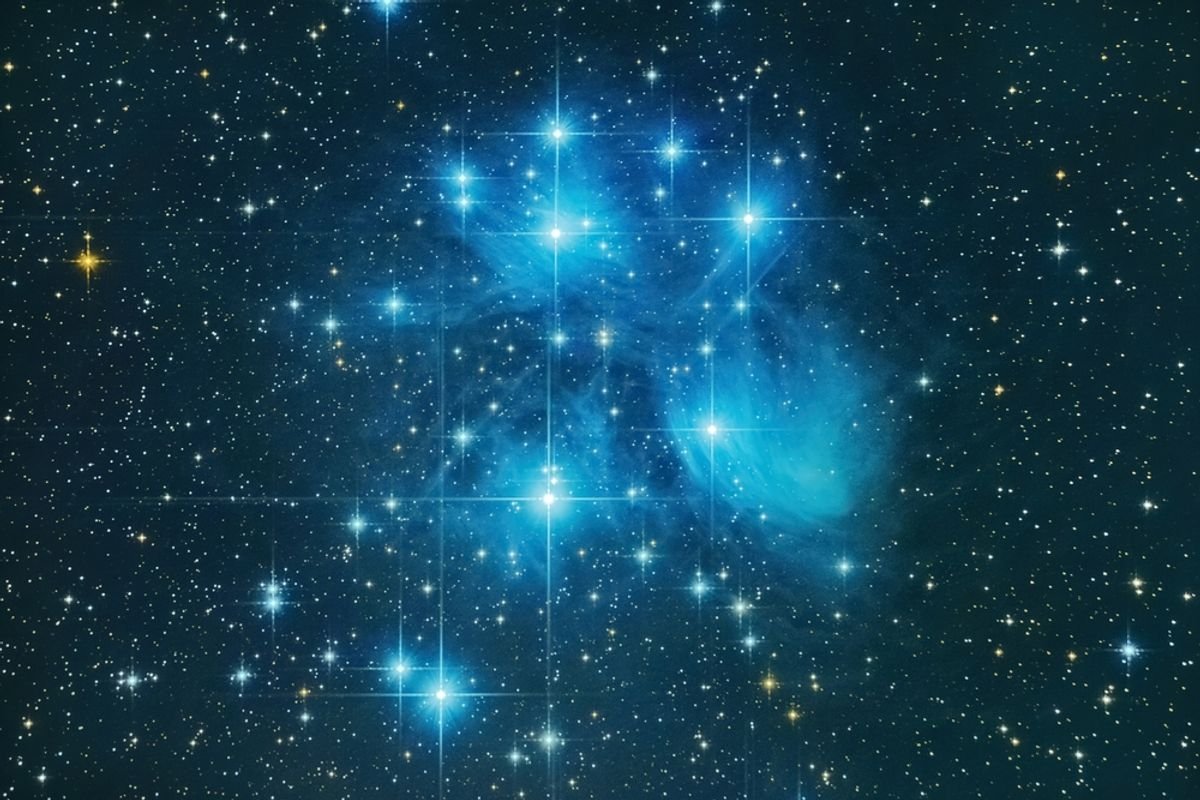
The Seven Sisters Star Cluster Is 20 Times Larger Than We Thought

For as long as humans have looked up, the Pleiades, also known as the Seven Sisters, have stood out — a compact cluster of blue-white stars that seems small to the eye but hides a vast galactic family. Astronomers have traced that family outward, uncovering thousands of long-lost siblings and redefining what we know of the Pleiades.
Using measurements from NASA’s Transiting Exoplanet Survey Satellite (TESS) and the European Space Agency’s (ESA) Gaia mission, researchers uncovered a network of related stars stretching far beyond the cluster’s edge. They’ve named it the Greater Pleiades Complex, a family 20 times broader than anyone imagined.
“This study changes how we see the Pleiades — not just seven bright stars, but thousands of long-lost siblings scattered across the whole sky,” said Andrew Boyle, lead author, in a press release.
The Pleiades: A Cultural Icon and Astronomical Touchstone
The Pleiades — also known as Melotte 22, Subaru, or the Seven Sisters — is one of the nearest and most recognizable open clusters, about 440 light-years (136 parsecs) from Earth. Named for the daughters of the titan Atlas and the sea-nymph Pleione in Greek mythology, the cluster has appeared in the Old Testament and Talmud, marks the Māori New Year in New Zealand, and even inspired Subaru’s six-star emblem, whose name means “to unite.”
For astronomers, the Pleiades has long been a cornerstone of stellar astrophysics. At about 127 million years old, it weighs roughly 850 suns, making it ideal for studying how stars slow their spin, mapping the stellar mass function, and searching for young planets.
Earlier research had already hinted that the Pleiades might not stand alone. Studies comparing its motion to nearby stellar associations — such as AB Doradus and several Theia groups — suggested they might share a common origin. That possibility set the stage for the new work to test those links and uncover what lay beyond the familiar cluster.
Read More: The JWST May Have Discovered the Milky Way’s Twin
Using TESS and Gaia to Map the Pleiades’ Hidden Stars
To uncover the reach of the Pleiades, astronomers at the University of North Carolina at Chapel Hill paired data from NASA’s TESS and ESA’s Gaia telescopes.
TESS monitors millions of nearby stars for subtle dips in brightness that reveal how fast they spin — a stellar clock that slows down with age. Gaia, meanwhile, maps each star’s position and motion through the Milky Way with pinpoint precision. By merging these datasets, the team developed a new Bayesian “gyro-tagging” method to identify stars that not only move like the Pleiades but also share the same age.
They began with more than 6.6 million nearby stars, filtering out older, slow-spinning ones and those whose data lacked precision. Then, using clustering algorithms, they searched for patterns in space and motion, a kind of stellar fingerprint. What emerged was 3,019 stars, all roughly 127 million years old, moving in lockstep across nearly 600 parsecs, or about 2,000 light-years.
A New Way to Trace the Galaxy
The study opens a new path for uncovering how stars were born and scattered through the Galaxy. By using stellar spin as a cosmic clock, astronomers can now spot clusters that are too stretched out to see by position alone. The team expects that many of the stars shining near us today are remnants of other long-dissolved families.
“By measuring how stars spin, we can identify stellar groups too scattered to detect with traditional methods — opening a new window into the hidden architecture of our Galaxy,” said Boyle.
This technique could eventually help astronomers reconstruct the Milky Way’s family tree — and reveal whether our own Sun was once part of a stellar clan.
Read More: Space Tornadoes Are Swirling Around the Milky Way’s Core
Article Sources
Our writers at Discovermagazine.com use peer-reviewed studies and high-quality sources for our articles, and our editors review for scientific accuracy and editorial standards. Review the sources used below for this article: