
The Oldest Known Rock Art Is Over 67,000 Years Old, Offering Clues Into Our Ancient Ancestors’ Migrations
The outline is faint and faded. It’s a human hand, though it’s a little claw-like, too.
Found in a cave on a satellite island of Sulawesi in Indonesia, this stencil represents a memory — a memento of a population that may have embarked on the first human migration into Australia. According to a new study in Nature, it’s now the oldest recorded rock art that’s been reliably dated, predating previous discoveries of cave paintings in the region by around 16,600 years.
“It is now evident from our new phase of research that Sulawesi was home to one of the world’s richest and most longstanding artistic cultures,” said study author Maxime Aubert, from the Griffith Centre for Social and Cultural Research at Griffith University in Australia, according to a press release, “one with origins in the earliest history of human occupation of the island at least 67,800 years ago.”
Read More: Modern Humans May Have Lived Alongside an Extinct Human Species in Ancient Indonesia
Rock Art Records
The Indonesian island of Sulawesi is a significant site in human history. Of course, it has served as an important space for art and artistic innovation, preserving some of the oldest cave expressions ever identified, including the painting of human and animal figures — a possible hunt scene — that the study authors analyzed in a prior study in Nature from 2024.
Yet the archipelago may have also supported our ancient ancestors’ early movements, acting as a potential stepping stone for Homo sapiens as they migrated from Asia to Sahul, the paleocontinent that previously connected Australia, New Guinea, and Tasmania.

The 67,800-year-old stencil was identified in Indonesia’s Liang Metanduno cave, shown in an aerial view above.
(Image Credit: Supplied by Ratno Sardi)
Hoping to learn more about the art and migrations of H. sapiens, the study authors’ recent research remained in Sulawesi and its surrounding islands, identifying a series of ancient rock art paintings. Several were stencils — outlines of pigment in the shape of human hands — including the oldest, in the Liang Metanduno cave on the island of Muna, which had been altered to look something like a claw.
Harnessing a handful of techniques, including uranium-series dating and mineral deposit analysis, the team determined that the claw-like stencil was made around 67,800 years ago, before any other recorded rock art in the region, and attributed it to an H. sapiens artist who was probably connected to the ancestors of the Aboriginal Australians.
“It is very likely that the people who made these paintings in Sulawesi were part of the broader population that would later spread through the region and ultimately reach Australia,” said study author Adhi Agus Oktaviana, from Indonesia’s National Research and Innovation Agency, according to the release. “This discovery strongly supports the idea that the ancestors of the First Australians were in Sahul by 65,000 years ago.”
Read More: Hominins Moved Into the Neighborhood of the Hobbit Humans Around 1.04 Million Years Ago
Art on the Move
Previously published research had suggested that H. sapiens arrived in Sahul on one of two timelines: the “long chronology” timeline, around 65,000 years ago, and the “short chronology” timeline, around 50,000 years ago. That research also suggested that modern humans landed on the paleocontinent through one of two island-hopping routes: the northern route and the southern route, with the former tracing through Sulawesi and the latter tracing through Timor, to respectively arrive at the New Guinean and Australian portions of Sahul.

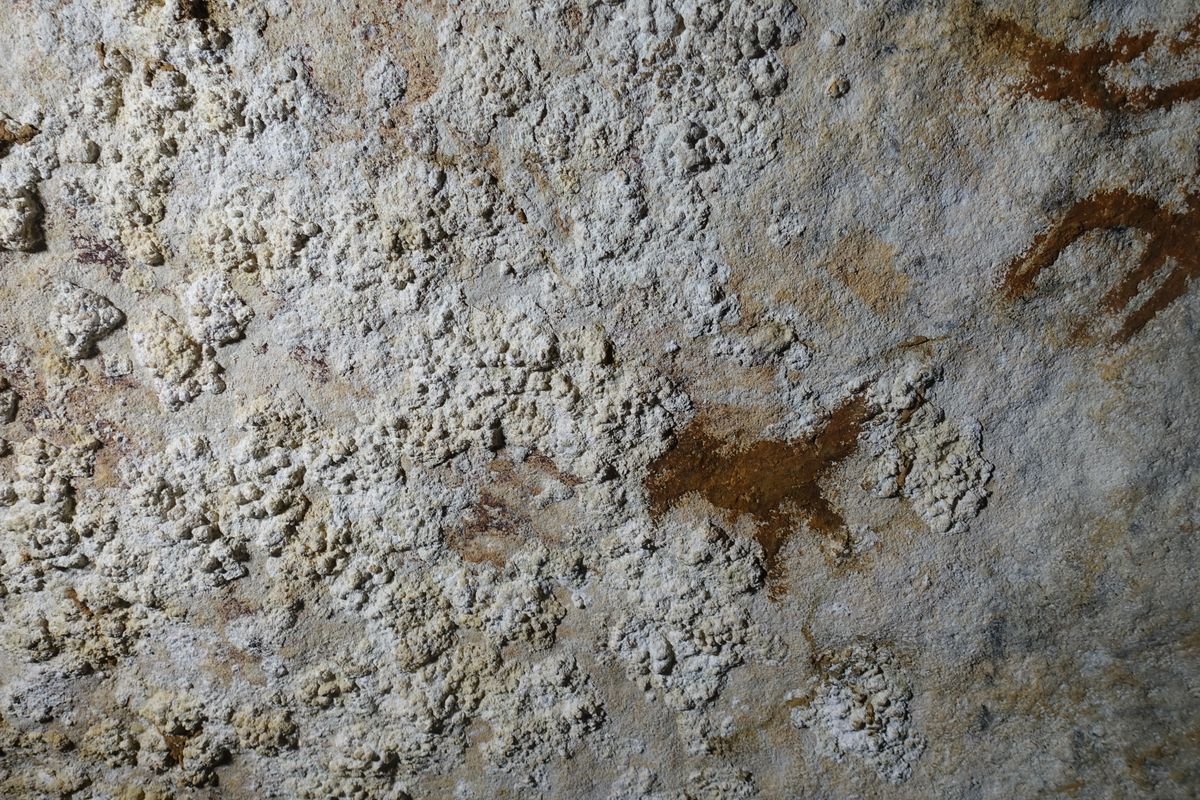
According to the study authors, Liang Metanduno also contains younger paintings, suggesting a substantial period of occupation, some 35,000 years long or longer.
(Image Credit: Supplied by Ratno Sardi)
“With the dating of this extremely ancient rock art in Sulawesi, we now have the oldest direct evidence for the presence of modern humans along this northern migration corridor into Sahul,” said study author Renaud Joannes-Boyau, from the Geoarchaeology and Archaeometry Research Group at Southern Cross University in Australia, according to the release.
Looking to the future, the team hopes to continue its search for the traces of human art and migration, concentrating on sites along the northern route into Sahul.
“These discoveries underscore the archaeological importance of the many other Indonesian islands between Sulawesi and New Guinea,” Aubert added in the release, alluding to new targets for further investigation.
Article Sources
Our writers at Discovermagazine.com use peer-reviewed studies and high-quality sources for our articles, and our editors review for scientific accuracy and editorial standards. Review the sources used below for this article: