
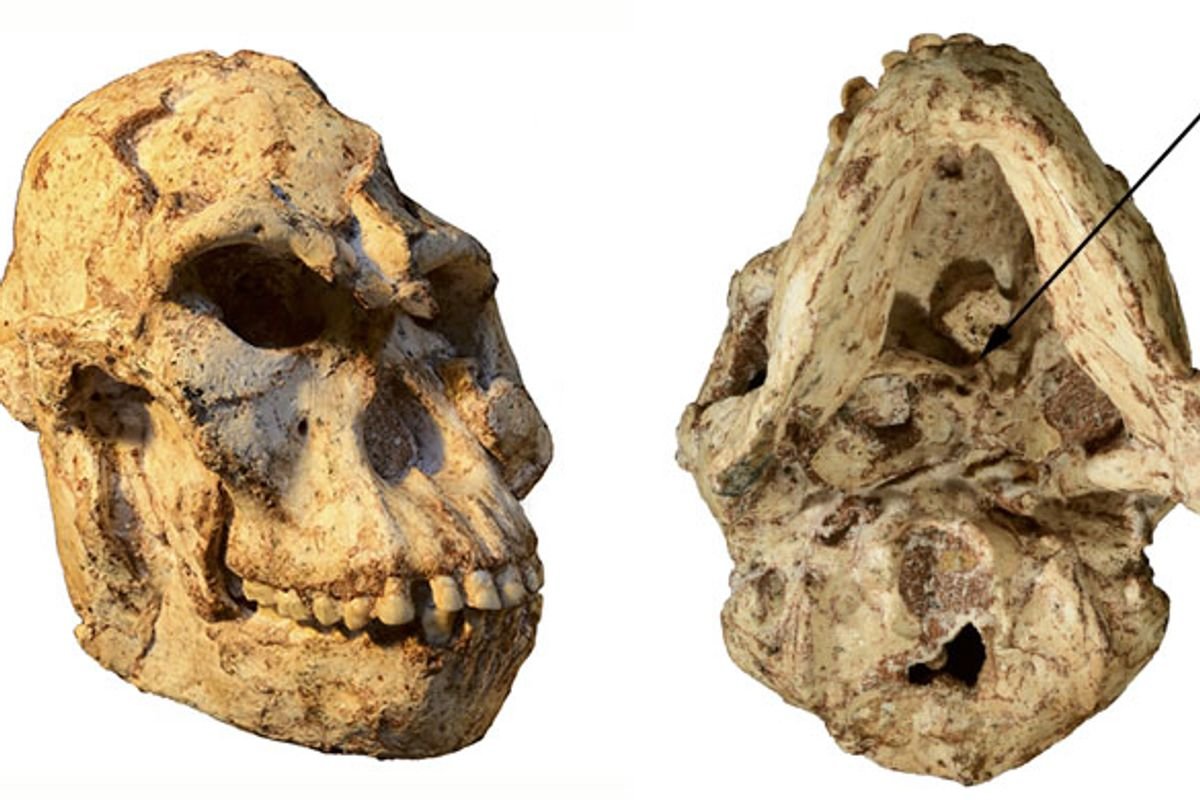
The Mysterious Little Foot Fossil May Rewrite Hominin History, Representing a New Human Relative

Australopithecus prometheus or Australopithecus africanus? Though the question might sound simple, it isn’t so straightforward for scientists, who have been stumped by the famous “Little Foot” fossil for almost 30 years.
Found in South Africa’s Sterkfontein Caves in the 1990s, this fossil — an almost complete skeleton from a few million years ago — represents one of the most mysterious and most comprehensive australopith specimens in the hominin record, and has been attributed to two separate species since the time of its discovery. But a new analysis in the American Journal of Biological Anthropology challenges these traditional classifications, hinting that the fossil could correspond to another human relative completely.
“This fossil remains one of the most important discoveries in the hominin record, and its true identity is key to understanding our evolutionary past,” said Jesse Martin, a study author and an adjunct at La Trobe University in Australia, in a press release. “We think it’s demonstrably not the case that it’s A. prometheus or A. africanus. This is more likely a previously unidentified human relative.”
Read More: How Did Humans Evolve?
A Classification Challenge for Little Foot
Affectionately named after the small size of its feet, the Little Foot fossil from the Sterkfontein Caves took almost 20 years to dig up and analyze, and is consistently categorized as an australopith, a member of the lineage of ancient hominins that thrived in South Africa from around 3 million to 1.95 million years ago.
But the specific species classification of the ape-like fossil is still less than clear, and has been since the fossil was first found. In fact, while the scientists who discovered the specimen connected it to the species A. prometheus in their first full anatomical description of their find’s skull in the Journal of Human Evolution in 2019, other teams attributed it to the species A. africanus, which was active at the same site in South Africa at around the same time as Little Foot.
Returning to the specimen to tease out its identity, the authors of the new study have determined that the anatomy of the Little Foot fossil is distinct, differing from that of the fossils of A. prometheus and A. africanus.
“Our findings challenge the current classification of Little Foot,” Martin said, according to the release, “and highlight the need for further careful, evidence-based taxonomy.”
Read More: An Introduction to the History of Human Evolution
Little Foot’s Special Skull
To arrive at their results, the study authors analyzed the structure of Little Foot’s skull and identified several traits that differentiated the specimen from both A. prometheus and A. africanus. Among these distinguishing characteristics were the small size, or cranial capacity, of the skull and its overall shape, including the bump at the back of the cranium and the bony ridge at the top of it, which were more pronounced in Little Foot than they were in A. prometheus in particular.
“It is clearly different from the type specimen of Australopithecus prometheus,” said Andy Harries, another study author and a professor at La Trobe University, according to the release. “Its importance and difference to other contemporary fossils clearly show the need for defining it as its own unique species.”
Additional analyses are needed to come up with a new classification for Little Foot, the study authors say. When it comes, it could transform the way we think about the history of hominins as they spread through South Africa and shared its terrain, millions of years ago.
Read More: Humans Evolved From a Common Ancestor That Appeared 6 Million Years Ago
Article Sources
Our writers at Discovermagazine.com use peer-reviewed studies and high-quality sources for our articles, and our editors review for scientific accuracy and editorial standards. Review the sources used below for this article: