
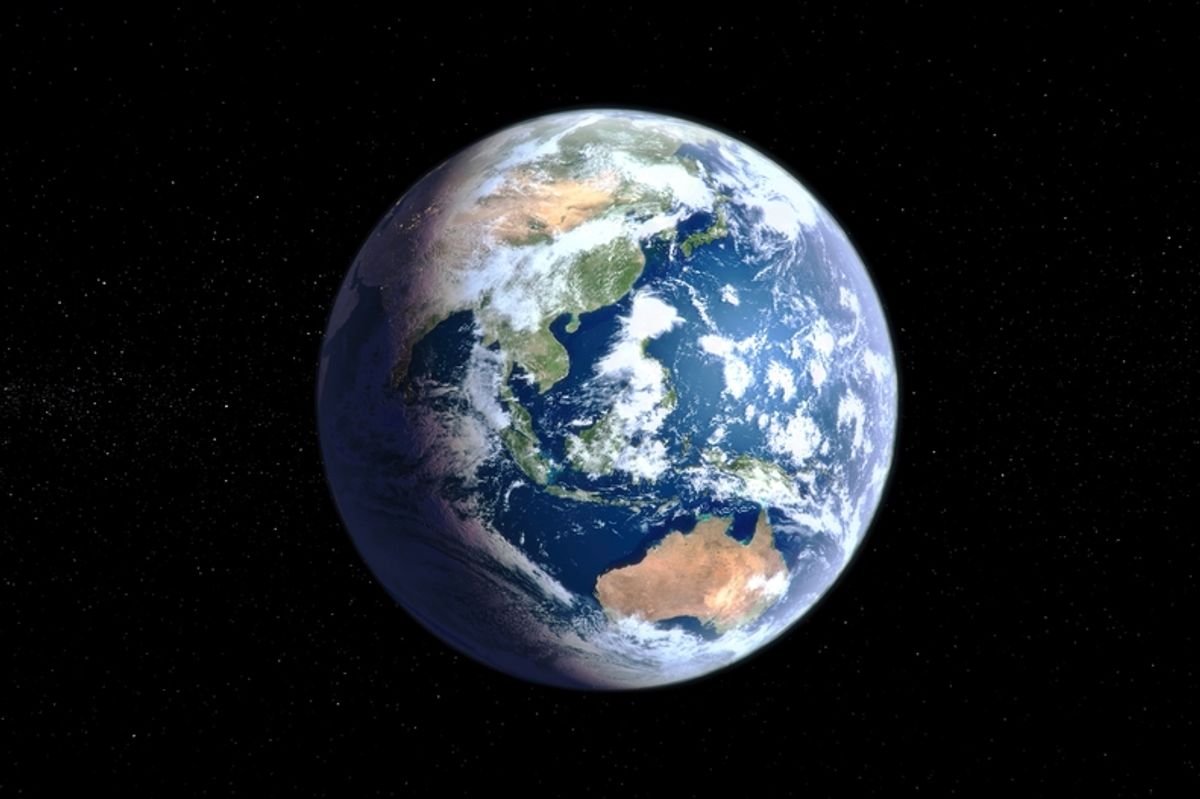
The Earth Is Round, and Is Also a Shifting, Squashed Spheroid

Key Takeaways on How the Earth Is Round
- The Earth is round, and we know this from detailed measurements and geometric inferencing based off satellites with lasers.
- Earth is often described as a circle or an oval, but it is neither. As the planet spins more than 1,000 miles per hour at the equator, it develops a slight bulge around its middle. The result is what geodesists call an oblate spheroid: a sphere gently flattened at the poles like a frisbee.
- Just like its exterior, Earth’s interior isn’t uniform, either. Rising plumes of hot mantle shift mass and density around inside the planet, subtly altering the pull of gravity between places.
What is the shape of Earth? This seemingly simple question puzzled scholars for centuries, with theories ranging from flat to cylindrical. Philosophers like Aristotle were among the first to give traction to our modern conception of the sphere.
Observations of constellations, horizons, and eclipses all pointed to this well-rounded conclusion, but these findings don’t mean our planet is perfectly smooth, or even perfectly spherical. As it turns out, the Earth may be throwing us a few more curveballs than Greek scholars would have anticipated.
What Proves the Earth Is Round?
Some of the most powerful proof of our world’s globosity comes from satellites armed with lasers. With detailed measurements and clever geometric inferencing, they can record the Earth’s size and curvature with millimeter-level precision, demonstrating definitively that it is round, according to JGR Solid Earth.
Other phenomena are noticeable from the ground. “I like the ship-horizon effect,” says Dr. Frank Flechtner, a geophysicist at the GFZ Helmholtz Centre for Geosciences. As a ship sails away, it slowly disappears behind the curved ocean.
The sky provides another line of evidence. “In a lunar eclipse, you can see the curved shadow of the Earth,” says Dr. Attreyee Ghosh, a geophysicist at the Indian Institute of Science. “The Sun and Moon are spheres. Why would Earth be an exception?”
Dr. John Vidale, a professor of Earth sciences at the University of Southern California, points to something more mundane.
“It is simultaneously different times of day in various cities across the globe,” he says. “Such an observation makes perfect sense for a round Earth and is much harder to explain without one.”
Read More: When Will Earth’s Magnetic Poles Flip? Probably Not Anytime Soon — Here’s How We Know
Is the Earth More Round or Oval?
With Earth’s roundness now established, a more complex question follows: just how round?
In everyday language, Earth is often described as a circle or an oval, but it is neither. As the planet spins more than 1,000 miles per hour at the equator, it develops a slight bulge around its middle. The result is what geodesists call an oblate spheroid: a sphere gently flattened at the poles like a frisbee.
“If it didn’t spin, it would be almost a perfect sphere,” says Dr. Jon Kirby, an associate professor of geodesy at Curtin University. “It is the centrifugal force that causes the bulge at the equator.”
Kirby explains using the analogy of a roundabout in a kids’ playground. “If you sit right at the center you will spin, but you won’t get flung off,” he says. “As you inch away, you experience a force pushing you away, and this force grows so that when you’re right at the edge you hang on for dear life.”
This same phenomenon occurs on our planet. Masses of rock and water near the equator sit farther from the spin axis and experience stronger outward acceleration, causing Earth’s “waistline” to bulge about 21 kilometers farther from the planet’s center.
Relative to the entire planet, this bulge is tiny, equivalent to laying a single human hair on a tennis ball. Yet it’s enough to place volcanoes in Ecuador closer to space than the summit of Mount Everest, despite the latter rising higher above sea level, according to the National Oceanic and Atmospheric Administration (NOAA).
Since the Earth’s spin applies a force that flings objects outward, the apparent weight of anything standing along the equator is slightly diminished. The strength of gravity also decreases with distance, so being farther from the Earth’s center weakens the pull.
Read More: A Strange Zig-Zagging Solar Phenomenon Just Appeared Near Earth
What Shapes the Gravitational Field?
Just like its exterior, Earth’s interior isn’t uniform, either. Rising plumes of hot mantle shift mass and density around inside the planet, subtly altering the pull of gravity between places.
Geodesists describe this gravity-defined shape as the geoid, the surface Earth’s oceans would form if they were perfectly calm, according to the NOAA.
“These variations are not something you would ever see by eye,” Ghosh says. “They reflect how mass is distributed deep inside the Earth, not the shape of the surface.”
One of the most striking examples is the Indian Ocean Geoid Low, where the sea level sits one hundred meters lower than expected. In a 2023 study published in Geophysical Research Letters, Ghosh and her colleague traced the anomaly to low-density material in the upper mantle. Strangely, the ocean doesn’t pile as high over the Geoid Low because extra water would “spill” into surrounding high-gravity regions that hold it more tightly.
Earth’s geoid shape is not fixed, though. Since 2002, scientists have tracked changes using the GRACE and GRACE Follow-on (GRACE-FO) satellite missions, which measure tiny variations in Earth’s gravity field, according to NASA.
“We can measure every month how much mass is moving in the Earth system,” says Flechtner, who is also a project manager for GRACE-FO.
As ice sheets melt, water shifts from the poles into the oceans. Like a figure skater stretching out their arms, the Earth’s rotation slows due to this mass shift. In a 2024 study published in Proceedings of the National Academy of Sciences, researchers found that the accumulation of water at the equator was on track to slow the Earth’s day by one to two milliseconds this century.
This affects our planet’s shape. “The slowing decreases the centrifugal forces, which are the main reason for the oblateness,” says Dr. Benedikt Soja, a professor of space geodesy at ETH Zurich and an author of the paper. “So, the Earth is also becoming less oblate.”
The horizon may appear to be a static line, but beneath that calm curve lies a restless planet. Our world is constantly being sculpted by spin, gravity, deep motion, and now by a changing climate rewriting its dimensions fast enough to be measured from space.
Read More: Terrestrial Particles Travel to the Moon by Hitchhiking Along Earth’s Magnetic Field Lines
Article Sources
Our writers at Discovermagazine.com use peer-reviewed studies and high-quality sources for our articles, and our editors review for scientific accuracy and editorial standards. Review the sources used below for this article: