
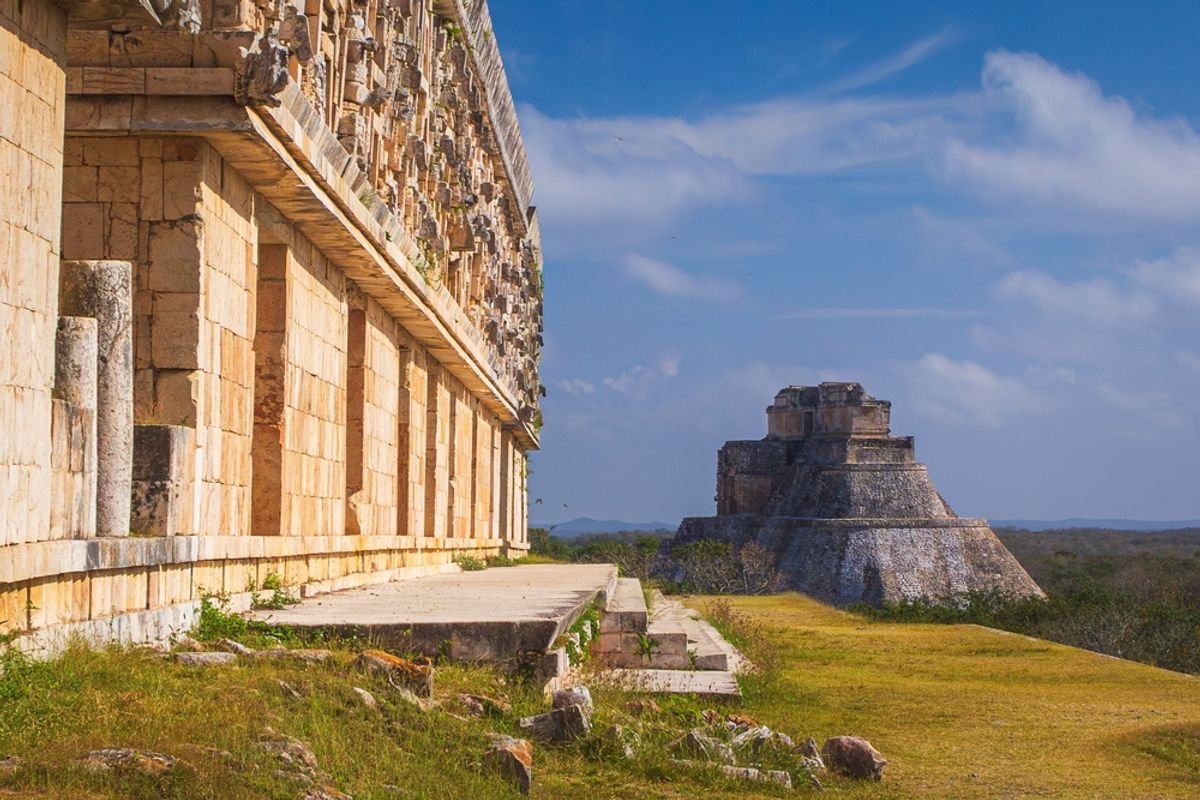
The Disastrous Maya Collapse Knocked Down an Entire Network of Cities in Mesoamerica

In a span of over 3,000 years, the Maya civilization broke ground in astronomy, architecture, and mathematics. But despite being so rich in advancements, this Mesoamerican culture experienced some major bumps along the way. The most disruptive turning point came at the tail end of the Maya golden age, when populations plummeted and dynasties crumbled.
A new study published in Biogeosciences has found a twist to help explain why the Classic Maya period came to such a tumultuous end between 750 and 900 C.E. While it’s believed that drought caused the downfall of many Maya cities, the archaeological site of Itzan in modern-day Guatemala tells a different story; this city maintained a stable climate, but was still roped into the chaos because of its link to other struggling cities.
The Demise of the Maya Golden Age
During the Classic Period of the Maya civilization (from 250 to 900 C.E.), cities flourished and innovations abounded. This is when the Maya truly made their mark on Mesoamerican history, developing writing systems, astronomical calendars, and public architecture.
But by 750 C.E., trouble was on the horizon. Droughts began to hit cities across the Maya Lowlands, a historical region that today encompasses Guatemala, southeastern Mexico, and parts of Belize and Honduras. This climate crisis brought political turbulence, leading people to abandon cities as populations shifted northward.
The Maya civilization entered a Post-Classic period following this episode of turmoil. Although this era continued for several more centuries, it was marked by gradual decline until the last remaining city fell to Spanish colonizers in 1697.
Read More: From Ruins to Ancient Farming, Lidar Technology Helps Reveal Ancient Societies
Piecing Together Maya History
Scientists have attributed the Maya collapse to repeated droughts, but that doesn’t explain why Itzan went down along with so many other cities in the Maya Lowlands.
Researchers involved with the new study sought answers as they analyzed sediment samples dating back to 3,300 years ago. These samples, taken from a lake near the archaeological site called Laguna Itzan, opened a window into the history of the region.
The researchers looked for three geochemical indicators within the sediment: polycyclic aromatic hydrocarbons (PAHs), leaf waxes, and fecal stanols. With these indicators, the researchers determined that after an initial reliance on slash-and-burn fires, an agricultural practice that converts forests into farmland, the Maya modified their agricultural strategies to feed a growing population.
Caught in a Collapsing Web
Analysis of hydrogen isotopes also revealed that Itzan was consistently replenished with rainfall due to its location, unlike cities further north that faced drought.
But Itzan was still abandoned after a major population decline between 1,140 and 1,000 years ago. If the area didn’t experience drought, why did this happen?
The researchers say it’s because Itzan was tied to a network of trading relationships and political alliances that linked multiple cities together.
“When the central lowlands were hit by drought, this may have triggered a cascading series of crises: wars between cities over resources, the collapse of royal dynasties, mass migrations, disruption of trade routes, and so on,” said study author Benjamin Gwinneth, a professor of geography at the University of Montreal, in a statement.
In other words, it wasn’t a lack of water that destroyed Itzan; it was the city’s reliance on the network it was rooted in. The collapse of cities further north created a domino effect that spread to Itzan, causing it to meet the same fateful end.
“The transformation or “collapse” of the Maya civilization was not a mechanical result of a uniform climate catastrophe; it was a complex phenomenon in which climate, social organization, economic networks and political dynamics were intertwined,” Gwinneth said.
The researchers said that what happened during the Maya collapse could be relevant to the world today, as modern society learns how to respond to ongoing environmental changes.
Read More: Where Is Tulum and Why Was It So Important to the Ancient Maya?
Article Sources
Our writers at Discovermagazine.com use peer-reviewed studies and high-quality sources for our articles, and our editors review for scientific accuracy and editorial standards. Review the sources used below for this article: