
The Burtele Foot and Other Fossils Reveal How Two Hominin Species Thrived Side by Side
Understanding the evolution of our ancestral hominins and their place in the family tree drives paleoanthropologists. By analyzing fossilized remains, scientists can reconstruct life millions of years ago and explore what environmental pressures shaped the path to modern humans.
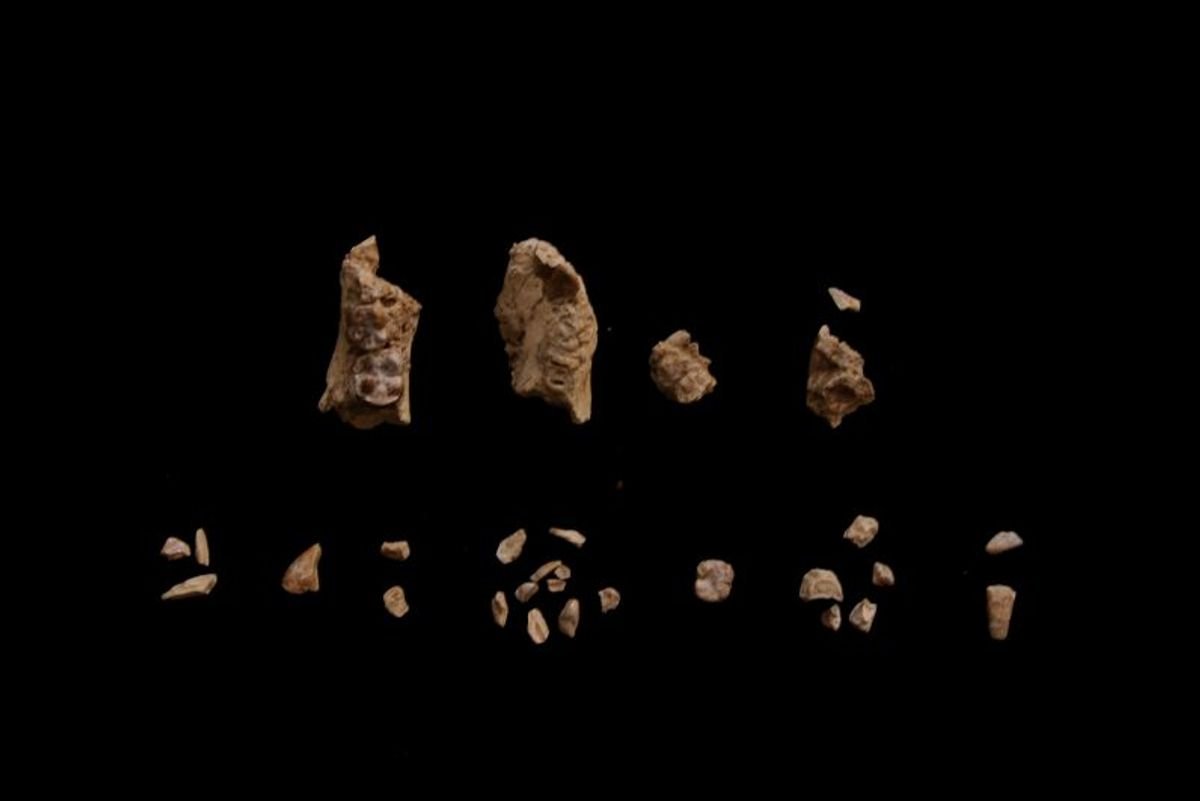
A team from Arizona State University recently reexamined unassigned foot bones discovered in 2009 and linked them to teeth and jawbones from the newly described hominin Australopithecus deyiremeda, according to their study published in Nature. Comparing these fossils with Australopithecus afarensis — the species of the famous Lucy — offers the first glimpse of how two hominin species coexisted 3.4 million years ago.
Read More: Humans Arose From Two Ancestral Populations That United 300,000 Years Ago
Unclassified Foot Bones Find Their Hominin Species

The Burtele foot (left) and the foot embedded in an outline of a gorilla foot.
(Image Credit: Yohannes Haile-Selassie, Arizona State University)
The story begins in 2009, when researchers uncovered eight foot bones at the Woranso-Mille site in Ethiopia, a hotspot for fossils from the mid-Pliocene, a key period in hominin evolution. Because these bones differed from the known A. afarensis specimens, scientists suspected they belonged to a different species. The remains were indeterminate and dubbed the “Burtele foot.”
What makes the Burtele foot unique is its opposable big toe, ideal for navigating trees, which is a contrast to the Lucy species, which was more adapted for walking on the ground. The discovery of A. deyiremeda in 2015 provided new context, and by combining older and newer fossil finds, the research team confidently associated the Burtele foot with this species.
Ancient Hominins Diet Depended on Preferred Territory
“It is not common practice in our field to name a species based on postcranial elements — elements below the neck — so we were hoping to find something above the neck in clear association with the foot. Crania, jaws, and teeth are usually the elements used in species recognition,” said senior author Yohannes Haile-Selassie, professor at the School of Human Evolution and Social Change, in a press release.
To also explore A. deyiremeda’s diet, Naomi Levin of the University of Michigan sampled eight of the 25 teeth found at Burtele for isotope analysis.
“I sample the tooth with a dental drill and a very tiny (<1mm) bit — this equipment is the same kind that dentists use to work on your teeth,” she said in the press statement.
The results revealed distinct feeding habits. While A. afarensis was a mixed feeder of tree and shrub vegetation as well as grass and sedge plants, A. deyiremeda relied more heavily on trees and shrubs for its diet.
“I thought the distinctions between the diet of A. deyiremeda and A. afarensis would be harder to identify, but the isotope data show clearly that A. deyiremeda wasn’t accessing the same range of resources as A. afarensis,” said Levin.
Haile-Selassie’s team also examined a juvenile jaw from the same region, whose developing teeth confirmed it belonged to A. deyiremeda. Using CT scans, scientists determined the jaw belonged to a roughly 4.5-year-old, linking tooth development patterns to overall growth biology. Taken all together, the foot, teeth, and jaw remains show that both A. afarensis and A. deyiremeda thrived in the same region, yet likely avoided direct competition due to differences in their locomotion and diet.
Different Hominin Species Coexisted Peacefully
Woranso-Mille is not only an important site showing clear evidence of two related hominin species coexisting in the same area, but now we understand what that actually looked like.
“Despite our growing awareness of how diverse these early australopith species were — in size, diet, locomotion, and anatomy — these early australopiths seem remarkably similar in the manner in which they grew up,” said Haile-Selassie.
Understanding how these hominin ancestors moved and what they ate offers insight into how multiple species coexisted without one outcompeting the other.
“All of our research to understand past ecosystems from millions of years ago is not just about curiosity or figuring out where we came from,” added Haile-Selassie. “It is our eagerness to learn about our present and the future as well. If we don’t understand our past, we can’t fully understand the present or our future.”
Read More: 8 Things We’ve Learned Since Lucy’s Discovery 50 Years Ago
Article Sources
Our writers at Discovermagazine.com use peer-reviewed studies and high-quality sources for our articles, and our editors review for scientific accuracy and editorial standards. Review the sources used below for this article: