
Stone Age Tools Found in Central African Cave Were Remarkably Stable for 5,000 Years

New research shows stone tool production in the Central African rainforest remained remarkably consistent for a period of more than 5,000 years. While the results suggest considerable similarity across time, the study highlights the technical and cultural diversity present in the region as a whole during the Later Stone Age.
Lead author Marie-Josée Angue Zogo, a doctoral student in African prehistory and lithic technology at the French National Research Institute for Sustainable Development, said the findings “significantly refine” our understanding of the Later Stone Age and “highlight the extent of the techno-cultural diversity that characterized this period.”
The results have been published in the journal Plos One.
Read More: Stone Age People Traveled Miles To Source Stunning Raw Materials, Like Red Jasper, for Tools
Stone Age Material
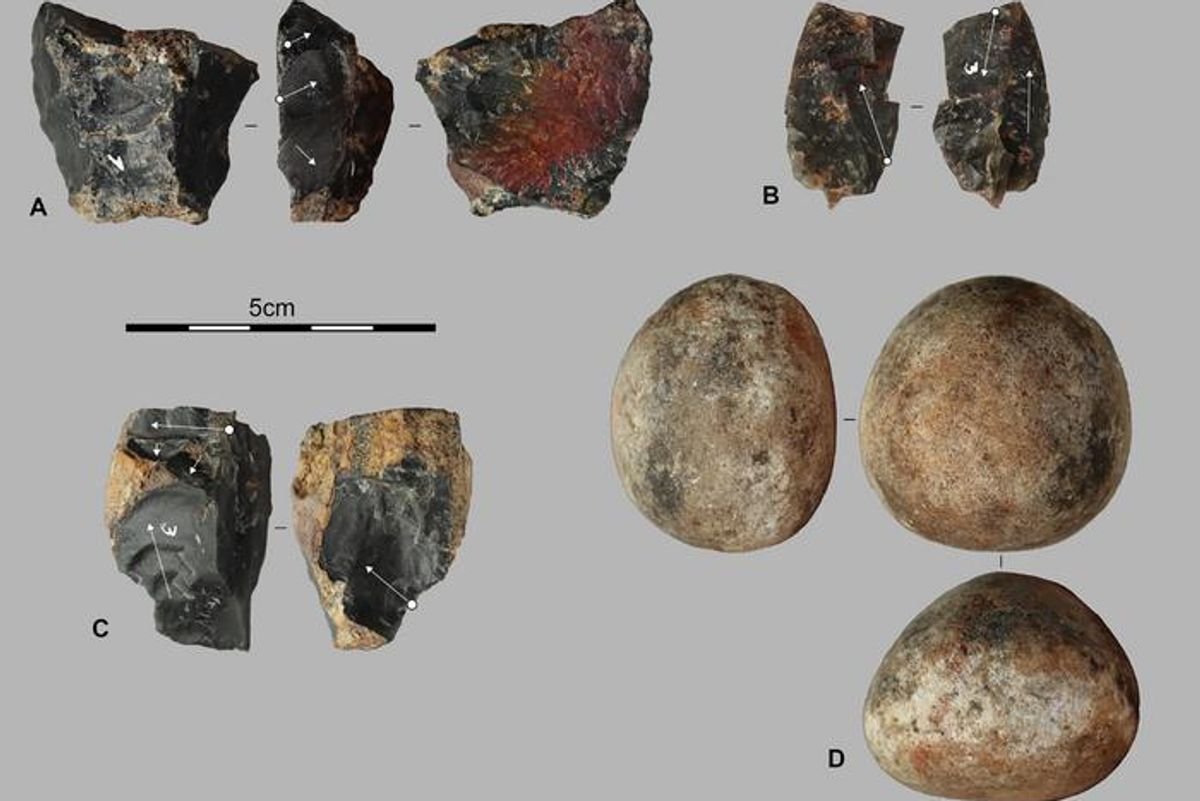
The paper follows excavations at Pahan Cave in western Gabon, which have unearthed hundreds of lithic (stone) artefacts, including debris, fragments, and natural pieces.
Pahan Cave lies in the Ogooué Basin, an area covered in lush rainforest home to gorillas, chimpanzees, elephants, and other large mammals. The cave also appears to have been a source of shelter to nomadic groups living in the region 7,571 to 2,523 years ago, a prolonged stretch of time covering the Later Stone Age and Early Iron Age.
This period included a “Neolithic phase,” characterized by polished stone tools and the advent of agriculture, and marked the beginnings of the Bantu Expansion, which dispersed Bantu-speaking peoples and languages across the region.
During this time, humans employed a range of subsistence strategies. This included metalworking and pottery making. However, the tools discovered at Pahun Cave appear to be simple and unmodified — showcasing “highly flexible technical systems,” the researchers wrote in the study.
A Hammerstone, an Axe, and Waste Material
In total, the team uncovered 1,131 lithic objects, of which approximately 90 percent are considered waste material. Among the artefacts is a hammerstone — a stone used to mark other stones, the Neolithic equivalent of a hammer — and a fragment of a polished axe. However, what stands out is the relative similarity of the artefacts over such an extended period. This suggests the same type of products were being produced for more than 5,000 years.
“One of the most important results of this study is the remarkable stability of the lithic industry from Pahon Cave over several millennia,” said Angue Zogo. “This is a non-standardized industry, characterized by a short operational sequence and a high proportion of unretouched flakes showing clear use-wear.”
This contrasts with collections found at other important archeological sites, such as Shum Laka in northwest Cameroon, which features quartz and basalt tools from the Later Stone Age as well as ceramics and objects made from iron. Taken as a whole, the researchers say the results reinforce the idea that the era was marked by a great deal of diversity in terms of tool production.
Stone Age Animal Bones
Stone objects were not the only treasures found in Pahan Cave. Archeologists have also discovered the well-preserved remains of various animals, including a brush-tailed porcupine, a bushpig, and a smallish antelope called a duiker.
The most prolific animal remains belong to various species of bat, which mostly died of natural causes. In contrast, small mammals and giant snails may have been brought to the cave for human consumption.
In terms of next steps, Angue Zogo and the team plan to resume excavations at Pahan Cave and to investigate lithic collections from other Central African countries.
Read More: 6,000-Year-Old Rock Murals in Texas and Mexico Reveal Ancient Beliefs on the Cosmos
Article Sources
Our writers at Discovermagazine.com use peer-reviewed studies and high-quality sources for our articles, and our editors review for scientific accuracy and editorial standards. Review the sources used below for this article: