
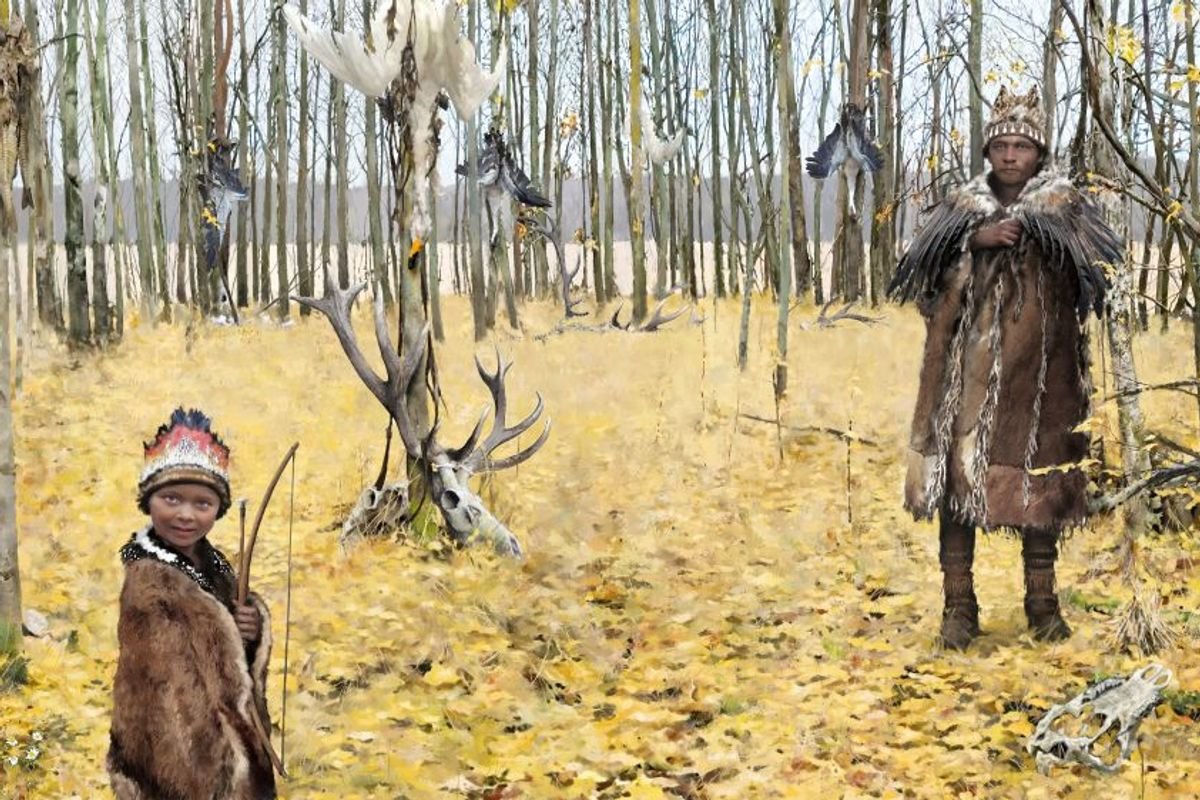
Stone Age Graves in Sweden Reveal the Dead Dressed in Furry Shoes and Feathery Headdresses

Stone Age graves often carry remarkable finds, like symbolic objects and clothing bestowed on the dead. A fascinating example of this is at the Skateholm cemeteries in southern Sweden, where deceased Stone Age individuals were laid in their graves with items made from animal fur and feathers.
A new study published in Archeological and Anthropological Sciences has unearthed evidence of clothing in the Skateholm graves by separating microscopic organic fibers from soil samples. This revealed that the dead at Skateholm sported accessories like colorful headdresses and shoes, showing how animal parts played a role in Stone Age burials.
Read More: Medieval Burial Sites in Denmark Show Illness Didn’t Erase Social Status
Decorating Burials in the Stone Age
Burials provide a window into Mesolithic society in southern Scandinavia (from around 9000 to 4000 B.C.E.). Many of them have been found to contain not only human remains, but also ornamental items. Those buried with such grave goods may have been spiritual leaders or shamans who were highly regarded in hunter-fisher-gatherer communities.
The Skateholm cemeteries — consisting of Skateholm I (65 graves) and Skateholm II (22 graves) — were excavated in the 1980s, revealing stone artifacts, animal bones, antlers, and teeth, according to a statement on the new study. Among the most prominent individuals at Skateholm is the “seated woman,” who was buried on a base made of antlers and outfitted with teeth ornaments from deer, elk, and boars — this treatment may reflect her high status in society.
Not all individuals were buried with ornate items, but the dead laid in what were previously considered empty graves (meaning they lacked objects) were still given pieces of clothing to wear, as evidenced by fur and feather remains found in the new study.
“This is the first time that soft organic materials have been separated from soil samples in Late Mesolithic graves in Scandinavia,” said study author Tuija Kirkinen, an archeologist at the University of Helsinki, to Discover. “The results speak for the importance of clothing the dead even when there are no marks of other grave goods such as animal tooth pendants or stone implements.”
Sieving for Organic Fibers
To get a better idea of what the dead at Skateholm were given, the researchers involved with the new study applied a novel technique on 35 of the graves; the method involved rinsing soil samples with water and sieving the water to separate fibers.
“The use of water for separating the microscopic organic materials is favoured as it is gentle for different kinds of materials and doesn’t destroy fragile materials. The material culture of prehistoric societies was based mostly on animal and plant originated materials that have mostly decayed by time, however, these materials can be traced by analyzing the soils samples microscopically,” Kirkinen told Discover.
Dressed with Furs and Feathers
During the sieving process, the researchers recovered a large number of bird feathers and mammalian hairs from multiple species.
At 11 graves, feather remains from hawks, eagles, and owls were detected near individuals’ heads, suggesting these people may have been wearing feather headdresses. One grave contained a particularly impressive head decoration that may have featured a combination of red deer tooth pendants and owl feathers, as well as lagomorph (mammalian order with rabbits/hares), mustelid (mammalian order with weasels/stoats/otters), and bat skins.
Another grave contained a woman over the age of 60 who may have been dressed in multicolored shoes made of white hair from the winter coat of a weasel/stoat and brown hair from a carnivore (potentially a feline).
The researchers concluded that soil samples stored in museums could be crucial sources of microscopic fibers and, as such, should be managed and handled with great care.
“The systematical collecting of precisely documented soil samples from archaeological sites is vital for the future research as the soil is full of information!” said Kirkinen. “Also, the analysing methods are developing rapidly, and we have to be prepared for future needs. This means that we have to solve how to collect, manage, and store the sediment samples even for decades.”
Read More: China’s Ancient Tombs Reveal Links Between Political Stability and Prosperous Landscapes
Article Sources
Our writers at Discovermagazine.com use peer-reviewed studies and high-quality sources for our articles, and our editors review for scientific accuracy and editorial standards. Review the sources used below for this article: