
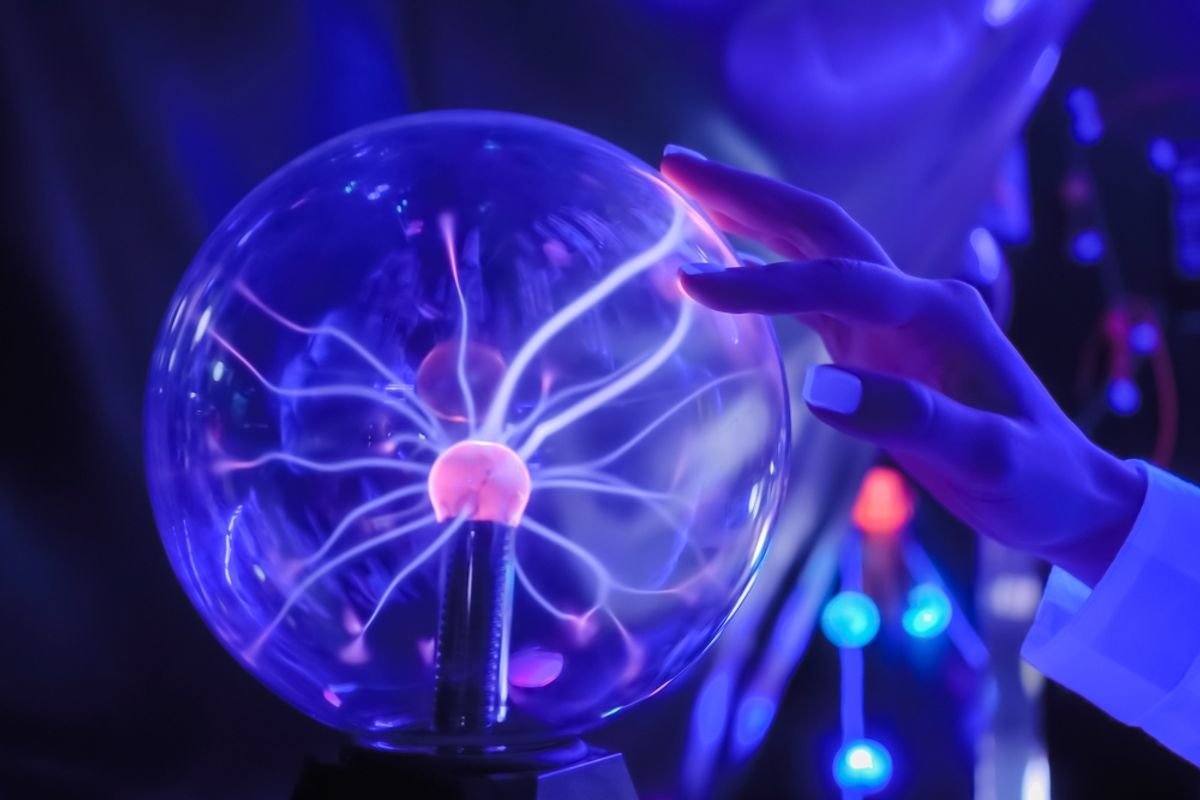
Static Electricity Shapes Everyday Life — but Its Origin Remains Shockingly Mysterious

Key Takeaways On How Static Electricity Works
- Unlike flowing electricity, static electricity can accumulate on surfaces and discharge as a shock.
- According to some theories, static electricity may have helped spark life on Earth.
- A new study finds that rubbing not only moves electrons around to build up a charge, but the force may also be tearing molecules apart, making static electricity a little more complicated than we originally thought.
Most of us are quite familiar with static electricity. Whether you’ve had the misfortune of getting zapped by a metal railing or the delight of shocking your friends after shuffling your feet on a carpet, this phenomenon is all around us. Literally.
“Static electricity is generated whenever any two objects touch,” Scott Waitukaitis, a physicist at the Institute of Science and Technology Austria, told Discover. “It is all around us all the time.” Even when nothing dramatic happens, tiny amounts of charge are constantly migrating between surfaces as they brush, collide, or separate.
Unlike a flowing electric current, static charge can sit on surfaces and build up until it suddenly discharges as a shock, or even a bolt of lightning. While we’ve known about this force since the ancient Greeks rubbed amber against fur, we are only now realizing its profound impact on the workings of our universe.
Read More: Dust Devils on Mars Crackle and Pop with Electricity, Showing How Sparks Fly in Martian Storms
How Does Static Electricity Occur In Nature?
“No joke, we may owe our existence to static electricity,” Waitukaitis said to Discover. “It creates the lightning in volcanoes that is thought to be the energy source for the chemistry of life.”
As ancient volcanic dust particles collided and exchanged charge, they generated shocks that accelerated key chemical reactions. A 2023 study published in Nature Communications proposed that lightning in volcanic ash clouds could have helped drive reactions forming the first ingredients for life.
Static electricity may have even helped in the earliest stages of Earth’s formation.
“There is recent work showing that static electricity plays a significant role in how planets form,” Laurence Marks, a materials scientist and professor emeritus at Northwestern University, told Discover. “When small particles are charged, they attract.”
As our Solar System formed, dust grains constantly collided, transferring charge and helping small grains clump together to sizes where gravity alone would have been too weak to hold them together. Over millions of years, charged dust became pebbles, then boulders, and eventually entire planets.
Weather Depends on Static Electricity
Even the weather depends on static electricity. Lightning forms when charge separates inside storm clouds, driven by collisions between ice crystals and water droplets. Fernando Galembeck, a chemist at the University of Campinas in Brazil, notes that water itself is electrically active.
“Water droplets carry a positive or negative charge,” he said to Discover. As droplets grow and collide, they sort themselves by size and charge, building enormous voltage differences that can erupt as lightning.
What Causes Static Electricity?
Given its role in life, weather, and planetary formation, it is striking how little we still understand about how static electricity works at the smallest scales.
“When you really look at what is going on, you see that it is an exceptionally complex phenomenon,” Daniel Lacks, a chemical engineer at Case Western Reserve University, told Discover.
Static charge only appears during fleeting moments when materials touch, slide, or break apart. These moments are extraordinarily hard to model because the imbalance is so tiny.
Lacks uses a common party trick to illustrate the scale of the mystery.
“For example, when you rub a balloon on hair, the balloon can charge to over 10,000 volts,” he said. “However, this is due to imbalances of only about 1 electron charge per 100,000 surface atoms. Trying to identify which atoms were involved and why is like looking for a needle in a haystack.”
Marks argues he has solved one major part of the puzzle: why rubbing works so well to generate charge. When two surfaces slide against each other, they experience shear. On the microscopic level, even smooth objects are covered in tiny bumps called asperities.
As these asperities bend and deform, they trigger a phenomenon known as flexoelectricity, in which mechanical strain generates voltage that can drive charge from one material to another.
Flexoelectricity itself has been known for decades, and scientists have even explored some surprising applications, such as creating electricity by bending and compressing ice crystals. What’s newer is the idea that this same effect may be central to everyday static electricity.
“If you just touch two materials together, there is some charge transfer,” Marks said. “But when you rub them, shear amplifies the effect dramatically.”
Why Does Rubbing Create Static Electricity?
In a 2024 study published in Nano Letters, his team showed that elastic shear is the dominant reason rubbing generates strong static electricity. This explains how energy enters the system, but not what particles carry the charge.
On that question, scientists still disagree. “Some think electrons are moving. Others think adsorbed ions are moving. Still others think bonds are breaking,” Lacks said. “At this point, it’s all guesses.”
Galembeck pushes the solution further into the realm of chemistry. He argues that the shearing itself can break chemical bonds via mechanochemistry, creating ions and reactive fragments that redistribute charge. Rubbing, in this view, may tear molecules apart rather than just shuffling electrons between surfaces.
Static electricity may not be a single mechanism but rather a family of processes. In some materials, electron transfer dominates. In others, ions or chemical fragments are the movers. The spark looks the same to us, even if its exact origin differs.
“Every time I see lightning, I am in absolute awe,” Waitukaitis said to Discover. “To the best of our knowledge, it’s caused by tiny ice crystals colliding and exchanging charges. And once again, we are basically clueless as to why.”
We may still be struggling to fully understand this invisible force, but scientists are already learning how to work with it. From dust-resistant spacesuits for future moon missions to body-powered wearable batteries, static electricity keeps proving it’s more than just a shocking nuisance.
Read More: AI Data Centers Come With a Hidden Environmental Cost — Is Sustainability Possible?
Article Sources
Our writers at Discovermagazine.com use peer-reviewed studies and high-quality sources for our articles, and our editors review for scientific accuracy and editorial standards. Review the sources used below for this article: