
State Library Victoria: The Most Beautiful Free Thing to Do in Melbourne
Nobody told me to go to the State Library Victoria. It wasn’t in my original Melbourne plan. I walked past it on my way somewhere else, saw the chess set on the forecourt, went in to have a quick look, and stayed for two hours.
That seems to be how most people discover it. You don’t plan the State Library – you stumble into it, and then you can’t quite believe it’s free.
This post is everything I wish someone had told me before I went in: what’s inside, what to look for, where to go first, and why this building opened in 1856, on a corner of Swanston Street in the Melbourne CBD is one of the most quietly extraordinary places in the city.
What Is State Library Victoria?

State Library Victoria is Australia’s oldest public library and one of the first free public libraries in the world. It opened on 11 February 1856 – just two years after Victoria became a separate colony – with a collection of 3,800 books and a simple rule: anyone over the age of 14 was welcome, as long as they had clean hands.
Today the building fills an entire city block at 328 Swanston Street, comprising over 24 interconnected structures built across different eras. It holds more than five million items – books, manuscripts, photographs, maps, newspapers, and objects – and receives around 1.7 million visitors a year, many of whom, like me, had no idea what they were walking into.

Entry is completely free. No booking required. No timed entry. You walk in off Swanston Street and you are inside one of the most beautiful buildings in Melbourne.
The La Trobe Reading Room: Go Here First

The La Trobe Reading Room is why most visitors come, and it will not disappoint you.
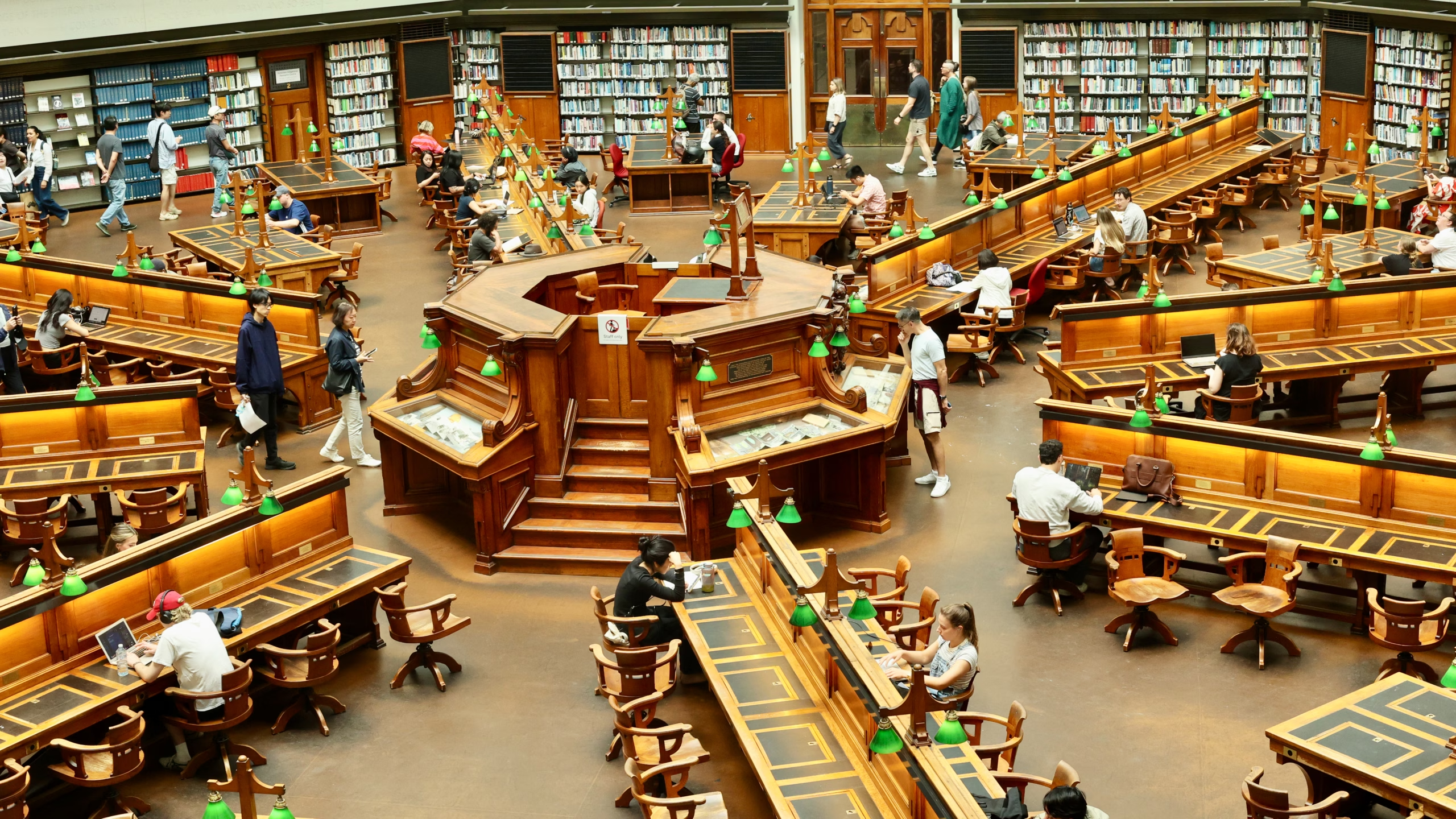
Opened in 1913 and modelled on the British Museum Reading Room in London and the Library of Congress in Washington, it is an octagonal domed room six storeys high. When it was built, its reinforced concrete dome was the largest in the world. The dome’s skylights were hidden behind copper sheathing for decades and were only reinstated during a major restoration in 2003 – which also sourced the brown linoleum flooring from the same Scottish company that supplied the original in 1913.
https://youtu.be/kno2RiR9d_I]
The reading desks radiate outward from a central octagonal platform – the raised desk where librarians once sat to oversee the room. Each desk has its original silky oak chair and a green glass lamp. The room can seat 320 readers and house 32,000 books. On the day I visited, most of those seats were occupied by students working quietly, completely undisturbed by the stream of visitors looking up in amazement around them.

The best view of the La Trobe Reading Room is not from the floor – it is from above. Take the stairs or lift to the upper galleries (levels 4, 5, or 6) and look down. The geometry of the room – the radiating desks, the concentric galleries of books, the dome overhead – only makes sense when you see the full picture from height. This is where your best photographs will come from.
The Rest of the Building
The La Trobe Reading Room gets the attention, but there is more.
Ian Potter Queen’s Hall

Directly across from the La Trobe Reading Room is the Ian Potter Queen’s Hall – the original reading room of the library, opened in 1856 and recently restored. It is quieter than the dome room, less photographed, and in some ways more beautiful – high ceilings, stone columns, natural light from tall arched windows, and an atmosphere that feels genuinely Victorian without being staged. If you want to sit and read, or simply sit and think, this is the better room.
The Cowen Gallery

On the second level, the Cowen Gallery displays more than 150 works from the library’s Pictures Collection – Australia’s oldest photographic archive. The paintings on the walls are largely colonial-era works, landscapes and portraits from Victoria’s earliest European decades. They are not labelled with the fanfare you’d find in a dedicated gallery, which makes them easy to miss – and worth slowing down for.
Ned Kelly’s Armour
In the Redmond Barry Reading Room, you will find Ned Kelly’s armour. The full suit – helmet, breastplate, back plate, shoulder plates – is on display in a case. Ned Kelly was an Australian outlaw who became one of the country’s most mythologised figures in the late 1870s, and the armour he wore in his final stand against police is one of the most recognisable objects in Australian history. The irony of its location is not lost: the armour is displayed in a room named after Judge Redmond Barry – the man who sentenced Kelly to hang.
It is a strange, powerful thing to stand next to. The armour is heavier and cruder than you expect. The helmet slot is very narrow. You find yourself thinking about the person inside it.
The Outdoor Forecourt
Before or after your visit, spend a few minutes on the Swanston Street forecourt. The giant chess set is a permanent fixture – pieces the size of small children, on a paved board, free to play. On any given afternoon there will be students, tourists, and passing office workers stopping to watch or move a piece. It is one of those small Melbourne touches that makes the city feel genuinely public.
What to Know Before You Visit

Address: 328 Swanston Street, Melbourne VIC 3000 – right on the corner of Swanston and La Trobe Streets, directly opposite Melbourne Central station.
Entry: Free. No booking required. Walk in.
Opening hours: Monday to Sunday, 10am to 6pm. Open late on Thursdays until 9pm. Closed Christmas Day and Good Friday. Check the State Library Victoria website for current hours and any closures.
Getting there: The library is inside the free tram zone. Any tram on Swanston Street stops nearby – the City Circle Tram (Route 35) passes within a very short walk. Melbourne Central train station is directly across the road. If you’re using the free tram network, the Route 35 City Circle guide has everything you need.

How long to spend: A quick visit to see the La Trobe Reading Room takes 30-45 minutes. If you explore the full building including the galleries, exhibitions, and other reading rooms, allow 1.5 to 2 hours. I stayed longer than I planned both times.
Photography: Personal photography is permitted throughout most of the building. Flash is not allowed. Tripods may be restricted during busy periods – check with staff. The best light for the La Trobe Reading Room is during the day when natural light comes through the dome.
Cafes: There are two cafes inside the library. Mr Tulk, named after the first chief librarian, is the main one – good coffee, reasonable food, and a pleasant space that carries the library’s aesthetic.
Wi-Fi: Free throughout the building.
Photography Tips for the State Library Victoria

Since you’re likely to want photographs, here is what I found works:
Go to the upper floors first. The La Trobe Reading Room is beautiful from the ground, but the overhead view from level 4, 5, or 6 is the shot. You need height to understand the geometry of the room.

Come early if you want fewer people in your frames. The library opens at 10am and fills quickly, particularly on weekends. By mid-morning on a weekend day, the La Trobe Reading Room will have a steady stream of visitors.
The amber light in the reading galleries photographs beautifully with a slightly longer exposure. The warm tones of the lamps against the dark wood and bookshelves are best captured without flash – which is also the rule.
The dome itself, photographed straight up from the reading room floor, is a shot worth taking. Point your camera directly overhead and include the radiating structure of the dome panels.
The Ian Potter Queen’s Hall has cooler, cleaner light than the La Trobe Room and less foot traffic. If you want quieter, more architectural shots, start there.
Where the State Library Fits in a Melbourne Visit
The State Library Victoria is on Swanston Street, which is one of Melbourne’s main pedestrian arteries. It sits about ten minutes on foot from Flinders Street Station and Federation Square, and about five minutes from Melbourne Central. That makes it a natural stop on any Melbourne city day – particularly as a free indoor option if the weather turns, or as a quiet interlude between busier parts of the day.
It pairs naturally with the free tram. The City Circle Tram (Route 35) runs past the library and connects to the Melbourne landmarks that make up the rest of a good city day. If you’re building a broader Melbourne picture, the Melbourne landmarks photography post covers the key outdoor stops along the same stretch of the city.
For a full day in Melbourne without spending much, the combination works well: start at Flinders Street Station, walk up Swanston Street to the State Library, spend an hour or two inside, then continue to Melbourne Central and the Queen Victoria Market nearby. Everything on that route is free or very low cost, and all of it is inside the free tram zone.
If you’re planning day trips out of the city, the day trips from Melbourne without a car guide covers the Great Ocean Road, Puffing Billy, the Dandenong Ranges, wild kangaroos, and wild penguins – all doable from a CBD base.
Is It Worth Visiting?
Yes. Without reservation.
The State Library Victoria is free, it is extraordinary, it is in the centre of the city, and it takes no planning. You do not need to book, you do not need to time your visit around a tour, and you do not need a particular interest in books or libraries to find it worth your time.
What you will find inside is one of the most beautiful rooms in Australia – the La Trobe Reading Room, with its dome and its green lamps and its radiating desks and its 110 years of quiet industry. You will find a building that has been many things – library, museum, gallery, archive – and still functions as all of them at once. And you will find, if you spend more than thirty minutes inside, that Melbourne has more depth than most of its visitors realise.
It is the kind of place that makes you want to slow down. That, in a city known for its coffee and its laneways and its sports, is not a small thing.
Practical Summary
| Address | 328 Swanston Street, Melbourne VIC 3000 |
| Entry | Free |
| Hours | 10am – 6pm daily (9pm Thursdays) |
| Getting there | Free tram zone – any Swanston Street tram. Melbourne Central station opposite. |
| Time needed | 45 min minimum, 1.5-2 hours recommended |
| Photography | Yes – no flash, no tripod during busy periods |
| Cafe | Yes – Mr Tulk cafe on site |
| Wi-Fi | Free |
| Website | slv.vic.gov.au |
FAQ
Yes. Entry is completely free, no booking required. Walk in off Swanston Street anytime during opening hours.
10am to 6pm daily, with late opening until 9pm on Thursdays. Closed Christmas Day and Good Friday. Always check the library’s website for current hours before visiting.
The La Trobe Reading Room is the centrepiece of State Library Victoria – an octagonal domed room six storeys high, opened in 1913, with radiating wooden reading desks, green glass lamps, and original silky oak chairs. It is one of the most photographed interiors in Melbourne and one of the most beautiful rooms in Australia.
Yes. Personal photography is permitted in most areas. Flash is not allowed. Tripod use may be restricted during busy periods.
It is at 328 Swanston Street in Melbourne CBD, directly opposite Melbourne Central station. It sits inside the free tram zone – any tram on Swanston Street will get you close.
At minimum, 30-45 minutes to see the La Trobe Reading Room and the main spaces. If you explore the galleries, exhibitions, and other reading rooms, allow 1.5-2 hours.
Yes. The complete suit of armour worn by bushranger Ned Kelly is on display in the Redmond Barry Reading Room. Entry is free.
Very. The La Trobe Reading Room in particular is one of Melbourne’s most photogenic interiors. The best shots come from the upper galleries looking down at the reading desks. Come during daylight hours for natural light through the dome.
PS: If you’re building a Melbourne visit day by day, the day trips from Melbourne without a car guide covers everything beyond the city – Great Ocean Road, Puffing Billy, wild kangaroos, and the St Kilda penguins. The State Library fits naturally into a city day, and those posts cover the rest.