
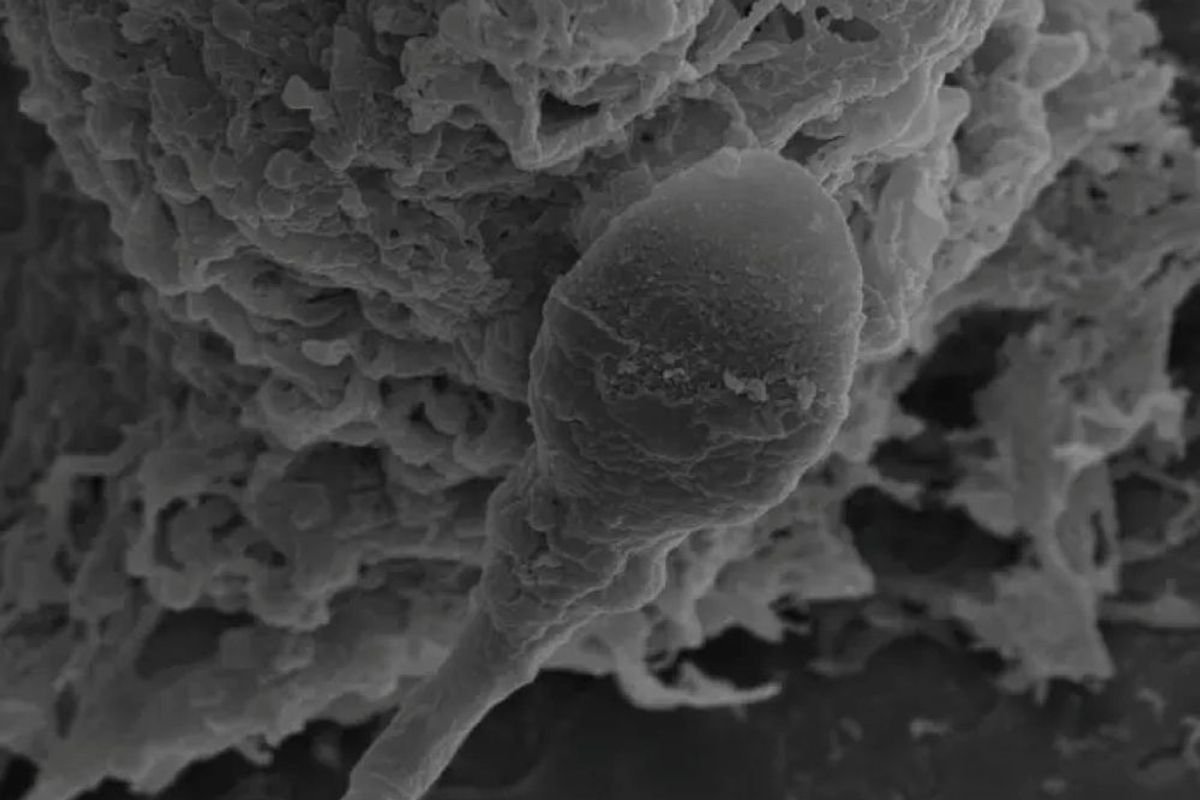
Sperm Loses Its Ability to Navigate in Zero Gravity — A Biological Hurdle for Long‑Term Off‑Earth Settlement

When you think of the challenges posed by the lack of gravity in space, you might not immediately think of sperm. But research shows zero gravity (or microgravity) can interfere with human biology, causing muscles to weaken, bone density to decline, and sperm to get a little confused.
A new study published in Communications Biology suggests sperm have a tricky time navigating the reproductive tract in space-like conditions — findings that could prove troublesome if we hope to become an interplanetary species.
“Every successful pregnancy is the result of an extraordinary sequence of biological events, refined over billions of years of evolution under the constant pull of gravity,” senior author Nicole McPherson from Adelaide University’s Robinson Research Institute told Discover.
“What that means for conception on the moon, Mars, or in deep space is something we are only just beginning to unpack.”
Read More: NASA Unveils Roadmap for Permanent Moon Base and Increased Missions to the Moon
Microgravity’s Effect On Navigation
To find out how microgravity affects sperm, McPherson and colleagues collected samples from mice, pigs, and humans. The sperm were placed in a machine designed to mimic the effects of microgravity, called a 3D clinostat. The effect is to disorient the cells before they are transferred into a maze that represents the female reproductive tract. During the experiment, sperm appeared to get lost and were unable to navigate the maze.
“We expected microgravity to have some effect, but seeing sperm lose their sense of direction so dramatically while still being perfectly capable swimmers was striking,” said McPherson.
“It really highlighted that navigation and movement are very different things, and that gravity plays a role we had never previously tested.”
However, not all sperm were affected equally, and some reached their destination. As for those who found the journey challenging, there may be a partial solution. The team discovered that introducing a high dose of progesterone reversed some of the negative effects in human sperm.
Microgravity’s Effect On Fertilization
Additional experiments considered how microgravity affected the development of mouse embryos. The researchers report a sharp reduction in the number of successful fertilizations — eggs exposed to four to six hours of microgravity had 30 percent fewer fertilizations than those kept under Earth-like conditions.
As before, some sperm appeared to excel under pressure. Those that successfully fertilized eggs produced superior embryos.
“When you impose the stress of microgravity, it appears to act as a filter, clearing out the weaker sperm and leaving only the most resilient,” said McPherson. However, exposing embryos to microgravity for 24 hours was linked to development delays.
“The same environment that appeared to select for the best sperm in that short window became genuinely harmful once the embryo started to develop,” McPherson added.
Mice are not perfect substitutes for humans, so interpreting the results requires some caution. Human reproduction is considerably more complex and involves more variables. But the researchers say the findings highlight the need for more research into microgravity’s effect on reproduction.
Establishing Settlements In Space
Recently, NASA laid out plans to construct a permanent lunar base, and crewed missions to Mars are in the pipeline, showing that the complexities of reproducing in space are no longer purely in the realm of science fiction. Successful reproduction may be crucial if we hope to establish self-sustaining human outposts beyond Earth, not just for the astronauts but for animals and livestock, say researchers.
McPherson said the team’s first priority is to understand what happens between zero gravity and Earth gravity, and whether the effects occur gradually or there is a tipping point. They also hope to dig deeper into what enables certain sperm and embryos to succeed in microgravity.
But, McPherson explained, it doesn’t stop there: “Every subsequent stage, implantation, placental development, organ formation, gestation, has the potential to be affected too, and we have not yet studied any of them in this context.”
“Mission planners and space agencies need to be thinking about this now, not after humans are already living on the moon or Mars.”
Read More: Sperm May Hit a Hidden, Middle-Age RNA Drop-Off — What’s the Generational Impact?
Article Sources
Our writers at Discovermagazine.com use peer-reviewed studies and high-quality sources for our articles, and our editors review for scientific accuracy and editorial standards. Review the sources used below for this article: