
Species Slip Through the Cracks of the U.S. Frog Trade, Some Sold at a Premium
A frog once sold online for $1,400. It wasn’t an isolated sale. Over two decades, U.S.-based online classifieds listed thousands of amphibians spanning more than 300 species. Most move through legal channels, but some appear in the marketplace without ever showing up in federal import records — and they command a premium.
In a study published in Biological Conservation, researchers at the University of Illinois Urbana-Champaign analyzed 20 years of classified ads and compared nearly 8,500 listings against U.S. Fish and Wildlife Service data. They found that 44 non-native species (about 18 percent) had no corresponding paperwork. On average, those unrecorded species sold for roughly 40 percent more than documented imports.
“One thing this study reinforced for me is that the amphibian pet trade often gets categorized as ‘good’ by the people who keep these animals or ‘bad’ by people in the conservation community, but in reality it is much more complex,” research lead Devin Edmonds, U. of I. herpetologist, and lifelong frog collector, told Discover.
Mapping the U.S. Frog Trade
To understand what was circulating in the hobby, Edmonds and his colleagues built their own ledger of the trade. Automated scripts pulled amphibian listings dating back to 2004, followed by manual verification of species names, taxonomy updates, duplicate removal, and cross-checking against federal data.

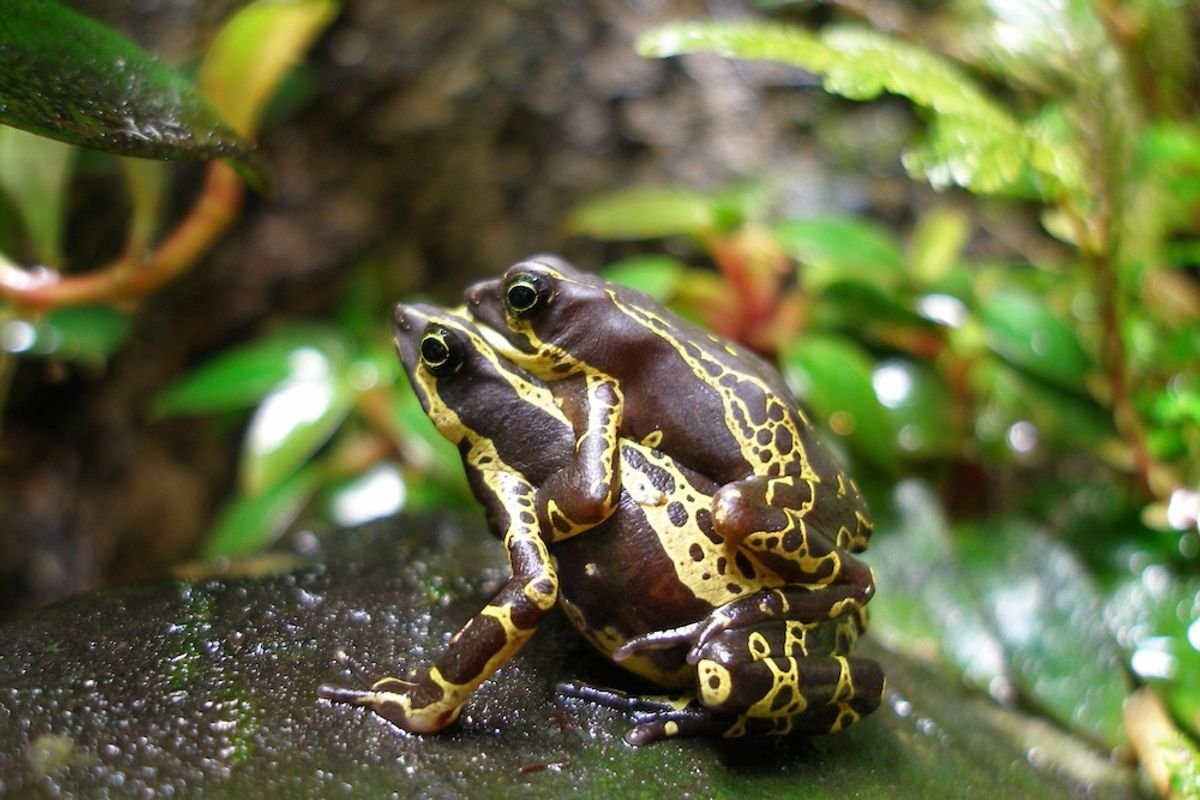
Amphibians as part of the research on undocumented species in U.S. trade.
(Image Courtesy of Devin Edmonds)
Comparing how often species appeared online with import records allowed the team to infer which were likely bred domestically and which relied on imports.
“For the most popular pet amphibians, we’re talking about hundreds of thousands of individuals imported in the last twenty years, and there were over 300 species traded online on a single forum,” Edmonds shared with Discover.
That diversity strains inspection systems designed for far smaller and less varied trade flows.
Read More: This Frog’s Secret Power? Eating Venomous Murder Hornets Like Popcorn
When Import Records Fall Short
The study traced many discrepancies back to documentation practices. Import forms often list amphibians only to the genus level rather than by exact species, allowing closely related frogs to enter under broad labels.
“Vague paperwork can become a loophole. If shipments are recorded only at the genus level, that ambiguity can be exploited to mask the true identities and origins of higher-risk or restricted species,” said study co-author Sam Sucre in a press release.
But ambiguous paperwork does not explain every case. Several species advertised online had no import record at all — including species native to Brazil and Australia, where commercial wildlife exports have been banned for decades.
Amphibians are the most threatened class of vertebrates worldwide. For rare species with small populations, even modest harvesting can accelerate declines. When trade moves through undocumented channels, it becomes harder to determine whether wild populations are being sustainably sourced or depleted.
Putting the Pet Market in Perspective
The findings do not portray the hobby as wholly illicit. At least 30 non-native species appear to be supplied primarily through domestic captive breeding, potentially reducing pressure on wild populations. But incomplete documentation blurs the line between sustainable trade and illicit supply.
At the same time, the study underscores how difficult it is for regulators to distinguish between sustainable trade and illicit supply when documentation is incomplete.
One of the aspects that surprised Edmonds most, however, was not the four-figure frog.
“The sheer volume of live American bullfrogs imported into the U.S. was astonishing. Tens of millions of live bullfrogs were imported mainly for food from farms in Asia over the span of the study, and in terms of numbers of individuals, this completely dwarfs the pet trade. It is just so many frogs,” he shared with Discover.
The pet market represents only one slice of a much larger system moving amphibians across borders at an extraordinary scale. The frogs sold online leave a digital trace. Whether that trace tells the full story depends on how closely anyone is looking.
Read More: The Sapo Concho Is the Only Native Toad to Puerto Rico, and It’s Endangered
Article Sources
Our writers at Discovermagazine.com use peer-reviewed studies and high-quality sources for our articles, and our editors review for scientific accuracy and editorial standards. Review the sources used below for this article: