
Shipwreck Reveals Over 2,350 Pieces of Yuan Dynasty Blue-and-White Porcelain

A trading vessel that sank in the 14th century lay hidden near the eastern entrance to the Singapore Strait for centuries. When archaeologists excavated the site between 2016 and 2019, they uncovered what is now known as the Temasek Wreck — the earliest historic shipwreck identified in Singapore waters.
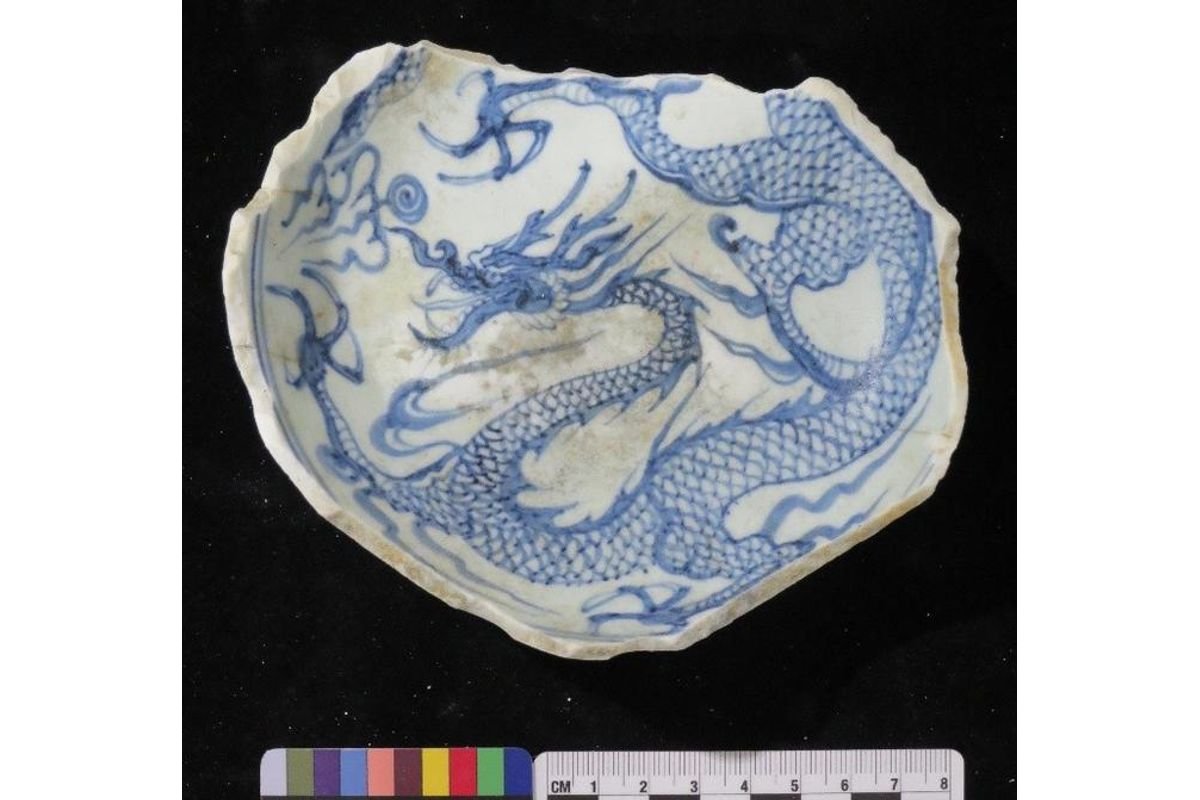
Excavating teams recovered roughly 3.5 tonnes of ceramic fragments along with a small number of intact pieces. Among them was an unusually large cache of Yuan dynasty blue-and-white porcelain — more than has been found at any other documented shipwreck. The findings are detailed in the Journal of International Ceramic Studies
The discovery anchors maritime trade at a moment when Temasek, the port that preceded modern Singapore, stood as a key hub linking southern China with Southeast Asia.
Read More: Ancient Dirty Dishes May Be Misleading Archaeologists and Rewriting History
Singapore’s Yuan Dynasty Shipwreck Cargo
In the mid-14th century, Temasek ranked among Southeast Asia’s busiest ports. Excavations along the Singapore River and at Fort Canning have turned up ceramics, glass beads, and fragments of gold, signs that goods from distant regions moved through its harbor. What had been missing was clear evidence of a ship delivering such cargo.
Much of the material survives only in fragments, yet the sheer amount recovered makes the shipment’s scale unmistakable. The blue-and-white porcelain alone weighs about 300 pounds (136 kilograms) and includes more than 2,350 pieces. Surviving bowl bases indicate that at least 300 bowls were once onboard, and bowls account for most of the identified vessel types.
The cargo extended well beyond blue-and-white porcelain. Nearly half consisted of Longquan celadon — a green-glazed ceramic widely traded at the time. Pale bluish-white wares from Jingdezhen, white ceramics from Dehua, green-glazed bowls likely made in Fujian, and large storage jars from Cizao were also part of the shipment. Rather than coming from a single source, the ceramics reflect production across several major kiln regions in southern China.
Dating the Temasek Wreck and Tracing Its Route
The blue-and-white porcelain provides the clearest clues about when the ship sailed. These wares first appeared in the late 1320s, and kiln disruptions in the 1350s narrow the likely window to between about 1340 and 1352.
No trace of the wooden hull survived. Without deep sediment to preserve it, waves and marine organisms gradually destroyed the ship, leaving the ceramics as the primary evidence of the voyage.
The exclusively Chinese cargo points to a Chinese junk, a large wooden merchant vessel commonly used in regional trade. Because the ceramics originated from kiln centers across southern China, the shipment was likely assembled and loaded at a major port such as Quanzhou.
Comparable ceramics have been found at archaeological sites in Singapore, strengthening the case that Temasek was the intended destination. The shipment includes no large blue-and-white dishes, forms typically associated with Indian Ocean markets, indicating it was not bound for ports farther west.
A Single Voyage Preserved in Time
Unlike sites that accumulate goods over decades, the Temasek Wreck captures one voyage frozen in place. The ceramics were produced and loaded within a narrow period, linking the cargo to a specific moment in regional trade.
Because the shipment can be dated so closely, it provides a reliable reference for identifying similar Yuan dynasty wares found elsewhere without a clear archaeological context.
The mix of finely decorated porcelain and sturdy storage jars also reflects the range of goods moving through Temasek — from tableware used by wealthy residents to containers that carried everyday commodities.
In that sense, the Temasek Wreck preserves more than a collection of ceramics; it records the movement of goods through a port that connected southern China with Southeast Asia.
Read More: Ancient Shipwreck Cargo Sheds Light on Iron Age Trade And a Lost Mediterranean Seaport
Article Sources
Our writers at Discovermagazine.com use peer-reviewed studies and high-quality sources for our articles, and our editors review for scientific accuracy and editorial standards. Review the sources used below for this article: