
Shark Teeth Found in Whale Fossils Reveal How Sharks Fed 5 Million Years Ago

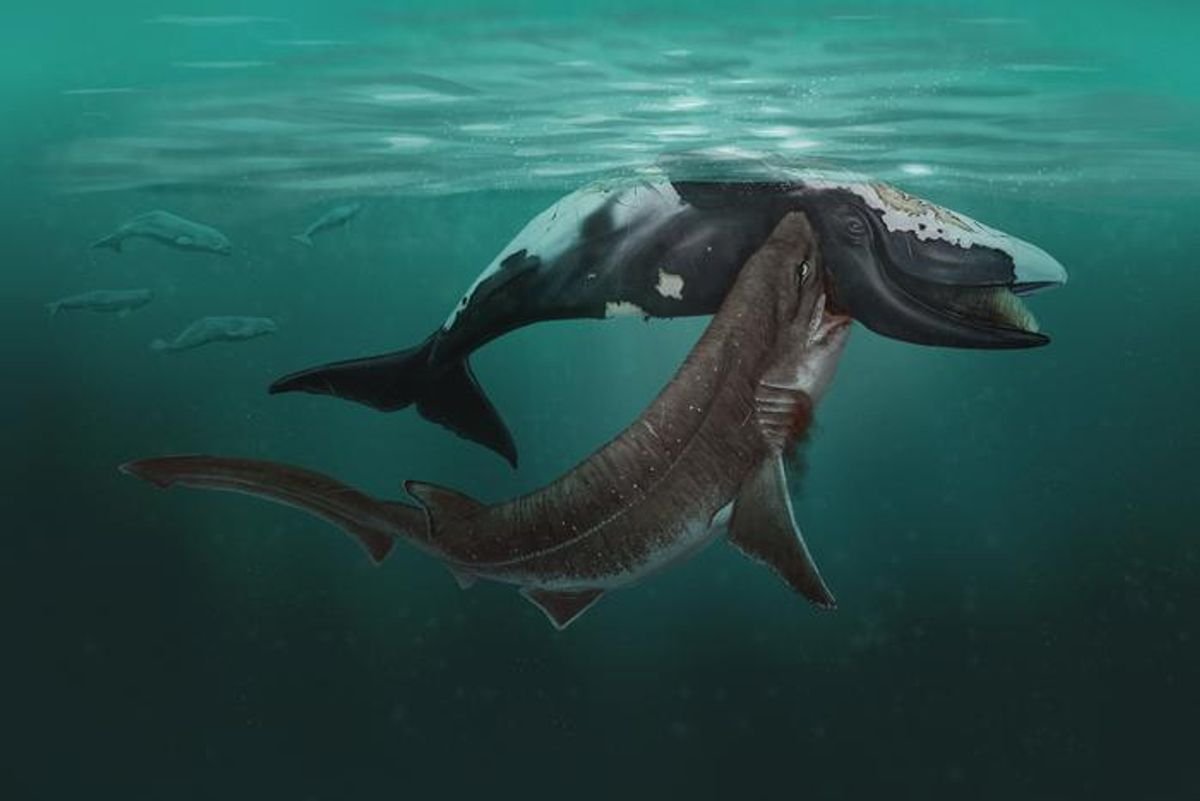
Sharks once fed on whales in the North Sea and left their teeth behind. Two fossilized whale skulls discovered in Belgium contain broken shark teeth embedded in the bone, capturing a feeding event from about 4 to 5 million years ago.
The fossils, dating to the Early Pliocene, were first collected decades ago but only recently analyzed using CT scanning, which allowed researchers to identify the tooth fragments without damaging the specimens. The findings were published in the journal Acta Palaeontologica Polonica.
Because the teeth can be linked to specific shark species, the fossils make it possible to identify exactly which predators were feeding — something that bite marks alone rarely reveal.
“Our knowledge of past marine mammal assemblages in the North Sea remains rather fragmentary, so any new fossil may prove informative. In this case, the studied skulls revealed some unexpected and fascinating clues about the way these whales’ [lives] ended,” said Olivier Lambert, who conducted the examination of the skulls, in a press release.
Read More: Ancient Shark-Like Whale Roamed Australia’s Surf Coast 26 Million Years Ago
Shark Feeding Evidence Found in Whale Fossils
The two skulls belonged to very different whales: Balaenella brachyrhynus, a small extinct right whale, and Casatia, a relative of modern belugas and narwhals. Fossil hunters in Belgium originally collected the fossils before modern imaging revealed what was inside.
To investigate further, researchers used micro-CT scanning to look inside the rock without physically extracting the bones — a process that would have risked damaging the fossils. The scans showed fragments of shark teeth that had snapped off during feeding and remained lodged inside the skulls.
The position of the damage on the right whale skull offers insight into how the interaction unfolded. Bite marks are concentrated on the upper portion of the skull, suggesting the whale had already died and was floating belly-up (a common position for whale carcasses) when the shark fed on it.
That pattern points to scavenging rather than active hunting, highlighting how large sharks relied not only on live prey but also on drifting whale remains as a food source in ancient seas.
Identifying the Predators
One fragment came from a cow shark, while the other belonged to a relative of the modern great white. In the case of the monodontid skull, bite patterns point to the shark having targeted the head, possibly attempting to sever it from the rest of the body.
Fossil evidence of feeding is usually limited to surface damage, which can make it difficult to determine exactly which species were involved. Here, the presence of tooth fragments provides confirmation — linking predator and prey in a single preserved interaction.
“Palaeontologists often have to make assumptions about the interactions between many of the species from this period. This study provides them with actual evidence they can work with – not just bite marks, but fragments from the predators who made the bites,” said John Stewart, who discovered one of the skulls decades ago, in a press release.
A Record of a Lost Ecosystem
The fossils also point to a North Sea ecosystem that no longer exists. Neither of the sharks identified, nor their close modern relatives, inhabit the southern North Sea today. Their presence alongside whales suggests that the region once supported a richer community of large marine predators and prey, shaped by different ocean conditions and food availability.
By documenting these interactions, the fossils also help trace how predator-prey relationships shifted over time, offering clues about how changes in prey availability may have contributed to the disappearance of large predatory sharks from the region.
Read More: The Evolution of Sharks: What Were Ancient Sharks Like?
Article Sources
Our writers at Discovermagazine.com use peer-reviewed studies and high-quality sources for our articles, and our editors review for scientific accuracy and editorial standards. Review the sources used below for this article: