
Separate Families Carved the 1,000 Easter Island Moai Statues — Some in Friendly Competition
On the island of Rapa Nui, more commonly known as Easter Island, more than 1,000 moai statues stand tall. These stone-faced humanoid figures may all look virtually the same from a distance, but look closely, and you’ll start to notice the individual quirks of each one.
A new study published in PLOS One suggests that the moai of Rapa Nui were built by different family groups that each incorporated slight variations in their statues to honor their ancestors. The findings challenge the view that production of monuments requires a top-down chain of command, a line of thought often held in Western society; the Rapa Nui culture, instead, shows a system where many groups could make moai on their own terms, competing and collaborating with others in the process.
“What emerges from this research is not mystery but one of humanity’s most successful adaptation stories: a society that thrived for half a millennium in one of Earth’s most isolated and resource-limited environments through institutional innovations that prevented both hierarchical domination and violent competition,” says study author Carl Lipo, a professor of anthropology at Binghamton University.
Read More: Ancient DNA Can Act Like a Time Machine to Uncover Lost Pacific Cultures
Differences in Moai Design
Most moai have a look that anyone would recognize — that stoic face with a pronounced brow and an elongated nose, all above a legless torso. But not all moai are the exact same. Some deviate considerably from the classic features, like Tukuturi (meaning “the squatting one”), a statue that is kneeling instead of standing upright like most moai.
Other moai possess smaller variations in design — some with chin beards, others with markings on the shoulders or chest, and even a rare few that are female in appearance.
“The moai represented ancestors, individuals, and each had a name (of the person it represented), so minor variations likely reflected a person’s particular traits (e.g., tattoos, etc.),” says study author Terry Hunt, a professor of anthropology at the University of Arizona.
The Rapa Nui people also prepared a few extra creations to go alongside the moai. The statues stood on ceremonial platforms called ahu, becoming sacred centers for groups. Their heads were occasionally fitted with pukao, red cylinder hats made of scoria, a lightweight volcanic rock pitted with cavities.
Sharing Resources and Work Spaces

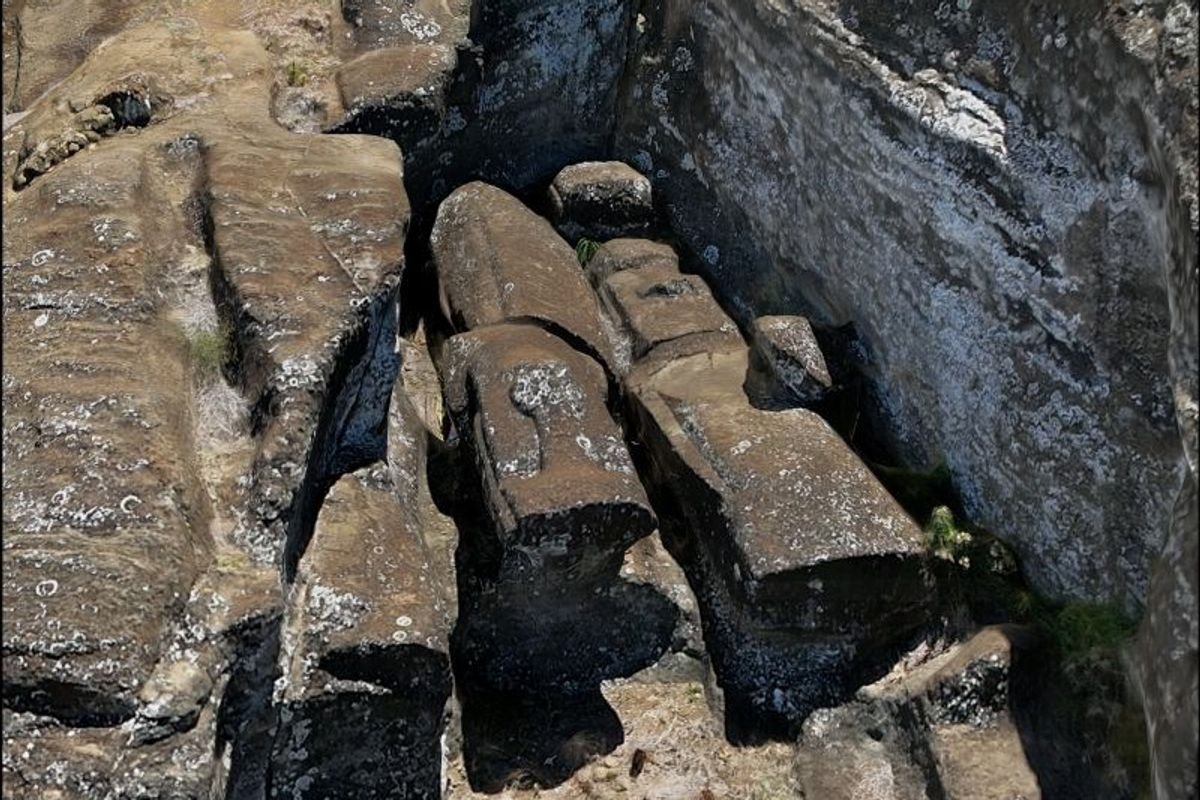
Quarry site on Easter Island
(Image Courtesy of Carl P. Lipo, Binghamton University and Terry L. Hunt, University of Arizona)
Starting in the 13th century, the Rapa Nui people began to carve moai from tuff, a porous rock composed of volcanic ash. The vast majority of moai — 95 percent — were constructed at the Rano Raraku quarry.
According to a press release, researchers involved with the new study collected over 11,000 images of Rano Raruku, creating a 3D model of the quarry that captures hundreds of moai in various stages of completion. From this model, the researchers distinguished 30 centers of quarrying activity at Rano Raruku and unveiled several distinctive carving techniques.
Multiple families set up their own moai construction sites at Rano Raruku, which the researchers say is a sign that the groups must have discussed how they would divvy out working spaces at the quarry.
Once moai were built, extended families of 20 to 50 people would move them out of the quarry in different directions, cleverly using a rocking motion to get the statues to “walk” along roads.
Heterarchy, Not Hierarchy in Rapa Nui Culture

Different views of Easter Island
(Image Courtesy of Carl P. Lipo, Binghamton University and Terry L. Hunt, University of Arizona)
The researchers say that while groups on Rapa Nui didn’t necessarily work together to build moai, they did share cultural information with each other, seeing as certain carving techniques spread across zones on the island.
Family groups also engaged in a bit of friendly rivalry, vying to make larger moai or more elaborate ahu.
“Inter-community relationships appear predominantly peaceful, with competition operating through formalized display rather than violence,” says Lipo. “This represents a sophisticated solution for managing competition on a small, isolated island, where communities developed mechanisms for contesting status without resorting to warfare.”
Looking at moai construction, it’s clear that the Rapa Nui culture was based not on hierarchy but on heterarchy: horizontal relationships and equal opportunities rather than vertical networks with chiefs or managers running things at the helm.
With the new model of Rano Raruku, researchers can see how Rapa Nui society functioned and confront the misconceptions that have faced this culture for centuries.
Read More: The Real Culprit Behind Easter Island’s Lost Forest Isn’t Humans — It’s Millions of Hungry Rats
Article Sources
Our writers at Discovermagazine.com use peer-reviewed studies and high-quality sources for our articles, and our editors review for scientific accuracy and editorial standards. Review the sources used below for this article: