
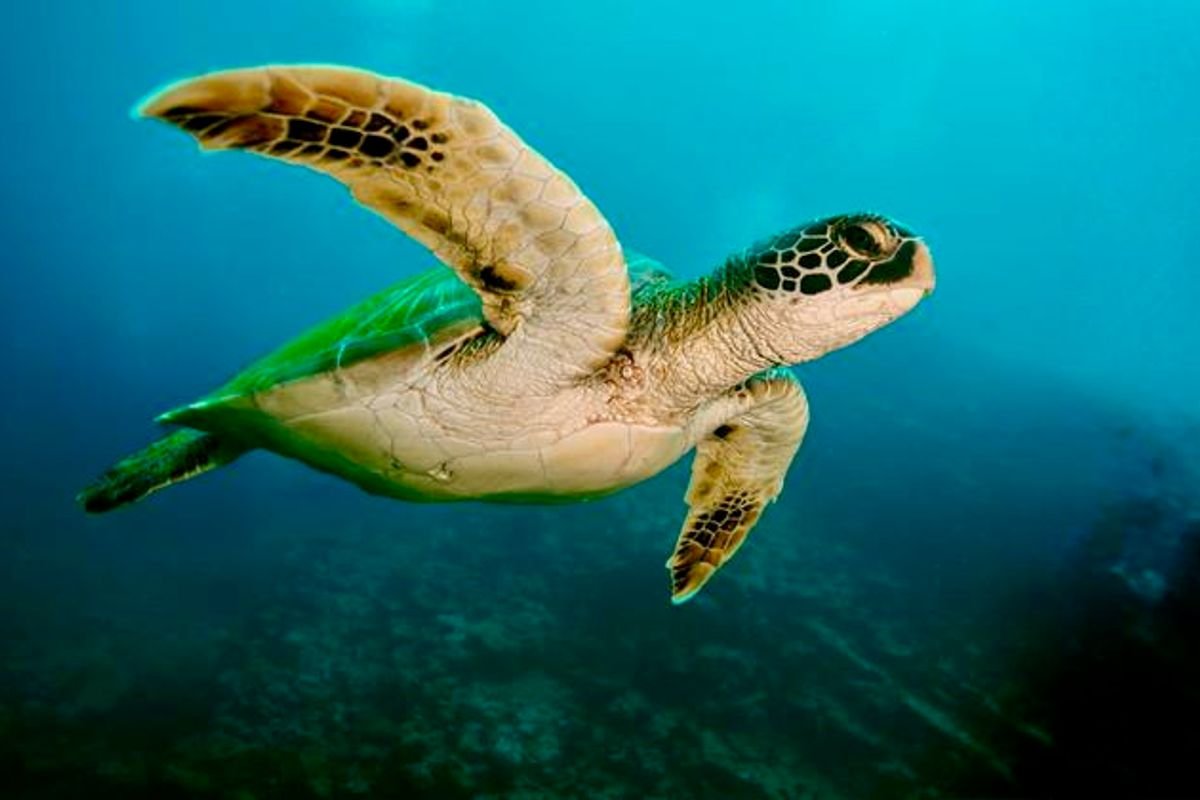
Sea Turtle Shells Hold a Hidden Timeline of Ocean Change — and Reveal How the Seas Are Shifting
Sea turtles don’t just move through the ocean — they quietly document it. New research shows that the hard plates on their shells contain a layered chemical record of where they’ve been, what they’ve eaten, and how the ocean around them has changed over time. By adapting techniques typically used to study ancient materials, researchers can now read that record with precision.
The study, published in Marine Biology, shows that those layers can be dated, allowing scientists to link changes in shell growth to specific environmental events over months and years.
“Sea turtle shells grow continuously throughout their lives, and each layer preserves evidence of past environmental conditions,” said research lead Bethan Linscott in a press release. “By analyzing these sequential layers, we can reconstruct foraging patterns, diet, and environmental changes over time.”
Read More: Why Are Sea Turtles Endangered and How Can We Save Them?
Turning Sea Turtle Shell Layers Into a Timeline

Infographic showing turtle shell growth.
(Image Credit: Bethan Linscott, Ph.D., and Amy Wallace, Ph.D)
Sea turtle shells are made of keratin — the same material found in human hair and nails — and they grow in overlapping layers. Each new layer forms on top of the last, locking in chemical signals from the turtle’s surroundings at that moment in time.
Researchers have used those signals before to study turtle diets and habitats. What’s been missing is a clear sense of timing — how long each layer actually represents. To answer that, researchers borrowed a technique more commonly associated with archaeology.
The team analyzed shell samples from 24 stranded sea turtles collected along the Florida coast, including loggerheads and green turtles, and generated 120 radiocarbon measurements from ultra-thin scute layers. Each layer was then radiocarbon dated and compared to the “bomb pulse,” a global spike in carbon levels left behind by nuclear weapons testing in the mid-20th century.
Using statistical modeling, the team estimated that each microscopic layer corresponds to roughly seven to nine months of growth — effectively turning the shell into a biological timeline. The average growth rate varied across turtles, with some turtles laying down shell more quickly than others.
Tracing Stress in the Ocean
With that timeline in place, the researchers could begin linking changes in shell growth to real-world events. Across multiple turtles, they identified periods when growth slowed simultaneously. Several of those slowdowns clustered around 2015 and again in 2017 to 2018, overlapping with major environmental disruptions in Florida waters. Those included harmful algal blooms known as red tides and large influxes of Sargassum seaweed.
“These shells are effectively recording environmental stress in the ocean,” Linscott said. “It’s a bit like sea turtle forensics. We can use chemical fingerprints preserved in scutes to detect ecological shifts.”
Because each layer contains chemical signals, the shells offer a way to detect environmental changes that might otherwise go unnoticed — especially in parts of the ocean that are difficult to monitor directly. The synchronized slowdowns suggest turtles in different places may have been responding to the same large-scale environmental stressors at roughly the same time.
A New Window Into Marine Life
Studying sea turtles over long periods has always been a challenge. They can live for decades, travel far distances, and spend much of their lives far from shore.
Analyzing scute layers allows researchers to reconstruct how turtles move through changing environments without needing to track them continuously in the wild. That kind of timeline could help scientists identify when turtles were using high-risk habitats or when ecological stress began to affect their growth.
“Our findings can help scientists better understand how marine ecosystems are changing and how species respond to those changes,” concluded Linscott.
More broadly, the work shows how tools developed to study the past can reveal new insights into the present, such as patterns that would otherwise go unnoticed. In many of the turtles studied, growth rates did not return to earlier levels, suggesting that the effects of these ocean disturbances may persist long after the events themselves fade.
Read More: Everything to Know About the Secret World of Sea Turtles
Article Sources
Our writers at Discovermagazine.com use peer-reviewed studies and high-quality sources for our articles, and our editors review for scientific accuracy and editorial standards. Review the sources used below for this article: