
Rock‑Climbing Fish Scale a 50‑Foot Waterfall Using Tiny Hooks in Their Fins

A waterfall isn’t supposed to be climbable. But thousands of small fish are doing it anyway, gripping wet rock and inching their way straight up.
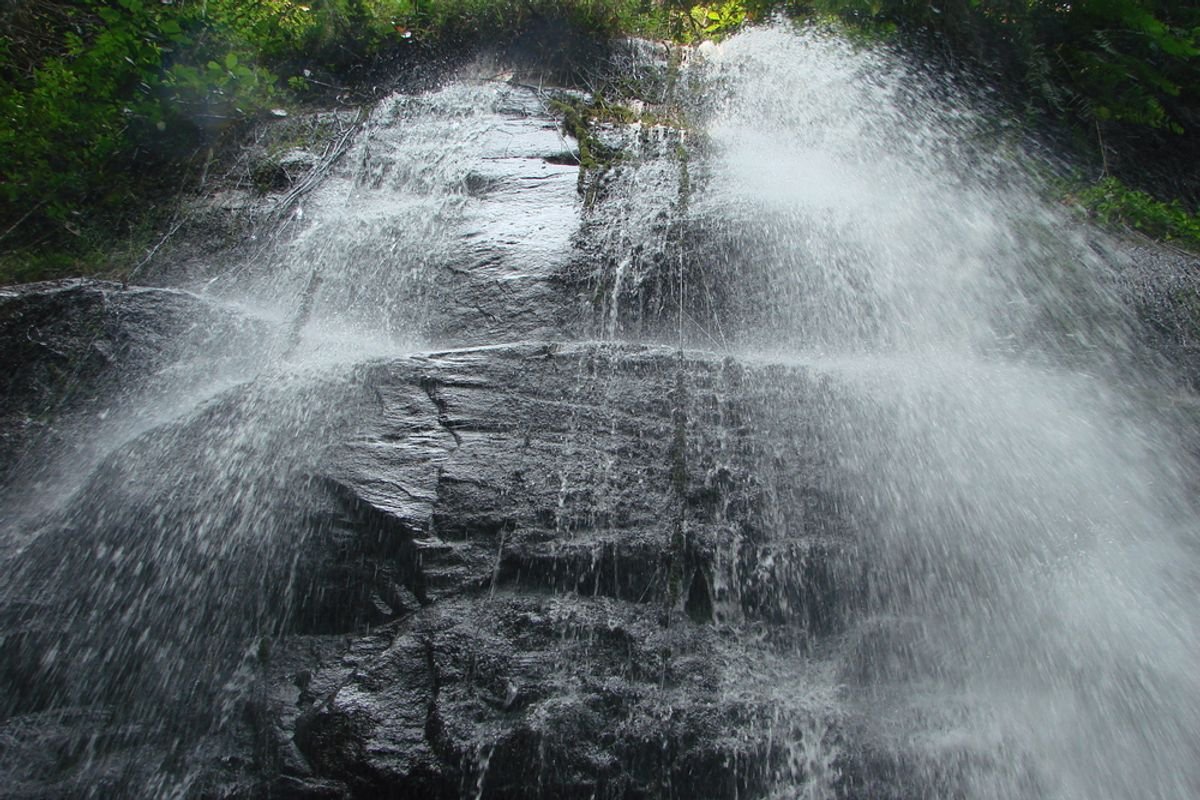
At Luvilombo Falls in the Democratic Republic of the Congo, these fish move along the slick, vertical face of a roughly 50-foot drop, advancing in short bursts as water rushes past them. Accounts of fish defying gravity and scaling the falls have circulated for years, but only now has the behavior been captured clearly, showing exactly how one species, Parakneria thysi, makes the climb, according to a study published in Scientific Reports.
The ascent happens during seasonal floods, when large numbers of fish move upstream together. What looks chaotic at first resolves into a coordinated migration, with individuals following the same narrow paths along the rock.
How These Fish Climb Straight Up
The fish don’t fight the main current. Instead, they move through the waterfall’s splash zone, where the rock stays wet, but the flow is less forceful.
From there, the climb becomes a sequence of grips and pushes. The fish anchor themselves with their pectoral fins, brace with their pelvic fins, and then drive upward using side-to-side movements of their bodies. The motion mirrors swimming, but rotated vertically against gravity.
Their grip comes from microscopic structures on their fins. The underside of each fin is lined with soft pads covered in tiny hook-like projections called unculi, which help them cling to the rock surface as they climb.
Progress is slow and deliberate. A few feet can take close to a minute of movement, broken up by frequent pauses. Reaching the top of the falls can take hours, with fish stopping repeatedly to rest along ledges before continuing upward.
Read More: This Glowing Fish Steals Bioluminescence Instead of Making Its Own Light
A Migration Limited by Size
Not every fish can make the climb. The migration is dominated by smaller individuals, typically measuring between 37 and 48 millimeters. Larger fish appear to lose their grip more easily, likely because their weight increases faster than the surface area of their fin pads can support.
That creates a split within the population. Some fish move upstream, while others remain below.
The climb coincides with the end of the rainy season, when flooding alters the river system and may push fish out of their usual habitats. As water levels begin to fall, groups of fish begin moving back upstream, sometimes in the thousands.
Activity tends to peak in mid-April and often appears to increase toward evening, suggesting the migration follows both seasonal and daily rhythms.
Why Make the Climb at All?
The journey is demanding and not without risk. Fish can lose their grip and fall, especially when navigating uneven rock or sudden bursts of water. Still, the behavior appears to serve a purpose.
One possibility is recovery. Fish displaced downstream during floods may climb back upstream to return to their preferred habitats. Another is competition, as food can be more limited at the base of waterfalls. Moving upstream could offer access to better resources.
Avoiding predators may also be a factor, particularly in crowded downstream conditions during flood periods.
Whatever the reason, the climb reveals a precise set of adaptations working together. The fins, the microscopic hooks, the body movement, and the timing all align to make something possible that seems, at first glance, unlikely.
Read More: A Mutant Clownfish Broke the Rules of Stripes and Offers Clues to How Animal Patterns Form
Article Sources
Our writers at Discovermagazine.com use peer-reviewed studies and high-quality sources for our articles, and our editors review for scientific accuracy and editorial standards. Review the sources used below for this article: