
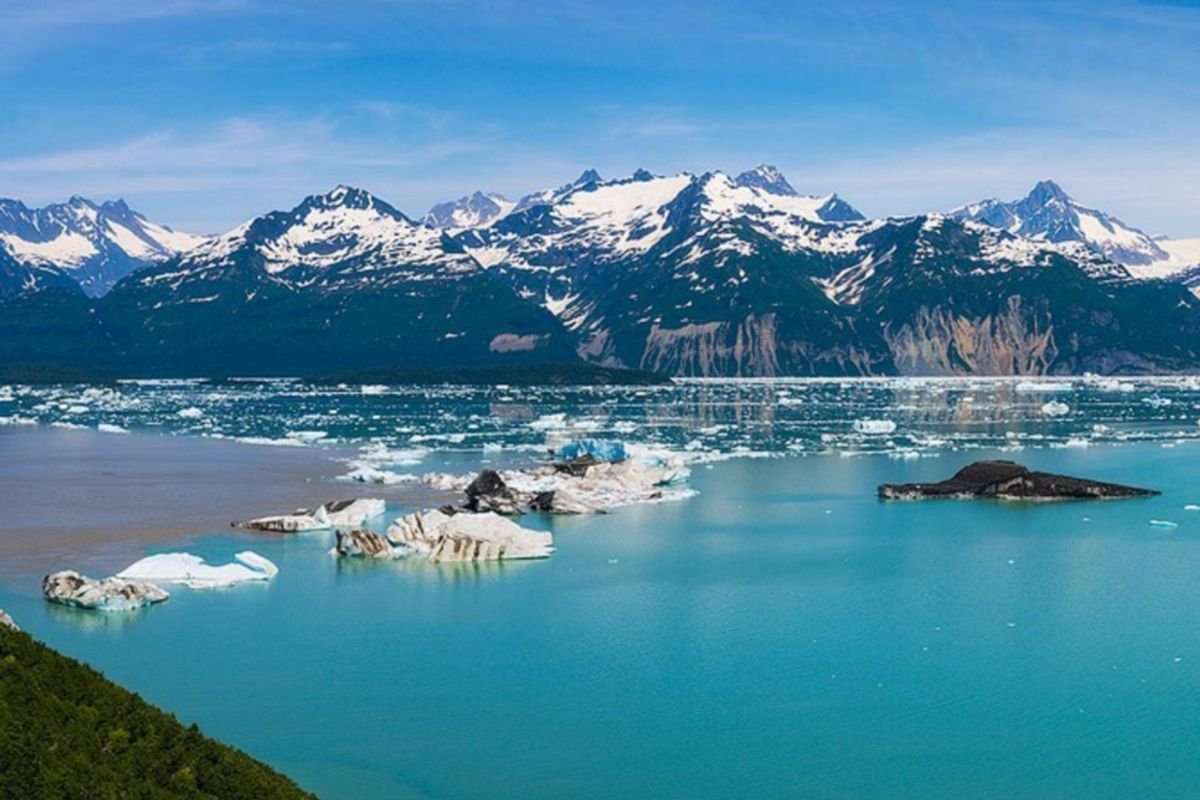
Retreating Ice Has Revealed a New Island in Alaska

There weren’t many witnesses to the birth of an island in southeastern Alaska. The nearest human settlement is 60 miles away, and the new landmass is nestled in a remote corner of the Saint Elias mountains.
Observed or not, the ice that once encased the island, which now sits in the azure waters of Alsek Lake, had been gradually melting over decades of global warming. Even if the fat Chinook salmon that swarm through the lake’s river tributary didn’t notice the changing borders of their waters, NASA’s Earth Observatory did. New images released by the satellite service show how the Alsek Glacier has retreated between 1984 and the present day. The pictures showing the difference between the decades were captured using the Landsat 5 and Landsat 9 satellites in 1984 and 2025, respectively.
Forty years ago, a small mountain called Prow Knob jutted into Alsek Lake, but was connected to the surrounding glacier by thick ice. Now, that ice has melted, leaving Prow Knob an island. The latest images from the Earth Observatory, taken in early August, show that the severance happened earlier in the summer.
The new island is a visible sign of a massive ice melt occurring all along the southeastern Alaskan coast. New lakes are emerging from thinning glaciers throughout the region.
Read More: Glacier in Antarctica Caught Committing Ice Piracy From Its Neighbor
How a Nunatak Lost its Glacier
Mauri Pelto, a glaciologist at Nichols College, explained the history of the Alsek Glacier in an Earth Observatory press release. In the early part of the 20th century, the glacier stretched three miles beyond Prow Knob to another small peak called Gateway Knob. The mountain was named by the photographer and glaciologist Austin Post in the middle of the 20th century after he noticed how it resembled a ship’s prow jutting from an icy sea.
At this point, Prow Knob would be considered a nunatak, a rocky peak above flowing glacial ice. When Pelto saw the glacier for the first time in 1984, the ice had retreated, but still wrapped a cold mitt around much of Prow Knob. The Alsek Glacier is also linked to the northern portion of the Grand Plateau Glacier at this point.
By 1999, both of these glaciers had shrunk, and images from 2018 show only the eastern edge of the mountain bound by ice. Landsat 9’s newest images reveal a glacier shrunk down to a stub.
Glacial Calving Will Continue
Pelto and Post had estimated that the new island would have formed from the glacier’s retreat by the year 2020, meaning the ice’s retreat was slightly slower than predicted. But the glacier’s withdrawal will likely continue in the next few years, said Pelto.
The ice’s separation from the mountain will weaken its structural stability and will continue to break apart in a process known as calving. Alsek Lake will continue to grow, having already expanded from 17 to 28 square miles since 1984. Its spreading waters will be a continued reminder of the toll that human-made climate change is wreaking on even the most remote corners of the planet.
Read More: Observations of Antarctica’s Doomsday Glacier Reveal a Cracked Surface
Article Sources
Our writers at Discovermagazine.com use peer-reviewed studies and high-quality sources for our articles, and our editors review for scientific accuracy and editorial standards. Review the sources used below for this article: