
Ravens Fly Up to 6 Hours Nonstop, Using Memory — Not Tracking — to Find Wolf Kills in Yellowstone National Park
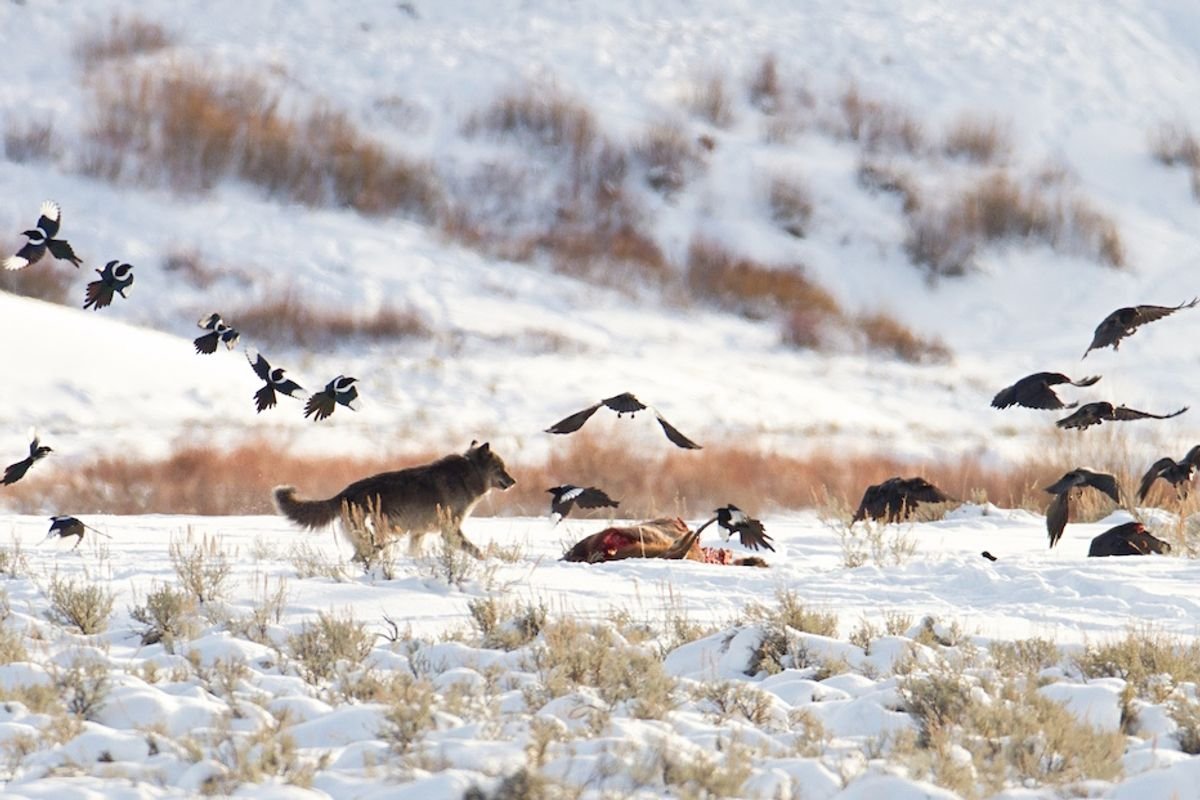
In Yellowstone National Park, a wolf kill rarely stays unnoticed for long — ravens often appear within minutes. The birds circle above the carcass or land nearby, waiting for scraps. Because ravens are frequently seen trailing traveling packs or hovering near hunts, researchers assumed the birds were following wolves. New tracking data, published in Science, points to the birds finding these meals in another way.
After tracking ravens and wolves across the landscape for more than two years, researchers found that ravens rarely trail wolves. Instead, the birds rely on spatial memory, navigating toward places where wolf kills are most likely to occur — sometimes flying for up to six hours without stopping to reach fresh meat.
“It was one of those moments when suddenly everything started to make sense,” first author and behavioral ecologist Matthias Loretto told Discover. “Once we realized that long-distance following of wolves was extremely rare in our data, we were quite puzzled.”
Tracking Ravens and Wolves Across Yellowstone
To track the birds, the team fitted 69 ravens with lightweight GPS transmitters and paired those data with movement records from 20 collared wolves already being monitored in Yellowstone. They also documented when and where wolves killed prey such as elk, bison, and deer.

Traveling on the road with ravens.
(Image Courtesy of Daniel Stahler)
The team focused their tracking during winter, when ravens are most likely to gather around wolf kills. GPS tags logged the birds’ positions roughly every 30 minutes, while wolf collars recorded movements about once an hour, allowing researchers to reconstruct how the two species moved across the park.
Ravens are famously alert to changes in their surroundings, which meant traps had to blend perfectly with the landscape to capture them. Near campsites, researchers even disguised traps with trash and fast-food bait to avoid suspicion.
Read More: The World’s Biggest Acidic Geyser Erupts at Yellowstone After Years of Minimal Activity
Ravens Aren’t Simply Following Wolves
The idea that ravens simply follow wolves has long seemed plausible. But the behavior of the two species doesn’t neatly line up. Ravens forage mostly during daylight hours, while wolves hunt both day and night — making it unlikely that ravens could consistently shadow wolf packs long enough to locate carcasses.
Loretto told Discover, “Ravens were still flying very directly to wolf kills, sometimes from more than 100 or even 150 kilometers away. At that point it became clear that something else must be guiding their movements, and spatial memory turned out to be the most convincing explanation.”

Fitting raven with GPS backpack.
(Image Courtesy of John Marzluff)
The tracking data confirmed this. Across the roughly two years of monitoring, researchers found only one case in which a raven followed a wolf for more than a kilometer or longer than an hour. Instead, the birds appear to rely on memory and navigation.
Wolf kills are not scattered randomly across the park. Successful hunts tend to occur in particular environments — especially flat valley bottoms. Over the years, these hunting grounds have created a landscape in which some areas repeatedly produce carcasses while others rarely do. Ravens appear to learn these patterns.
“It’s a reminder that animals don’t just respond to their physical environment — they also respond to the behavior of other species. Ravens are essentially tracking the ecological patterns created by wolves, which makes their world a bit more predictable,” Loretto said to Discover.
Not All Ravens Use the Same Strategy
The GPS data also showed differences between individual birds. Some ravens repeatedly located wolf kills, while others used them only occasionally, and a few never relied on them at all.
Experience may shape how ravens navigate Yellowstone’s scavenging opportunities. Birds raised in areas where wolf kills are common may gain an early advantage, learning which parts of the landscape tend to produce food.
“This study highlights how animals can use surprisingly sophisticated strategies to deal with very unpredictable resources. A wolf kill is hard to predict in the moment, but over time patterns emerge in the landscape, and ravens seem able to learn and remember those patterns,” Loretto told Discover.
Read More: Are Animals Like Mountain Lions and Bears Leaving Yellowstone National Park?
Article Sources
Our writers at Discovermagazine.com use peer-reviewed studies and high-quality sources for our articles, and our editors review for scientific accuracy and editorial standards. Review the sources used below for this article: