
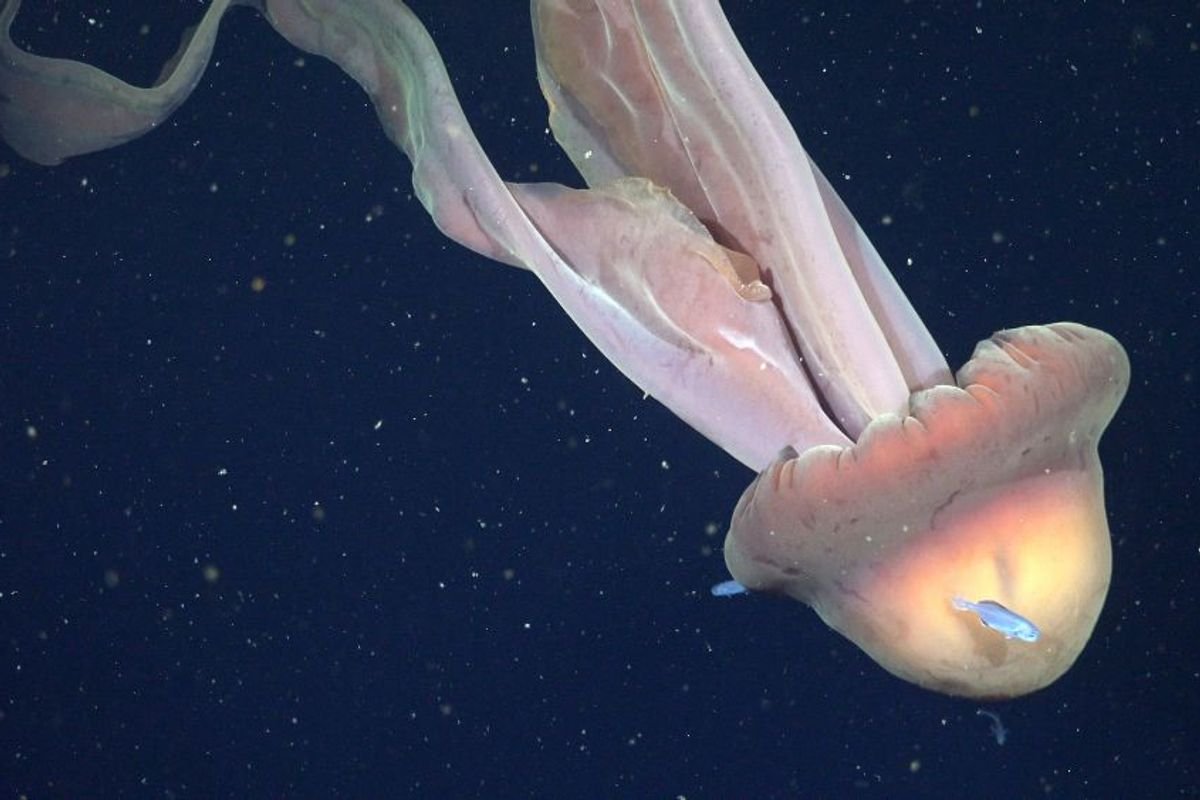
Rare Giant Phantom Jellyfish and a Well-Preserved Whale Skeleton Spotted Off the Coast of Argentina
Initially setting out to explore deep-sea cold vents in the South Atlantic Ocean near Argentina’s coast, scientists stumbled upon an ecosystem bustling with life.
The team aboard Schmidt Ocean Institute’s R/V Falkor (too) traveled along Argentina’s continental shelf from Buenos Aires to Tierra del Fuego, sending their remotely operated vehicle (ROV) SuBastian about 12,700 feet deep and describing the largest coral reef formed by the cold-water coral Bathelia candida known to date.
While traversing the pitch-black oceanic underworld, a giant phantom jellyfish — the rare red-brown “ghost of the deep” — made an appearance, alongside a variety of underwater critters such as worms, urchins, snails, anemones, and coral, of which 28 are suspected to be species never seen before.
“We were not expecting to see this level of biodiversity in the Argentine deep sea and are so excited to see it teeming with life,” said María Emilia Bravo, researcher from the University of Buenos Aires and CONICET, as well as the expedition’s chief scientist, in a press statement.
Read more: Brainless Jellyfish Need Rest Like Humans, and Reveal Sleep’s Evolutionary Purpose
Rare Observations 12,700 Feet Beneath the Waves

A whale skeleton, also known as whalefall, captured by SuBastian
(Image Credit: ROV SuBastian/Schmidt Ocean Institute)
This week, the Schmidt Ocean Institute shared some stunning imagery from their latest expedition in the South Atlantic. In particular, one of the most elusive ocean creatures, the giant phantom jellyfish (Stygiomedusa gigantea), suddenly popped up in front of SuBastian’s screen at around 800 feet. While its bell and stingless tentacles can reach up to 35 feet, making it one of the largest invertebrates in the ocean, it is rarely observed.
The team also came across Argentina’s first deep-sea whalefall at nearly 13,000 feet. Whale remains serve as the perfect food source for small animals, providing nutrients in an otherwise scarce environment and building ecosystems that can last for decades. Another discovery was ancient bubblegum coral gardens, identified by large, tree-like, bright-pink structures nearly 10,000 feet below the waterline in the Malvinas Trough near Tierra del Fuego. Numerous other discoveries were made, revealing the rich, still underexplored biodiversity of the deep sea.
“We collected an unprecedented number of chemical, physical, and biological samples that will be used to understand connections in our waters for years to come,” said Melisa Fernández Severini of Instituto Argentino de Oceanografía and CONICET, in the statement. “These samples represent a unique opportunity to understand not only how extraordinary these extreme ecosystems are, but also how vulnerable they can be.”
A Reef Nearly the Size of the Vatican

Some of the corals spotted by ROV SuBastian
(Image Credit: ROV SuBastian/Schmidt Ocean Institute)
While the team’s main goal was to look for cold seeps — seafloor vents expelling methane and hydrogen sulfide, chemicals that can support whole ecosystems by feeding chemosynthetic microorganisms — they instead stumbled upon a vast stony cold-water coral reef almost the size of the Vatican.
Although B. candida, the coral type the reef mostly consists of, has been observed throughout the Southwestern Atlantic Ocean, this is the biggest patch ever discovered. Since these reefs indicate vulnerable marine ecosystems and house a variety of underwater species, this is a promising find.
They also got to what they came for. The research team identified an active cold seep 250 acres large, covered in clams. These chemosynthetic ecosystems and their interactions with the local coral reefs are still poorly understood and remain an active subject of the team’s research.
Uncovering the Ocean’s Vast Biodiversity One Step at a Time
Unfortunately, even in Earth’s most remote areas, humanity leaves its traces. Discarded fishing equipment, garbage bags — even a VHS tape with Korean lettering — were seen by the researchers during their explorations.
Nevertheless, the Argentinian team remains buoyant, fueled by their recent wondrous discoveries and a reminder of the abundance of life in our oceans.
“Seeing all the biodiversity, ecosystem functions, and connectivity unfolding together was incredible,” said Bravo. “We opened a window into our country’s biodiversity only to find there are so many more windows left to be opened.”
Schmidt Ocean Institute’s executive director Jyotika Virmani added in the statement: “We have been privileged to work with outstanding scientists across three expeditions in Argentinian waters and look forward to seeing their research continue to unfold, unlocking new understanding and inspiration.”
Read more: Coral Reefs Do More Than Build Habitat — They Organize Microbial Life
Article Sources
Our writers at Discovermagazine.com use peer-reviewed studies and high-quality sources for our articles, and our editors review for scientific accuracy and editorial standards. Review the sources used below for this article: