
Raccoons May Thrive in Our Backyards Due to Their Insatiable Curiosity and Love for Puzzles
Urban environments are one big playground, at least for non-human urban dwellers like raccoons. Cities provide a unique stage, allowing animals to grow with challenges and then be rewarded with new resources, and it has been theorized that they improve their problem-solving skills purely through their curiosity.
To test this theory, researchers from the University of British Columbia (UBC) subjected raccoons to a multi-level puzzle box and found they’d continue exploring and solving opening mechanisms long after the small food reward was retrieved. This shows that raccoons may not be driven solely by an instant reward but may also possess genuine curiosity. The observations, published in Animal Behaviour, point toward raccoons’ intrinsic motivation to gather knowledge, which the researchers describe as “information foraging.”
Studies like this demonstrate how animals can adapt to complex human-made environments by prioritizing problem-solving skills and may also help us better manage how we peacefully cohabitate with curious creatures.
Read more: Bonobo Kanzi Plays Pretend Like a Child, Showing Ape’s Capacity to Imagine
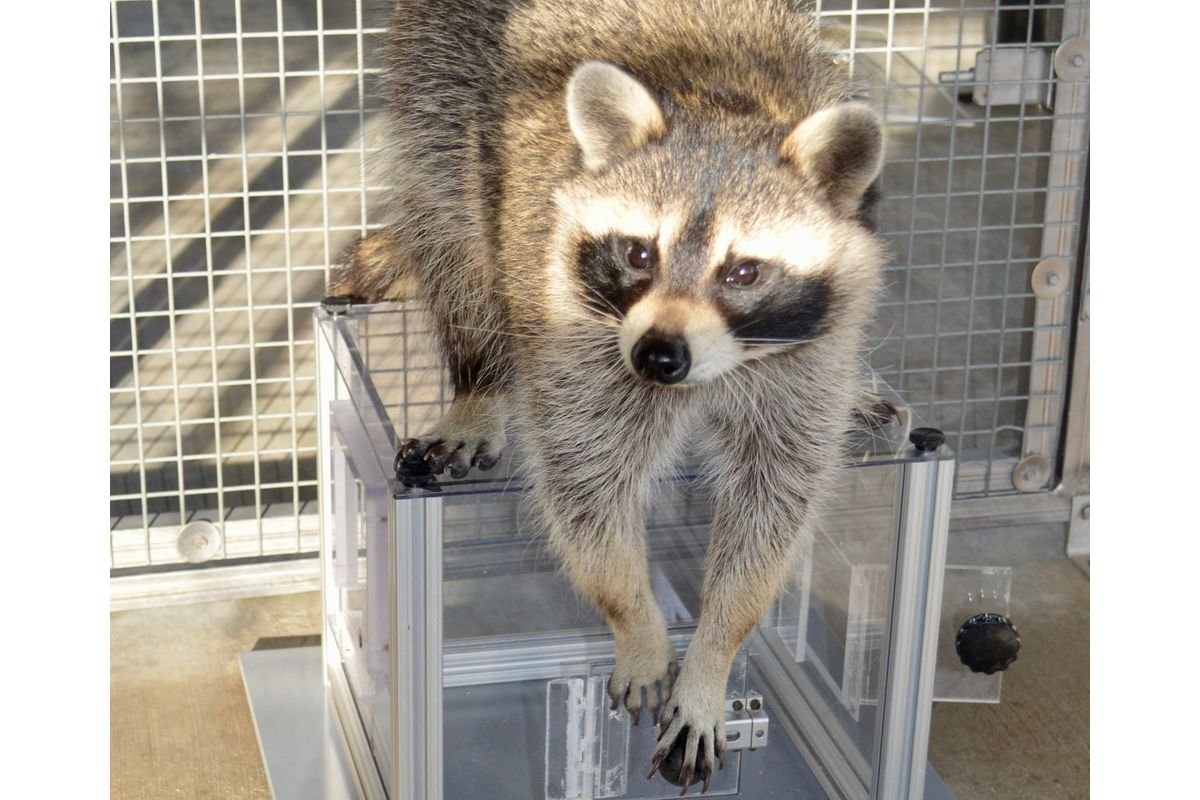
Exploring Continued After Getting the Treat

(Image Credit: Hannah Griebling)
The experiments used a custom-built Plexiglas box with nine entry mechanisms, categorized as easy, medium, and hard, comprising various types of latches, sliding doors, knobs, and locks. The raccoons — captive animals at a research facility in Colorado — had 20 minutes to retrieve a small marshmallow, and the researchers recorded and later rated the animals’ problem-solving strategies.
Interestingly, the raccoons often continued exploring the different opening mechanisms even after eating the reward, without being offered more treats, which the scientists interpreted as a clear sign of information-seeking. Importantly, the raccoons were fed just before the experiments, making sure their actions were not entirely driven by hunger.
“We weren’t expecting them to open all three solutions in a single trial,” said study first author Hannah Griebling, researcher at UBC, in a press release. “They kept problem-solving even when there was no marshmallow at the end.”
Weighing Risks Like Humans
The research team found that when raccoons first encountered and solved the easy opening puzzles, they continued to explore other mechanisms. But when meeting harder tasks, they went back to puzzles they had already solved. Still, the exploratory attitude was consistent, regardless of the difficulty level they were dealing with.
According to the researchers, this pattern points to flexible problem-solving skills, weighing curiosity against effort or risk, similar to decision-making strategies seen in other animals and humans.
“It’s a pattern familiar to anyone ordering at a restaurant,” said Griebling. “Do you order your favourite dish or try something new? If the risk is high — an expensive meal you might not like — you choose the safe option. Raccoons explore when the cost is low and quickly decide to play it safe when the stakes are higher.”
Adapted to Human Spaces
These findings help explain why raccoons are so successful in urban environments that require a certain level of cognition and physical skill to thrive. Raccoons’ forepaws, which initially evolved to forage in water, have the right sensory setup to interact with latches and knobs invented by humans.
By expanding their interest beyond just finding food, gathering information through their curiosity gives them an upper hand in complex human environments that are often designed to keep animals out of our spaces.
Learning from raccoons’ success could also help manage other species that wrestle with urban expansion and “inform strategies for other species, like bears, that use problem-solving to access human-made resources,” said Griebling.
“Raccoon intelligence has long featured in folklore, yet scientific research on their cognition remains limited. Studies like this provide empirical evidence to support that reputation,” added study lead Sarah Benson-Amram in the news release.
Read more: Is Trash Evolving Raccoons Into the Next Household Pet?
Article Sources
Our writers at Discovermagazine.com use peer-reviewed studies and high-quality sources for our articles, and our editors review for scientific accuracy and editorial standards. Review the sources used below for this article: