
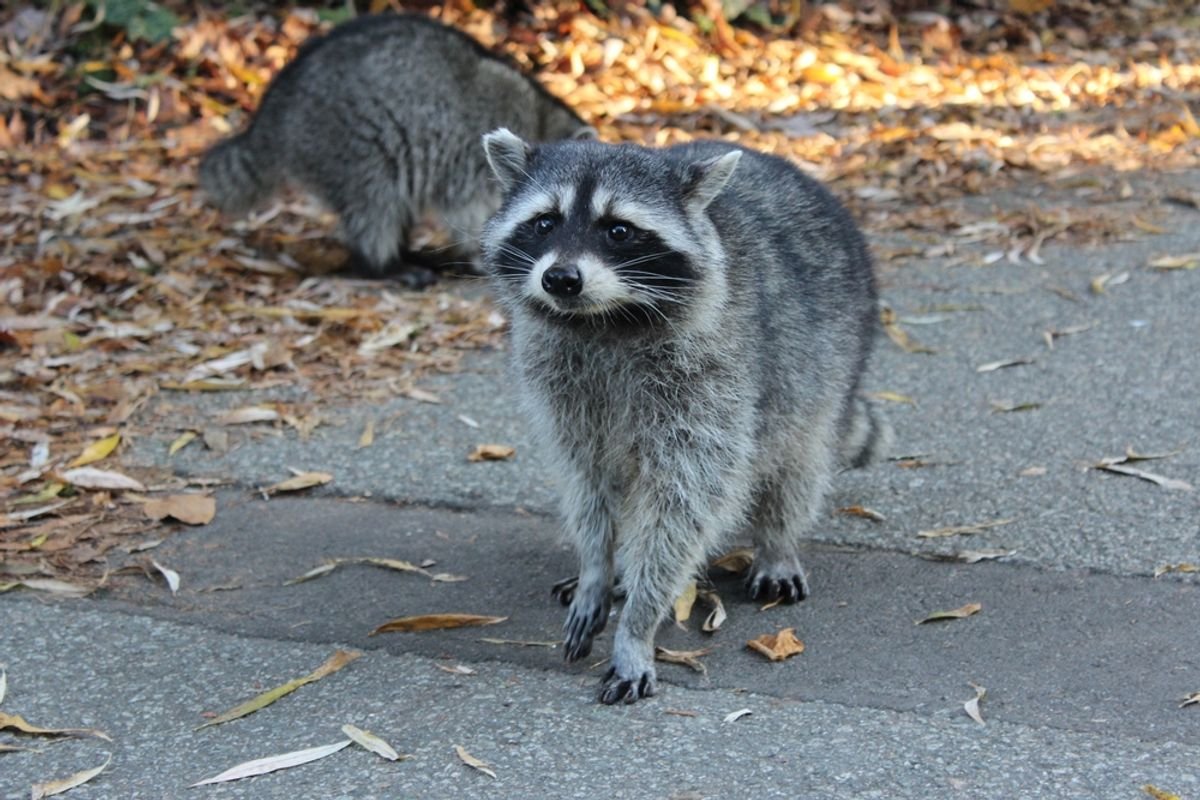
Raccoons Have Hidden Rules to Navigate Cities, and Refuse to Cross Roads, Even for Easy Meals

Raccoons are often cast as fearless opportunists, thriving wherever humans leave food behind. But new research from an urban park suggests that even these adaptable mammals draw clear boundaries when it comes to danger — boundaries that can reshape how wildlife survives in cities.
In Forest Park, a 1,326-acre green space in the middle of St. Louis, raccoons consistently avoided crossing roads, even when those roads were lined with trash cans and other easy meals. The findings, published in the Journal of Mammalogy, show how urban wildlife weighs risk against reward — and how infrastructure shapes animal behavior in ways that aren’t always obvious.
The Toll Roads Take on Wildlife
Roads are one of the most dangerous features of modern landscapes for wildlife. Previous research shows that vehicle collisions are the leading cause of death in 28 percent of animal populations studied worldwide, and in some extreme cases, roads have been documented killing up to 50 percent of a population in a single year, according to a review published in Biological Reviews.
The review also found that many animals respond to roads long before collisions occur, changing how they move, where they forage, and even when they are active — effectively treating roads as dangerous terrain rather than neutral space.
Tracking Raccoon Movement in a Major City Park
To see how raccoons move through a city landscape, researchers fitted 10 animals living in Forest Park with GPS-VHF collars between 2021 and 2024. Each collar also carried a tiny tri-axial accelerometer, a motion sensor that records movement in three dimensions, allowing the team to track not just where the animals went, but how active they were throughout the day and night.
Forest Park blends wooded habitat with heavy human use, including roads, parking lots, museums, and sports fields. Most raccoons stayed almost entirely within the park’s boundaries, maintaining relatively small home ranges. Only one individual regularly ventured beyond the park, primarily to forage in dumpsters outside its edges.
When researchers compared the raccoons’ real movements with thousands of simulated paths, a pattern emerged: the animals crossed roads far less often than expected. Even when food was present along roadways, raccoons appeared reluctant to cross, suggesting that the risks of traffic, noise, and exposure outweighed the promise of easy calories.
Rather than moving freely across the landscape, raccoons treated roads as invisible barriers, reshaping their routes and home ranges to avoid them — a finding that challenges the assumption that urban-adapted animals are largely indifferent to human infrastructure.
Read More: 20 of the Cutest Animals on Earth – From Cuddly Rodents to Waddling Birds
How Light and Temperature Shape Raccoon Activity
In addition to mapping where raccoons traveled, the accelerometer data offered a clearer view of how they adjusted their behavior in response to environmental conditions. The animals were most active at night, with activity peaking around dusk and dawn.
Temperature played a role as well. Raccoons moved more on warmer days, increasing overall activity as temperatures rose. Day length mattered too. During summer, when nights are short, raccoons compensated by being more active during each hour of darkness, effectively making up for lost time. In winter, longer nights allowed for more total nighttime activity, even though movement per hour was lower.
The results paint a picture of animals finely tuned to their surroundings — responding not only to food availability, but to light, temperature, and perceived risk. Even species known for their flexibility, it seems, are carefully negotiating the boundaries of city life rather than fully embracing them.
Read More: Why Don’t We See More Dead Animal Remains While Strolling in the Woods?
Article Sources
Our writers at Discovermagazine.com use peer-reviewed studies and high-quality sources for our articles, and our editors review for scientific accuracy and editorial standards. Review the sources used below for this article: