
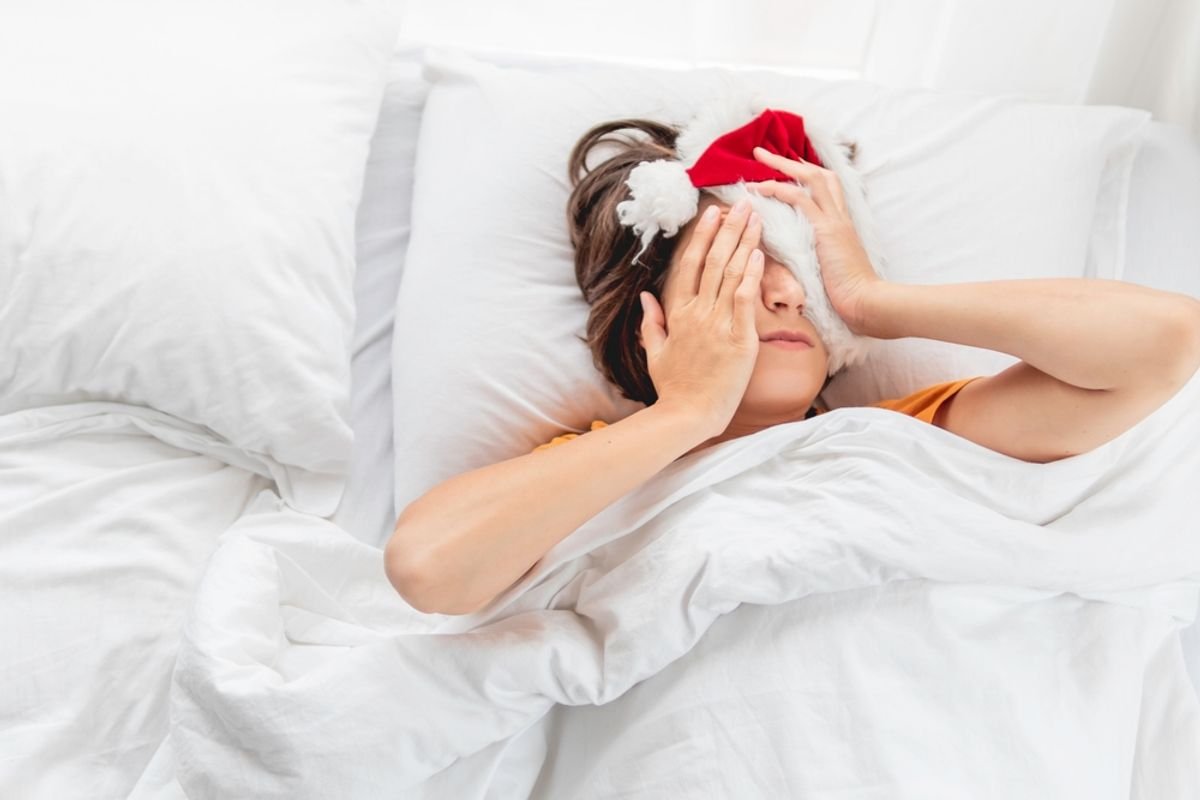
Post-Party Depression: Why Holiday Socializing Can Feel Like a Hangover

It’s that time of year again — a time when socializing can feel like a chore. While we might love to get together during the holidays for parties galore, it can also feel like too much. And once you get home from the party, it can be either hard to calm down, or it can promote fatigue because all that small talk can feel like a drain.
This is especially true for those who aren’t accustomed to so much socializing, especially if they’re more introverted and small talk takes a lot of work, says Laurie Helgoe, a clinical psychologist and author of Introvert Power: Why Your Inner Life Is Your Hidden Strength.
Read More: Decorate For the Holidays Early and it Might Improve Your Mood
What Causes That Post-Party Depression?
There’s a wide spectrum of personality types. Extroverts may thrive at social gatherings and even gain energy from them. But introverts have a harder time because for them, socializing takes energy.
Between those two personality types is a wide spectrum of people that fall somewhere on this continuum, says Helgoe. There are also people who, even though they are extroverted, are sensitive and worry about what others think of them.
Post party, an extrovert might have a different kind of hangover than an introvert. An extrovert might have a feeling of let down or a sense that it’s hard to calm down, while an introvert has a need to process the experience internally.
“Introverts need silence to hear themselves think,” says Helgoe. And if it’s the holiday season and you’re moving from the office party to a neighborhood get-together to your kid’s school play, there’s no time to do that processing.
Introverts and those who are more socially sensitive might also spend a lot of time looking at the things that they said and did at a party, which can cause a sense of anxiety or depression afterwards.
The Role of Alcohol in Post-Party Depression
According to a report from UCLA Health, by most estimates, alcohol consumption doubles during the holiday season, which is the result of a number of factors. For starters, there are more occasions at which to drink, and people who may be more nervous in social settings could be more likely to drink. Not to mention that people may be in a celebratory mood and more likely to imbibe in some holiday spirits.
“Alcohol is a disinhibitor, so there’s a process of being in it and letting go and then coming back down and feeling shame, wondering how you were perceived, and feeling lousy physically, which can all contribute to post-holiday depression,” says Helgoe.
Alcohol is also a central nervous system depressant, even though we think of it as something that makes you feel good, according to the National Library of Medicine. Ultimately, when you come down from it, it’s a depressant.
Drinking can also impact your sleep, which can further impact your mood because poor sleep makes it difficult to regulate emotions, according to a report from Johns Hopkins. If you’re going from party to party and consuming alcohol at each, it can cause problems with your sleep cycle for days. And if you already have issues with self-evaluation or looking at every conversation that you had at a party and deciding whether you said the right thing, it can make your self-judgment worse.
Working Against the Grain of the Holiday Season
And finally, says Helgoe, while the holiday season is busy with so many social activities, it’s also the time of year that many of us would rather be hibernating. It’s darker and often colder in the winter, yet instead of following our circadian rhythms, says Helgoe, we’re in go, go, go mode.
One study published in Current Biology found that post-industrial societies followed this rhythm in a way that we do not. Researchers found that both light and temperature were major determinants of sleep, and that this held across societies that were not connected to one another. Basically, even though we’re meant to sleep more in the winter when it’s dark and cold, we end up having more to do.
“There’s a cultural dissidence because nothing changes about the expectations around us, even though biologically we require more sleep when there’s less light,” says Helgoe.
Read More: Staying Up Past Midnight Might Make Us More Impulsive and Cynical
Article Sources
Our writers at Discovermagazine.com use peer-reviewed studies and high-quality sources for our articles, and our editors review for scientific accuracy and editorial standards. Review the sources used below for this article: