
Planets With Two Suns Are Almost Impossible To Find — General Relativity May Be Why

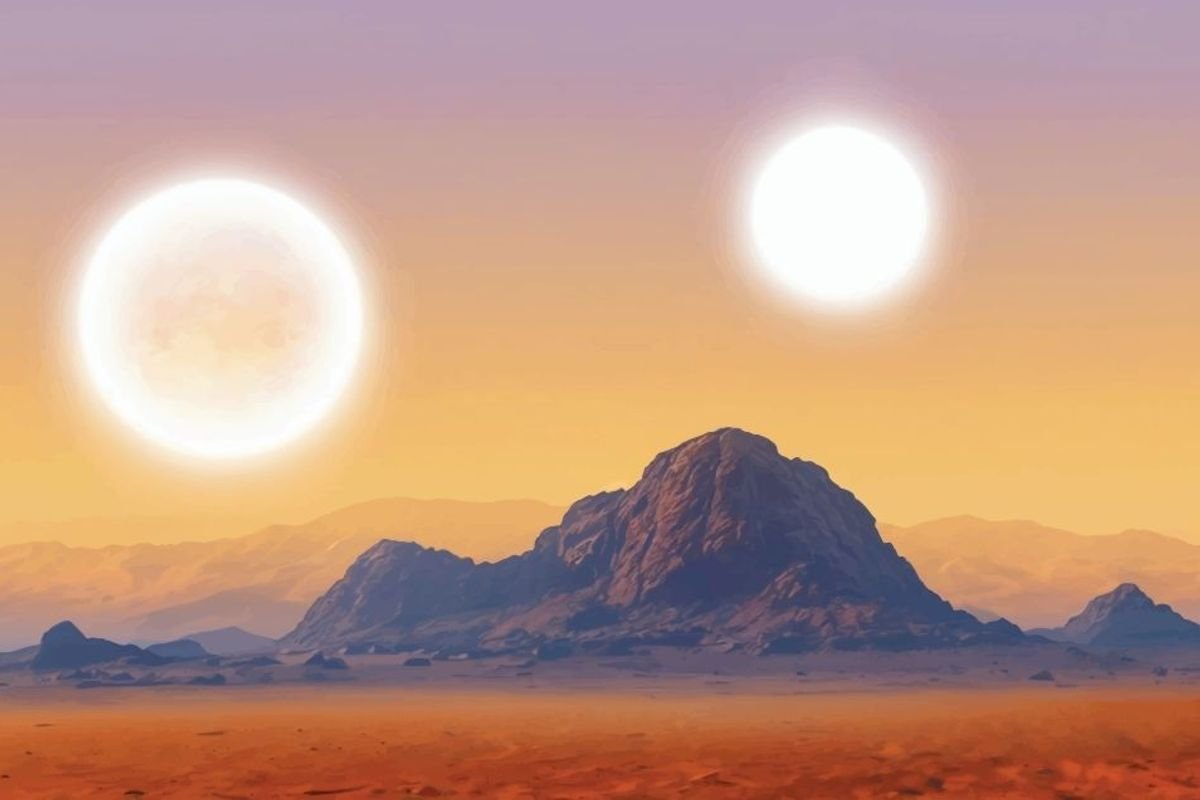
Planets with two suns have long captured the imagination of science fiction fans, thanks largely to Tatooine, the iconic desert world from Star Wars. Given what astronomers know about how stars and planets form, these worlds should be common. Most stars are born with planets, and many stars form in pairs. Yet when scientists look to the sky, planets orbiting two stars at once are surprisingly scarce.
Of the more than 6,000 exoplanets discovered so far — largely by NASA’s Kepler Space Telescope and the Transiting Exoplanet Survey Satellite (TESS) — only 14 are known to orbit binary star systems, which is far fewer than expected. Now, astrophysicists writing in The Astrophysical Journal Letters believe they know why: the missing planets may be casualties of a subtle but powerful effect Albert Einstein predicted more than a century ago.
“You have a scarcity of circumbinary planets in general and you have an absolute desert around binaries,” said first author Mohammad Farhat in a press release.
Why Tatooine-Like Planets Are So Rare
Binary star systems are chaotic places. In most cases, the two stars have slightly different masses and follow elongated, egg-shaped orbits around one another. Any planet that circles both stars — a configuration astronomers call a circumbinary orbit — must contend with competing gravitational forces that constantly tug it off balance.
There’s also a danger zone surrounding binary stars where planetary orbits are fundamentally unstable. Within this region, complex three-body interactions can either fling a planet out into interstellar space or pull it close enough to be shredded or swallowed by one of the stars. Observations suggest that most known circumbinary planets sit just outside this zone, implying they likely formed farther out and migrated inwards.
“Planets form from the bottom up, by sticking small-scale planetesimals together. But forming a planet at the edge of the instability zone would be like trying to stick snowflakes together in a hurricane,” added Farhat.
Read More: 5 of the Strangest and Most Dangerous Exoplanets Ever Discovered
Binary Stars and Planetary Orbits
The problem doesn’t stop with instability alone. Both the planet’s orbit and the orbit of the two stars slowly rotate over time in a process known as precession — similar to how a spinning top wobbles as it slows down. The planet’s orbit precesses due to the stars’ gravitational pulls, while the binary stars’ orbit precesses largely because of relativistic effects.
As tidal interactions gradually shrink the stars’ orbit, the precession rate of the stars speeds up, while the planet’s rate slows down. When these rates match, the system enters a resonance that stretches the planet’s orbit into an extreme oval.
This resonance typically results in one of two outcomes, as explained by Farhat: “Either the planet gets very, very close to the binary, suffering tidal disruption or being engulfed by one of the stars, or its orbit gets significantly perturbed by the binary to be eventually ejected from the system. In both cases, you get rid of the planet.”
How General Relativity Tips the Balance
The key insight of this new research is the role played by Einstein’s general theory of relativity. Proposed in 1915, the theory describes gravity not as a force, but as a bending of spacetime itself, often compared to the way a heavy object warps a trampoline.
In tight binary systems, this relativistic warping accelerates orbital precession enough to trigger destructive resonances. Computer models suggest that general relativistic effects eliminate roughly eight out of ten circumbinary planets around close binaries, with most of those planets ultimately destroyed.
The result is a universe where Tatooine-like worlds may exist, but mostly far from their suns and largely beyond the reach of today’s telescopes.
Read More: Astronomers Find a Third Planet in This Weird ‘Tatooine’ Star System
Article Sources
Our writers at Discovermagazine.com use peer-reviewed studies and high-quality sources for our articles, and our editors review for scientific accuracy and editorial standards. Review the sources used below for this article: