
Oviraptors May Have Used Sunlight to Help Incubate Their Eggs 70 Million Years Ago
If you picture a dinosaur guarding its nest, you might imagine something like a giant bird sitting on a clutch of eggs to keep them warm. Fossils show that oviraptors did brood their nests, but the unusual layout of their eggs has raised questions about whether they incubated them the way birds do.
A new study published in Frontiers in Ecology and Evolution points to a different strategy. Instead of relying only on body heat, some oviraptors may have depended partly on the sun to warm their clutches.
To test the idea, researchers in Taiwan built a life-sized oviraptor nest and measured how heat moved through the eggs.
“Oviraptors sat atop their clutch. Some paleontologists linked this observation to modern birds’ incubation behavior, some of them, like us, however, did not think oviraptors resembled modern birds,” senior study author Tzu-Ruei Yang told Discover. “And it was indeed surprising, the result supported our hypothesis — oviraptors’ incubation is similar in some ways, but also different in some ways to modern birds.”
Rebuilding a Cretaceous Dinosaur Egg Nest
The researchers focused on Heyuannia huangi, an oviraptor species that lived between about 70 million years and 66 million years ago in what is now China. These dinosaurs were relatively small by dinosaur standards, about 5 feet (roughly 1.5 meters) long and weighing about 44 pounds (around 20 kilograms).

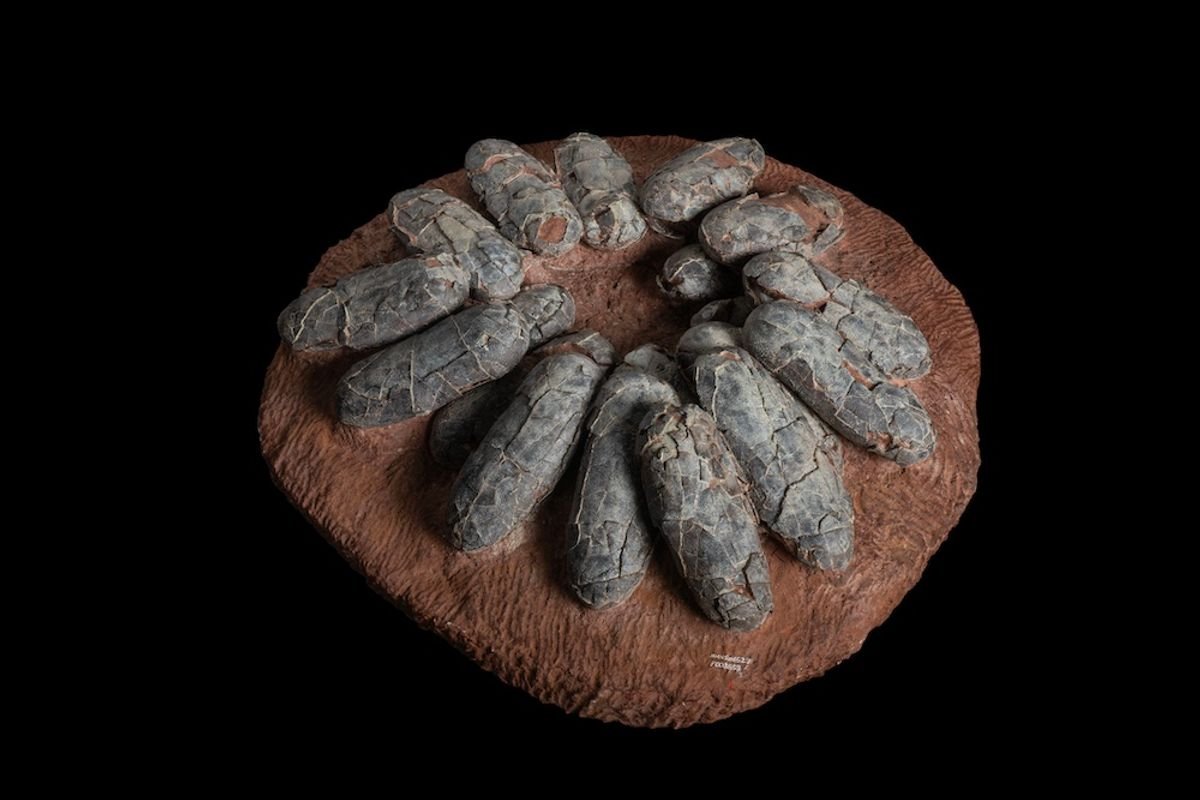
Reconstructed dinosaur clutch with eggs molded from casting resin.
(Image Credit: Chun-Yu Su)
Unlike modern bird nests, where eggs cluster tightly beneath a parent, oviraptor clutches formed wide rings. Fossils show that the eggs were arranged in multiple circular layers, leaving an open space in the middle where the adult likely sat.
Because the eggs were spread out, it would have been difficult for a brooding adult to touch every egg at once. Modern birds rely on a strategy called thermoregulatory contact incubation (TCI), where the adult sits directly on the clutch and transfers body heat to every egg. The layout of oviraptor nests shows these dinosaurs likely could not incubate their eggs in this way.
To examine how heat might move through such a layout, the team recreated a brooding dinosaur and its nest. The torso of the model oviraptor was built from polystyrene foam and a wooden skeletal frame, with layers of cotton, cloth, and bubble wrap used to approximate soft tissues. The eggs themselves were molded from casting resin and arranged in double rings that matched known fossil nests.
Read More: 90-Million-Year-Old Fossil Reveals a Fully Grown Dinosaur That Weighed Less Than 2 Pounds
How Heat Spread Across an Oviraptor Nest
Researchers then measured how temperatures changed across the eggs under different environmental conditions.
In cooler surroundings, eggs along the outer ring warmed unevenly. Temperatures sometimes differed by as much as about 11 degrees Fahrenheit (6 degrees Celsius) between eggs within the same clutch. Differences of that size could lead to asynchronous hatching, where some eggs hatch earlier than others.
When the surrounding air was warmer, however, the temperature differences between eggs dropped to about 1 degree Fahrenheit (0.6 degrees Celsius). Because oviraptor nests were open to the air rather than buried in soil, the environmental warmth — likely from sunlight — helped stabilize temperatures across the clutch.
“The unique pattern of clutch arrangement is indeed the best balance between the input of the sun and the heat from the adult,” Yang shared with Discover.
A Different Way to Incubate Eggs
Unlike modern birds that rely on thermoregulatory contact incubation, the researchers say oviraptors likely used a strategy shaped by the environments they lived in.
Rather than being worse at incubating eggs than birds today, these dinosaurs appear to have relied on a different balance of parental care and environmental heat.
Read More: 16,000 Fossilized Footprints Reveal South America’s Forgotten Dinosaur Highway
Article Sources
Our writers at Discovermagazine.com use peer-reviewed studies and high-quality sources for our articles, and our editors review for scientific accuracy and editorial standards. Review the sources used below for this article: