
Over 400,000-Year-Old Evidence of Fire-Making Unearthed — Thousands of Years Earlier Than Once Thought
From warmth and protection to cooking meals, fire has been a crucial part of human evolution, and new findings could offer better insights into when our early ancestors first began stoking the flame.
Publishing their findings in Nature, a research team has uncovered the earliest known evidence of human ancestors making fire at a site in the U.K. According to the study, the findings, including heated sediments and fire-cracked flint, are over 400,000 years old.
Prior to this, the oldest known evidence of fire-making came from northern France and was only about 50,000 years old.
Read More: The Dawn of Fire: When Did Early Humans First Discover Fire?
Unearthing Evidence of Fire-Making

A heat-shattered handaxe found at the Barnham site near remains of a 400,000-year-old campfire.
(Image Courtesy of Jordan Mansfield/Pathways to Ancient Britain Project)
According to the study, archaeological sites in Africa contain evidence suggesting that our ancient human ancestors used natural fire more than a million years ago. It’s possible these flames came from wildfires or lightning strikes. However, the artifacts and sediments recently uncovered at the site in Barnham, U.K., indicated that Neanderthals likely created and controlled fire here.
“The people who made fire at Barnham at 400,000 years ago were probably early Neanderthals, based on the morphology of fossils around the same age from Swanscombe, Kent, and Atapuerca in Spain, who even preserve early Neanderthal DNA,” said Chris Stringer, a professor with the Natural History Museum, in a press release.
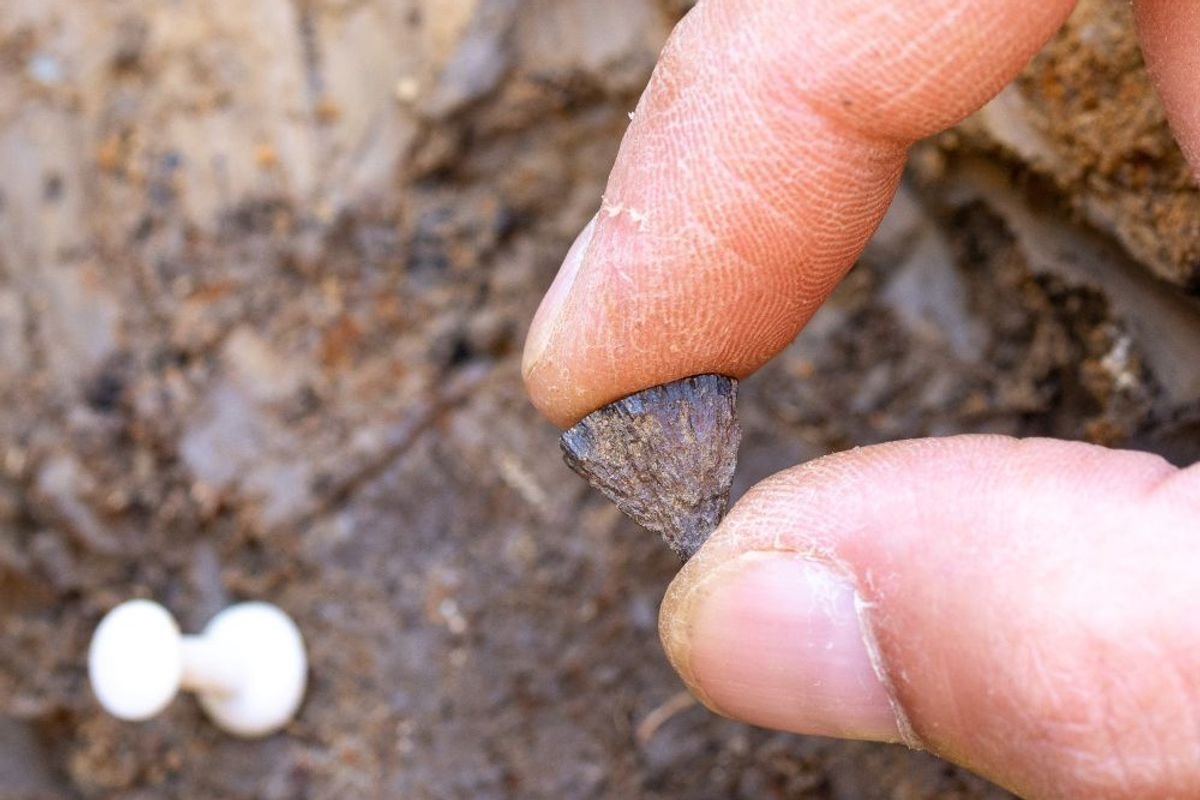
The uncovered artifacts, likely left by this Neanderthal group, consisted of heat-shattered flint handaxes, two tiny pieces of iron pyrite, and a patch of heated clay.
Proving Fire Was Created and Not Natural
Uncovering these items at the archaeological site is one thing; proving that they were created by controlled fire is another.
The research team, led by Nick Ashton and Rob Davis of the British Museum, spent four years demonstrating that the heated clay patch was not caused by wildfire. Using geochemical tests, the team indicated that a specific area of the site was repeatedly subjected to fire, with temperatures exceeding 1292 degrees Fahrenheit (700 degrees Celsius). These results led the research team to believe that this patch was used as either a hearth or a campfire.
Along with the results of the geochemical tests, the discovery of other artifacts, such as the flint handaxe and fragments of iron pyrite, also supports the conclusion that Neanderthals at this site were creating fire rather than relying solely on naturally occurring flames.
Iron pyrite, a rare mineral for that area at that time, can be used to strike flint and produce sparks, leading to fire. According to the study, because pyrite was a rare mineral in that area, the research team also believes that these ancient ancestors may have had prior knowledge of how to source this material and use it to create fire.
“It’s incredible that some of the oldest groups of Neanderthals had the knowledge of the properties of flint, pyrite, and tinder at such an early date,” said Ashton in a press release.
Flames That Shaped the Future
While these findings can help rewrite what we know about early humans using fire, they can also help us better understand when and how more complex behaviors began to develop. According to the press release, being able to create fire gave early humans the ability to choose their own campsites instead of relying on wildfires and lightning strikes, which could be very unpredictable.
Instead of the time-consuming manual effort required to maintain a fire, our ancient ancestors were able to travel and expand into new areas, including colder climates. This also means that they could expand the foods in their diet. Cooking foods, such as meats, roots, and tubers, helps remove toxins or pathogens they may contain. Additionally, cooked food is easier to digest, which allows more energy to fuel the brain.
According to the press release, the use of fire for warmth, protection, and cooking helped larger groups of ancient humans survive and perhaps remain social after dark, which may have helped with language and storytelling development. Being social in the evenings may have helped free up more time for hunting and tool-making during the day.
“The implications are enormous. The ability to create and control fire is one of the most important turning points in human history, with practical and social benefits that changed human evolution,” said Davis in a press release. “This extraordinary discovery pushes this turning point back by some 350,000 years.”
Read More: From Growing Crops to Cooking Food, Fire Shaped Ancient Civilizations
Article Sources
Our writers at Discovermagazine.com use peer-reviewed studies and high-quality sources for our articles, and our editors review for scientific accuracy and editorial standards. Review the sources used below for this article: