
Orbiter Observes Sun’s Hot Spots for Record-Breaking 94 Days, Enhancing Solar Storm Forecasts

At certain hot spots on the sun’s surface, plasma interacts with magnetic fields to whip up solar storms that careen toward Earth. These active regions can’t be observed from Earth at all times because the sun rotates on its axis; as they move toward the sun’s far side, they are inevitably obscured for two weeks.
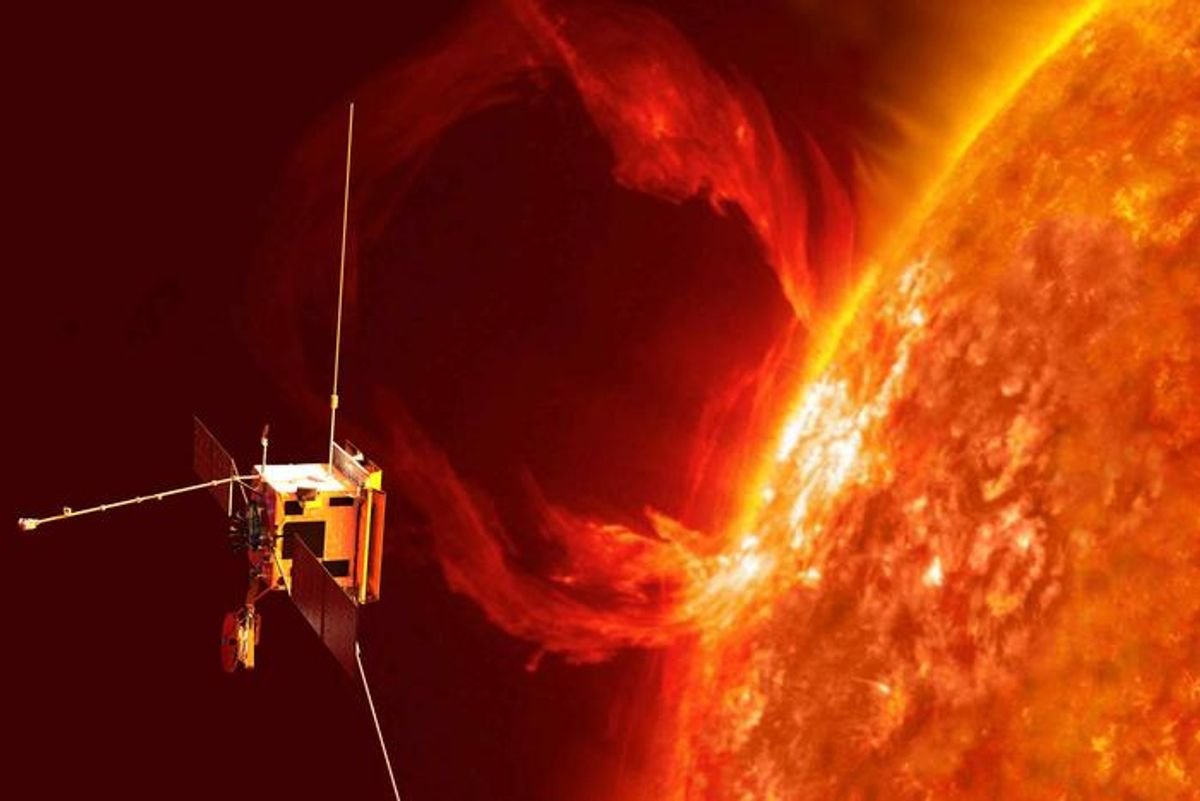
In 2024, however, the European Space Agency’s Solar Orbiter spacecraft followed a particular active region that had emerged on the sun’s far side for a record-breaking 94-day period. A new study published in Astronomy and Astrophysics reported that Solar Orbiter data gave researchers a rare chance to see how an active region develops over time; this kind of observation, they say, may unlock improved forecasts for solar storms in the future.
Read More: First Map of the Sun’s Outer Edge Demystifies the Escape Route of Solar Wind
Solar Activity on the Far Side
The ESA’s Solar Orbiter, launched in 2020, orbits the sun every six months, collecting instrumental data on the far side and its hidden features. This point of view turned out to be particularly beneficial from April to July 2024, when one of the sun’s most active regions in the past 20 years materialized.
This active region, known as NOAA 13664, was first spotted by the Solar Orbiter on April 16, 2024. The spacecraft observed as the region emerged and evolved on the far side. By May, NOAA 13664 had rotated to the near side of the sun (the one that faces Earth), unleashing the strongest solar storms on Earth since 2003. With the region then being visible, researchers watched its progress via NASA’s Solar Dynamics Observatory spacecraft, which is located on the Earth-sun line.
Overall, researchers were able to observe NOAA 13664 almost continuously for 94 days.
“This is the longest continuous series of images ever created for a single active region: it’s a milestone in solar physics,” said Ioannis Kontogiannis, a solar physicist at ETH Zurich, in a statement.
The Strongest Solar Storm in Two Decades
The May 2024 solar storms hit Earth with energized particles that had been launched from the sun in a series of chaotic eruptions. A barrage of electromagnetic radiation was sent by several flares that were observed from May 7 to 11; eight of the flares were the most powerful type of flare, known as an X-class, according to NASA.
The geomagnetic storm that impacted Earth reached a rating of G5 — the highest level on the geomagnetic storm scale. This storm created beautiful auroras that were seen across Earth, but it also caused power outages and tampered with communication signals.
NOAA 13664 had a particularly troublesome effect on agriculture; as signals from drones, satellites, and sensors were disrupted, farmers experienced difficulty with their crops, leading to economic losses.
“It’s a good reminder that the sun is the only star that influences our activities,” said Kontogiannis. “We live with this star, so it’s really important we observe it and try to understand how it works and how it affects our environment.”
A Better Forecast for Space Weather
With the Solar Orbiter’s view of NOAA 13664, researchers were able to track three solar rotations for the first time ever, seeing how flares originated from an increasingly complex magnetic structure in the active region.
Continuing to study the sun’s active regions, the researchers say, could be the key to forecasting solar storms.
“When we see a region on the sun with an extremely complex magnetic field, we can assume that there is a large amount of energy there that will have to be released as solar storms,” said Louise Harra, a physicist at ETH Zurich.
Space weather forecasts remain a long way from being perfected. Researchers still cannot predict the strength of an eruption or its exact timing, but improved technology is on the way. The ESA Vigil space probe, still under development and planned for a 2031 launch, will be a major aid in improving space weather forecasts.
Read More: A Solar Probe’s Journey to the Sun Has Revealed the Mystery of Solar Flares
Article Sources
Our writers at Discovermagazine.com use peer-reviewed studies and high-quality sources for our articles, and our editors review for scientific accuracy and editorial standards. Review the sources used below for this article: