
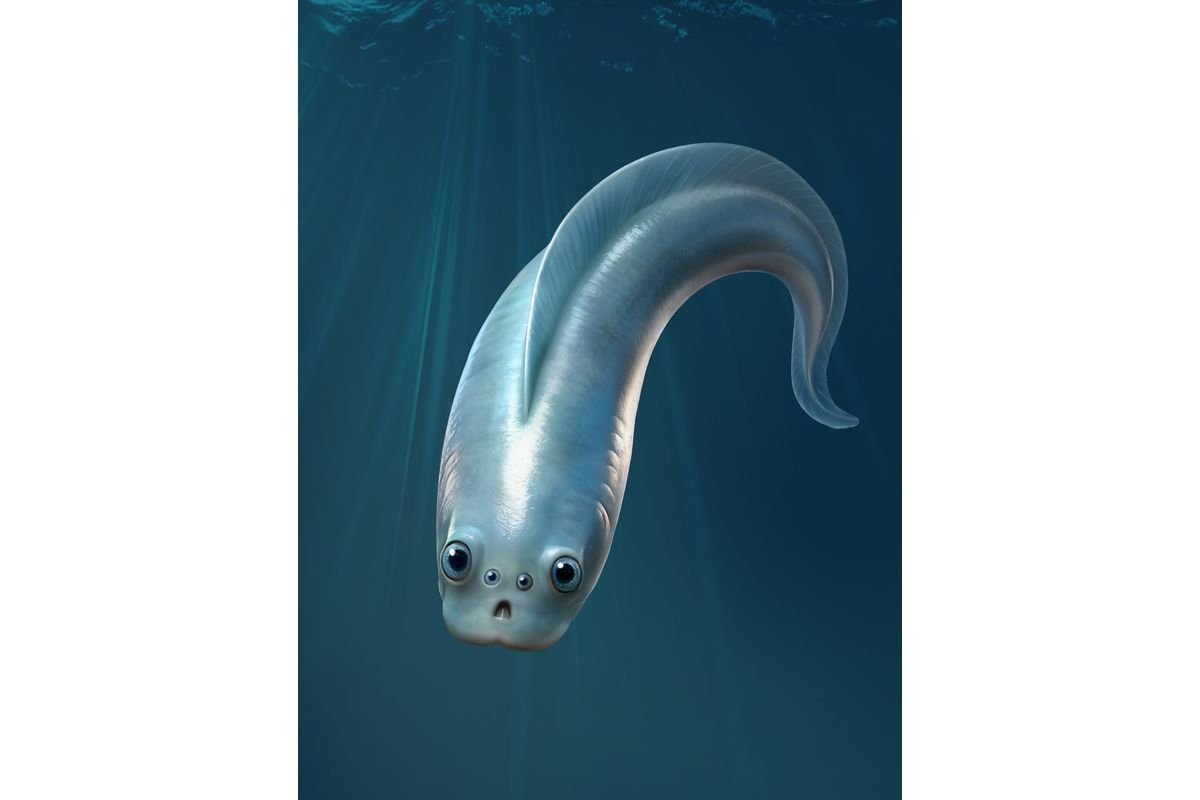
One of The Earliest-Known Vertebrates Navigated the Cambrian Dark Forest with Four Eyes
Spiders have eight eyes, bees have five, and boxed jellyfish have 24 — but these are the exceptions. The vast majority of animals on this planet possess two peepers. Even the vestigial eyes of the blind mole rat, which appear non-existent, come in a pair. And yet, new research suggests that the earliest vertebrates had four.
The myllokunmingiid is a prehistoric genus of fish that inhabited the waters near modern-day China over 518 million years ago and has the distinction of being the world’s oldest known fossil vertebrate. According to research published in Nature, fossil evidence suggests they possessed two pairs of eyes.
“This changes how we think about the early evolution of vertebrates,” said co-author Jakob Vinther of the University of Bristol, U.K., in a statement. “It turns out our ancestors were visually sophisticated animals navigating a dangerous world.”
Read More: A Small Genetic Shift May Have Launched Vertebrate Evolution
Finding a Second Pair of Eyes in Myllokunmingiid

Close-up of the head of a myllokunmingid fossil, the oldest known vertebrate, revealing four eyes — two large lateral eyes and two smaller central eyes — preserved as dark patches in the fossil.
(Image Courtesy of Xiangtong Lei & Sihang Zhang)
Researchers came to this conclusion after analyzing the remains of 10 specimens. This included six H. ercaicunensis and four slabs containing fossils of undetermined myllokunmingiids, all discovered in the Chengjiang formation of southern China — a particularly abundant fossil bed that highlights the diversity and complexity of marine life during the Cambrian period.
“Fossil eyes are incredibly rare — you wouldn’t expect something as delicate as an eye to survive for hundreds of millions of years,” co-author Professor Emeritus Sarah Gabbott from the University of Leicester, U.K., explained in a statement. “Yet under the right conditions they can, and when they do, they open a rare window into how extinct animals saw and experienced their world.”
In this case, microscopic and chemical analyses revealed two large eyes positioned on either side, accompanied by two smaller eyes in the center of the face, all of which would have been “camera-type eyes” like those of modern organisms. This means they rely on light in order to be able to see. The team came to this conclusion after discovering melanosomes in each of the four eyes.
While melanosomes — organelles that synthesize and store melanin — can be found in various parts of the body, those in the eye are responsible for light absorption and the coloring of the eye itself. The presence of melanosomes was determined by high-power microscopy and confirmed by additional chemical analysis. The subsequent discovery of circular structures, believed to be lenses, again shows just how complex the visual systems of these ancient animals really were. It suggests the eyes were not just able to detect light; they could also form images.
From Four Eyes to Two Eyes — and a Pineal Gland
Somewhere along the evolutionary journey, modern-day vertebrates lost their third and fourth eye. But its remnants may lie somewhere deep in the brain, in the pineal gland.
The pineal gland helps regulate sleep by producing melatonin in response to light stimuli, and has even been referred to as the “third eye.” In some animals, including certain species of fish, amphibians, and reptiles, it can still detect light, but this new research suggests that once upon a time — at least, for some vertebrates — it was a functioning pair of eyes.
“What we’re seeing is that the pineal organs began as image-forming eyes,” said Professor Peiyun Cong of Yunnan University, China, who led the research, in a statement.
“Only later in evolution did they shrink, lose visual power, and take on their modern role in regulating sleep.”
Adapting to a “Dangerous World”
The study’s authors suggest the additional pair of eyes may have served an evolutionary purpose during a difficult transition, triggered by the Cambrian explosion.
This saw the emergence of large predators, including squid-like radiodonts and marine worms, that may have preyed on small, soft-bodied myllokunmingiids. The “ensuing arms races” may have been a key driver of “sensory repertoire innovation” in predators and prey.
Indeed, a second pair of eyes may have helped myllokunmingiids evade predators and navigate the seas, “aiding survival in the Cambrian ‘Dark Forest’,” the researchers wrote.
Read More: Walking Sharks Are Breaking the Rules of Evolution and Reproduction
Article Sources
Our writers at Discovermagazine.com use peer-reviewed studies and high-quality sources for our articles, and our editors review for scientific accuracy and editorial standards. Review the sources used below for this article: