
Oldest Cremation Pyre Found in Africa Rewrites Our Understanding of Hunter-Gatherer Ritual Behavior
How humans deal with death and the rituals we build around it are a crucial part of our identity. Burial practices may stretch back hundreds of thousands of years, emerging soon after our ancestors left the trees. Cremation, however, is a different story. Burning the dead requires planning, fuel, and coordinated labor, making it a rare and complex practice in early human history.
A new discovery from northern Malawi is now reshaping that narrative. Researchers from the U.S., Africa, and Europe have uncovered evidence of a cremation pyre dating back about 9,500 years, the earliest known example of intentional cremation ever found in Africa. Published in Science Advances, the study suggests that ancient hunter-gatherers practiced more complex ritual behavior than scientists had previously assumed.
Read more: Life After Death: What Human Burial Options Will Look Like in a Sustainable Future
Reconstructing a 9,500-Year-Old Cremation

Hora Mountain
Photo courtesy of Jacob Davis
The cremation took place at Hora 1, a site at the base of a granite rock rising hundreds of feet above the surrounding plains. Previous research showed people lived there as early as 21,000 years ago and buried their dead between about 16,000 and 8,000 years ago. Taking a closer look revealed something else: ash.
Analysis of sediments revealed highly fragmented remains of a single individual. No evidence shows that anyone else was cremated there either before or after. The remains belonged to an adult woman between 18 and 60 years old, just under five feet tall. Patterns of heat damage show her body was burned shortly after death, before decomposition began.
One absence stood out. “Surprisingly, there were no fragments of teeth or skull bones in the pyre,” said study co-author and bioarchaeologist Elizabeth Sawchuk in a press release. “Because those parts are usually preserved in cremations, we believe the head may have been removed prior to burning.”
A Rare Practice in Human History

Pyre points
Image Courtesy of Justin Pargeter
Cremation itself isn’t new, but intentionally built pyres are rare in the archaeological record. Burned human remains appear as early as 40,000 years ago at Lake Mungo in Australia, yet clear evidence of constructed pyres doesn’t emerge until much later.
The oldest known in situ pyre dates to about 11,500 years ago in Alaska, containing the remains of a young child. In Africa, definitive cremations were previously known only from around 3,500 years ago and were associated with Pastoral Neolithic herders rather than hunter-gatherers.
Cremation is quite an undertaking, usually seen much later in human history, more commonly in food-producing societies, which tend to have more complex technologies available. For mobile hunter-gatherers, the labor and fuel required would have made cremation an impractical choice, making the discovery at Hora 1 particularly unexpected.
A Singular Woman and a Remembered Place
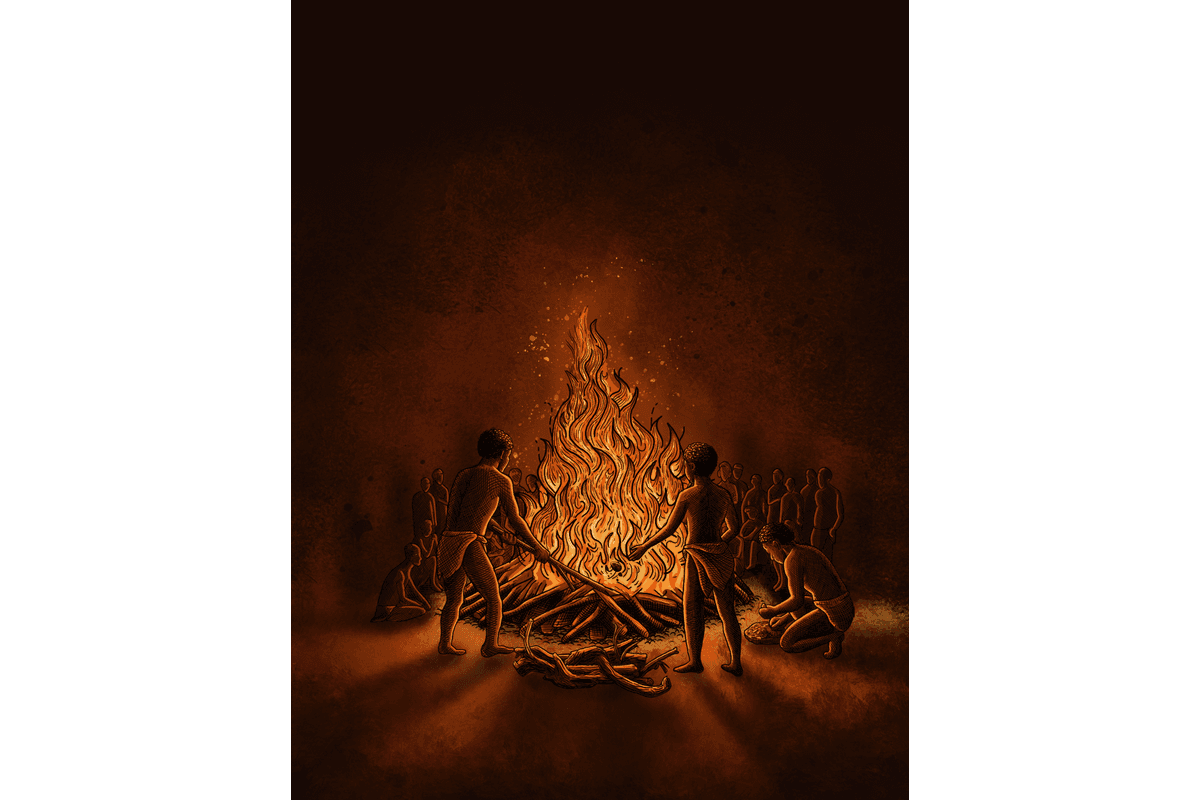
The pyre required substantial communal effort. Researchers estimate that at least 65 lbs. of material were gathered to fuel the fire. Stone tools found within the pyre may have been deliberately placed as funerary objects.
“Cremation is very rare among ancient and modern hunter-gatherers, at least partially because pyres require a huge amount of labor, time, and fuel to transform a body into fragmented and calcined bone and ash,” said lead author Jessica Cerezo-Román, an associate professor of anthropology at the University of Oklahoma, in the press statement.
The site’s importance did not end with the cremation. Large fires were lit there centuries before the event, and within 500 years afterward, people returned to light additional fires directly atop the pyre. Even though no one else was cremated, the location was clearly remembered.
Why this one woman received such distinctive treatment remains unknown.
“Why was this one woman cremated when the other burials at the site were not treated that way?” said senior author Jessica Thompson of Yale University in the release. “There must have been something specific about her that warranted special treatment.”
Read More: A Hidden Molecular Clock in Maggots Could Transform Forensic Time-of-Death Estimates
Article Sources
Our writers at Discovermagazine.com use peer-reviewed studies and high-quality sources for our articles, and our editors review for scientific accuracy and editorial standards. Review the sources used below for this article: