
New Snapshots of Comet 3I/ATLAS Highlight a Dazzling Glow and Two Separate Tails

The fanfare surrounding Comet 3I/ATLAS is far from quieting down, as the mysterious object from beyond our Solar System hurtles toward its closest approach with Earth. Flying at breakneck speeds of 153,000 as it passed the Sun, 3I/ATLAS is now set to whiz by Earth on Friday, December 19, 2025.
While astronomers eagerly await that anticipated flyby, they’ll have time to pore over the latest images of 3I/ATLAS, captured by NASA’s Hubble Telescope and the European Space Agency’s Jupiter Icy Moons Explorer (Juice). These observations have given astronomers a new look at the features that make 3I/ATLAS so unlike any other comet. And more details will continue to emerge well into next year as this interstellar visitor heads beyond the Solar System.
Read More: New Images of Comet 3I/ATLAS Reveal “How Magical the Universe Could Be”
3I/Atlas’ Bright Blue Glow
In a recent image from NASA’s Hubble Space Telescope, Comet 3I/ATLAS wows with a brilliant blue glow surrounding its core, visible as a tiny white speck. This latest observation, recorded on November 30 by Hubble’s Wide Field Camera 3 instrument, shows the comet 178 million miles from Earth. Several faint streaks of light in the background represent faraway stars, which appear that way since Hubble captured this image as 3I/ATLAS was moving across the sky.
Back in late July, soon after 3I/ATLAS was first discovered, NASA shared a similar, albeit lower-resolution image of the comet that was also taken by Hubble. Just like the most recent image, this one shows the blue glow of 3I/ATLAS.
What makes 3I/ATLAS so bright and blue? Comets normally get brighter as they approach the sun, when radiation causes solid ice to transform into gas through a process called sublimation. Then, gas and dust form around the comet to create its coma — which appears as a glowing aura — and its tail. The brightness comes from sunlight reflecting off dust in the coma and tail.
3I/ATLAS, however, is unusually bright for a comet. This may be due to its lack of a dust mantle, a feature gained by most comets that can tone down abrupt brightness. And while other comets usually tend to get redder as their dust reflects scattered sunlight, 3I/ATLAS has maintained a blue-green hue that may be caused by a combination of gases — possibly cyanogen and ammonia — being ejected from the comet’s body.
Two Tails Come into View
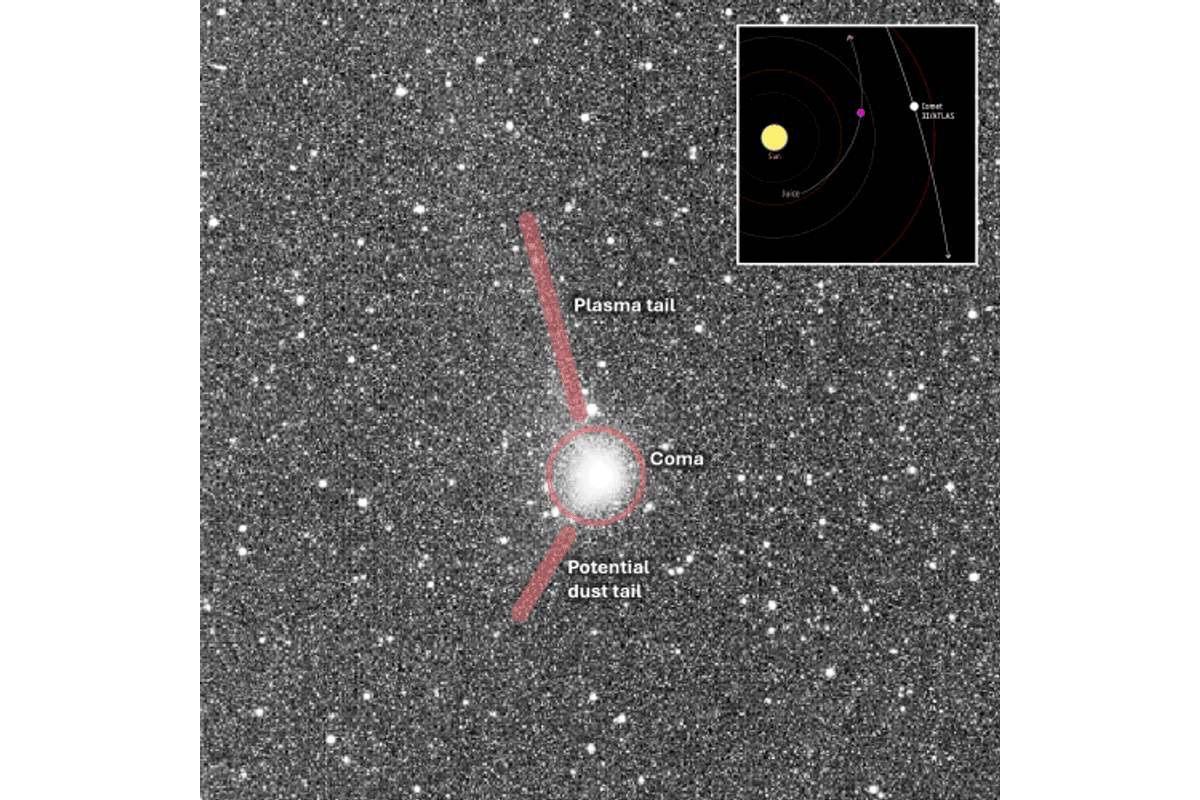
Another image of 3I/ATLAS, taken by the ESA’s Juice spacecraft on November 2, doesn’t show the comet’s blue flow, but it does display hints of two tails. Five scientific instruments on Juice were used to collect information on the comet’s behavior and composition, and the spacecraft’s onboard Navigation Camera (NavCam) took a snapshot.
While the data collected by the five instruments won’t be available to researchers until mid-February 2026, the NavCam image shows a sneak peek at the comet’s activity.
The image shows a bright spot where 3I/ATLAS’ coma is present, as well as two lines branching off of the coma that appear to be tails. One is the comet’s plasma tail, a stream of electrically charged gas stretching toward the top of the image. The other is the comet’s suspected dust tail, a fainter flow of tiny solid particles that points toward the lower left corner of the image.
Watching an Interstellar Visitor
More images and observations of Comet 3I/ATLAS are expected in the coming months as other telescopes join the effort.
Astronomers will keep watch on the comet as it nears Earth; its closest approach to our planet — about 168 million miles away — is not close enough to warrant any concern. When the comet passed by Mars on October 3, 2025, it was only 18 million miles away.
Early December will be the best time to view 3I/ATLAS from Earth with a good pair of binoculars or a telescope. According to theskylive.com, it will move through the constellation Virgo and Leo before becoming much fainter by the end of the year.
Read More: When Was Halley’s Comet Last Seen and Will It Ever Return?
Article Sources
Our writers at Discovermagazine.com use peer-reviewed studies and high-quality sources for our articles, and our editors review for scientific accuracy and editorial standards. Review the sources used below for this article: