
New Models Reveal If Neanderthals and Modern Humans Ever Met on the Iberian Peninsula During the Old Stone Age

Travel back a hundred thousand years to Paleolithic Europe, and you might find Neanderthals building fires, crafting jewelry, and feasting on mammoths.
Our hominin relatives dominated Europe for hundreds of millennia. Then, around 38,000 to 50,000 years ago, there was a shift. Anatomically modern humans moved in and expanded their reach. Meanwhile, Neanderthal populations experienced a sharp decline, leading to their eventual extinction.
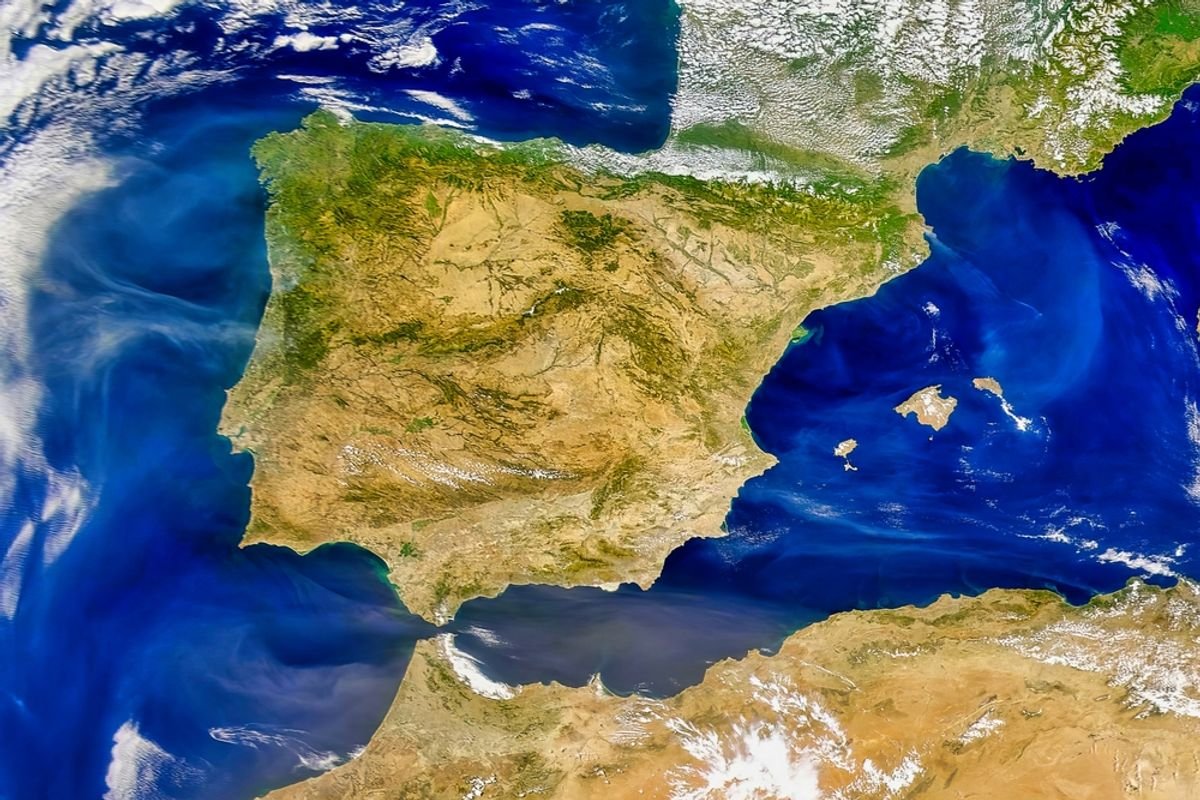
Now, researchers writing in PLOS One are studying the takeover, identifying possible encounters between Neanderthals and Homo Sapiens on the Iberian Peninsula during the Old Stone Age. This involved constructing a human dispersal model to simulate how the two species may have interacted under various climatic conditions.
“By linking climate, demography, and culture, our dynamic model offers a broader explanatory framework that can be used to better interpret archaeological and genomic data,” Gerd-Christian Weniger, a professor from the Department of Prehistoric Archaeology at the University of Cologne, Germany, said in a statement.
Read More: Is There a Benefit to Having Neanderthal DNA in the Human Genome?
Life in the Old Stone Age
The Middle to Upper Paleolithic Transition (circa 50,000 to 38,000 years ago) was marked by dramatic climatic variations, oscillating between rapid warming periods lasting only a few centuries and longer, more gradual cooling periods (called Dansgaard-Oeschger events), interspersed with severe cold snaps (known as Heinrich events).
While the exact timing of the Neanderthal’s demise is somewhat uncertain and modern humans’ appearance in Eurasia is equally vague, there is evidence that the two met and interbred — approximately 1 to 4 percent of DNA in non-African people is believed to be Neanderthal, according to a study in Current Biology.
Interactions (and interbreeding) between modern humans and Neanderthals are further supported by archeological remains in eastern Europe and southwestern Asia. However, there is little in the fossil record to confirm a meeting of the two on the Iberian Peninsula, in what is now Spain and Portugal.
Running Ancient Simulations
With scant physical evidence to rely on, researchers at the University of Cologne turned to computer modelling, running simulations that tested a range of scenarios based on the likelihood of Neanderthal extinction.
“Repeated runs of the model with different parameters allow for an assessment of the plausibility of different scenarios: an early extinction of the Neanderthals, a small population size with a high risk of extinction, or a prolonged survival that would allow mixing,” lead author Yaping Shao, a professor from the Institute of Geophysics and Meteorology at the University of Cologne, said in a statement.
A Small Possibility
There was no meeting between Neanderthals and modern humans in the majority of simulations.
By the time modern humans appeared on the scene, Neanderthal populations were probably already declining and largely restricted to coastal refuges. The impact of the Heinrich Event 5 (circa 48,000 years ago) would have hit Neanderthals hard and further hastened their extinction.
According to the study, there was just a teeny tiny possibility (1 percent) that the two would come into contact and become friendly, producing a small group (2 to 6 percent of the total population) carrying genes from both species. For this to have been possible, the population must have remained stable long enough—a situation more likely in the north-west of the peninsula, in coastal regions such as Cantabria, where modern humans may have arrived via France circa 42,000 years ago, prior to the Neanderthals’ collapse.
A “Powerful Alternative for Investigating Human Origins”
Moving forward, the team hopes to refine the model and incorporate additional factors — specifically, animal abundance or prey availability — that could influence population stability and spread.
“This work offers a powerful alternative for investigating human origin and dispersal that complements and contextualizes traditional archaeological and genomic approaches,” the researchers concluded in the study.
Read More: Neanderthal Families Took Trips to the Beaches of Portugal Around 80,000 Years Ago
Article Sources
Our writers at Discovermagazine.com use peer-reviewed studies and high-quality sources for our articles, and our editors review for scientific accuracy and editorial standards. Review the sources used below for this article: