
New Model Clarifies a Jupiter Mystery After Finding Oxygen Hidden Beneath Storm Clouds

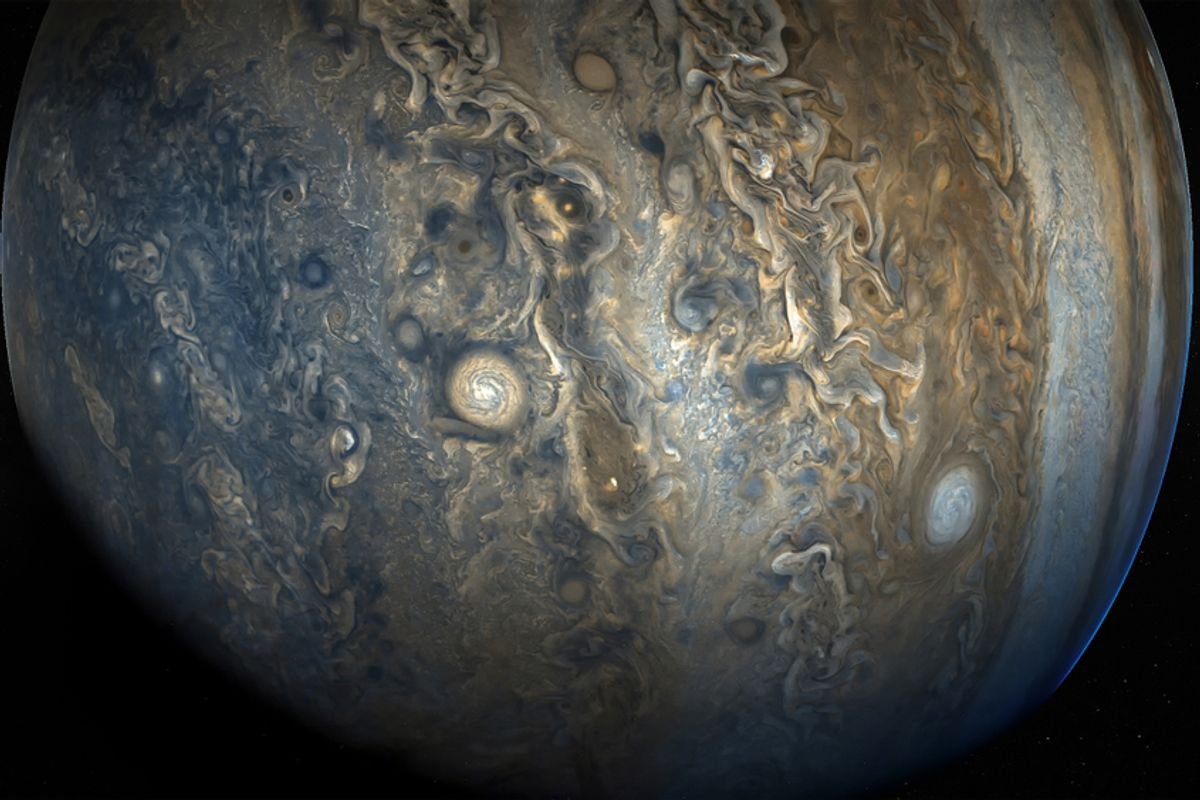
Views of Jupiter consistently capture its atmosphere swirling with wild storms, but there’s more to find beneath this chaotic scene. The clouds enveloping this gas giant are so dense that they conceal its deeper layers, hiding their secrets from view. Fortunately, scientists have figured out a way to see past the murky surface and explore the unseen aspects of Jupiter’s atmosphere.
A new study published in The Planetary Science Journal has unveiled the most extensive model of Jupiter’s atmosphere yet. The model confirms that Jupiter contains about one to one and a half times more oxygen than the Sun, a statistic that might hold clues to the planet’s past.
Jupiter’s Never-Ending Storms
As the largest planet in our solar system, Jupiter has always been a captivating challenge for scientists to study. The planet is often referred to as a gas giant because it’s mainly composed of gases and liquids — its upper atmosphere is around 90 percent hydrogen and 10 percent helium by volume.
Jupiter is perhaps best known for its Great Red Spot, a massive storm on the planet with winds that reach 400 mph. The storm region itself is twice the size of Earth, and it’s likely been around for at least 150 years or more, according to NASA. While the Great Red Spot is the fiercest storm on Jupiter, there are plenty of other storms raging across the planet.
According to Jeehyun Yang, first author of the new study and a postdoctoral researcher at the University of Chicago, Jupiter’s storms likely reflect its deep atmospheric energy budget, which represents the balance of incoming solar energy and outgoing energy emitted by the planet.
Read More: A Rogue Planet the Size of Saturn Detected 10,000 Light-Years From Earth
The Search for Atmospheric Water
Measurements and remote sensing of Jupiter’s upper atmosphere taken by NASA’s Juno spacecraft have shown a handful of ingredients: ammonia, methane, ammonium hydrosulfide, water, carbon monoxide, and others.
Previous models of Jupiter’s deep atmosphere, however, couldn’t come to a consensus on how much water (and, in turn, oxygen) the planet contains, according to a press statement on the new study.
“Understanding a planet’s bulk oxygen inventory is important because it provides insight into planetary formation processes,” says Yang. “For example, it can help address whether a planet preferentially accreted oxygen-rich, carbon-rich, sulfur-rich, or other types of material, and why such compositional differences arise.”
The new study solved this issue by combining chemistry with hydrodynamics to build a comprehensive model of Jupiter’s atmosphere. In doing so, researchers could calculate that Jupiter has about one and a half times more oxygen than the Sun. Still, most oxygen is locked deep within the planet (in the form of water and smaller amounts as carbon monoxide).
Rich in Carbon
Another important finding of the new study is that Jupiter has an elevated planetary carbon-to-oxygen (C/O) ratio of around 2.9. According to Yang, having a C/O ratio greater than 1 is an intriguing trait. This is because “if a planet accretes gas alone, the maximum achievable C/O ratio is 1, assuming the dominant carbon-bearing gas is carbon monoxide, which has a one-to-one carbon to oxygen ratio,” Yang says.
Jupiter’s elevated C/O ratio, therefore, suggests that the planet became enriched in carbon by accreting carbon-rich planetesimals (small, solid bodies that are like planetary building blocks) or ices during its early formation. Planets, after all, don’t just accrete gas as they evolve.
“They can also gravitationally accrete solid material such as ices (H2O, thus lots of oxygen), soot particles […] or dry ice […] allowing them to preferentially acquire specific elements,” says Yang.
There are still several unknowns when it comes to Jupiter’s composition. For example, scientists aren’t sure why the distribution of water is uneven across the atmosphere (the Great Red Spot contains more water than the global average). The new model serves as a crucial step toward answers, but many mysteries still remain unsolved for now.
Read More: What Is the Sun’s Magnetic Field and Why Is It Important?
Article Sources
Our writers at Discovermagazine.com use peer-reviewed studies and high-quality sources for our articles, and our editors review for scientific accuracy and editorial standards. Review the sources used below for this article: