
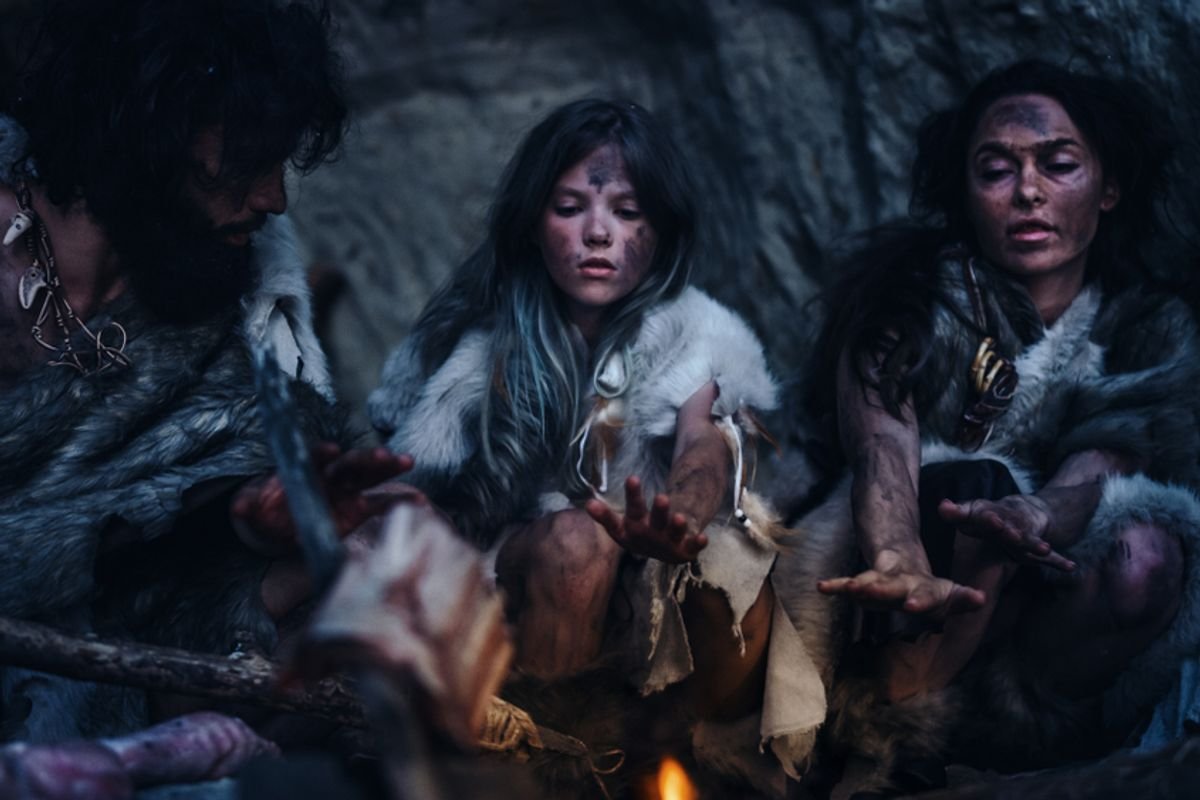
Neanderthals Mated With Modern Human Women — And It Still Shapes Many People’s DNA Today

When Neanderthals and modern humans met tens of thousands of years ago, they left behind a genetic legacy that most people of non-African ancestry still carry today. But a new study published in Science suggests those ancient pairings were not evenly matched.
The research indicates that interbreeding occurred predominantly between male Neanderthals and female modern humans — a sex bias that helps explain why Neanderthal DNA is largely missing from the human X chromosome.
For years, scientists believed those gaps, sometimes called “Neanderthal deserts,” existed because Neanderthal genes on the X chromosome were biologically incompatible and gradually eliminated by natural selection. But new genomic comparisons suggest something more social may have shaped the pattern.
“We found a pattern indicating a sex bias: gene flow occurred predominantly between Neanderthal males and anatomically modern human females,” said Alexander Platt, co-first author of the paper in a press release.
Missing Neanderthal DNA on the X Chromosome
The idea that Neanderthal DNA disappeared from the X chromosome because it was harmful has long been a leading explanation. Since the X chromosome plays an important role in reproduction, researchers suspected that certain Neanderthal variants may have reduced fertility or caused developmental issues, leading natural selection to remove them over time.
“Along our X chromosomes, we have these missing swaths of Neanderthal DNA we call ‘Neanderthal deserts,’” explained Platt. “For years, we just assumed these deserts existed because certain Neanderthal genes were biologically ‘toxic’ to humans.”
That theory carried an implication: if incompatibility were responsible, the same pattern should appear in Neanderthals when they inherited DNA from modern humans. In other words, Neanderthal X chromosomes should also show a depletion of human ancestry.
To find out, the researchers examined the exchange of DNA in the opposite direction.
Read More: New Models Reveal If Neanderthals and Modern Humans Ever Met on the Iberian Peninsula During the Old Stone Age
A Mirror Pattern in Neanderthal Genomes
Instead of focusing only on Neanderthal ancestry in modern humans, the team analyzed modern human DNA preserved in three Neanderthal genomes — Altai, Chagyrskaya, and Vindija. They compared those sequences with genetic data from sub-Saharan African populations that lack Neanderthal ancestry, allowing them to trace ancient gene flow more precisely.
The results pointed in the opposite direction of what incompatibility would predict.
Neanderthals showed a 62 percent relative excess of modern human ancestry on their X chromosomes compared with the rest of their genome. While modern humans display a deficit of Neanderthal DNA on the X chromosome, Neanderthals show an enrichment of human DNA there.
If reproductive incompatibility were the main explanation, scientists would expect to see a similar depletion of human DNA on Neanderthal X chromosomes. Instead, the pattern runs the other way.
That mirror-image result suggests that biological incompatibility alone cannot explain the genetic imbalance.
How Mating Direction Shaped Human Evolution
The explanation may lie in how X chromosomes are inherited. Females carry two X chromosomes, while males carry one. Because of this difference, the direction of interbreeding matters. If most pairings involved male Neanderthals and female modern humans, fewer Neanderthal X chromosomes would have entered the human gene pool to begin with. Meanwhile, human X chromosomes would have flowed more readily into Neanderthal populations.
Mathematical models showed that this kind of sex-biased interbreeding could recreate the genetic patterns observed today. Other factors, such as differences in migration between males and females, could have contributed, but they require more complex demographic scenarios.
“Mating preferences provided the simplest explanation,” Platt stated in the release.
Rather than reflecting only biological barriers, the structure of our genomes may preserve traces of ancient social behavior. Tens of thousands of years later, patterns of who paired with whom remain written into the human X chromosome.
Read More: Neanderthal Families Took Trips to the Beaches of Portugal Around 80,000 Years Ago
Article Sources
Our writers at Discovermagazine.com use peer-reviewed studies and high-quality sources for our articles, and our editors review for scientific accuracy and editorial standards. Review the sources used below for this article: