
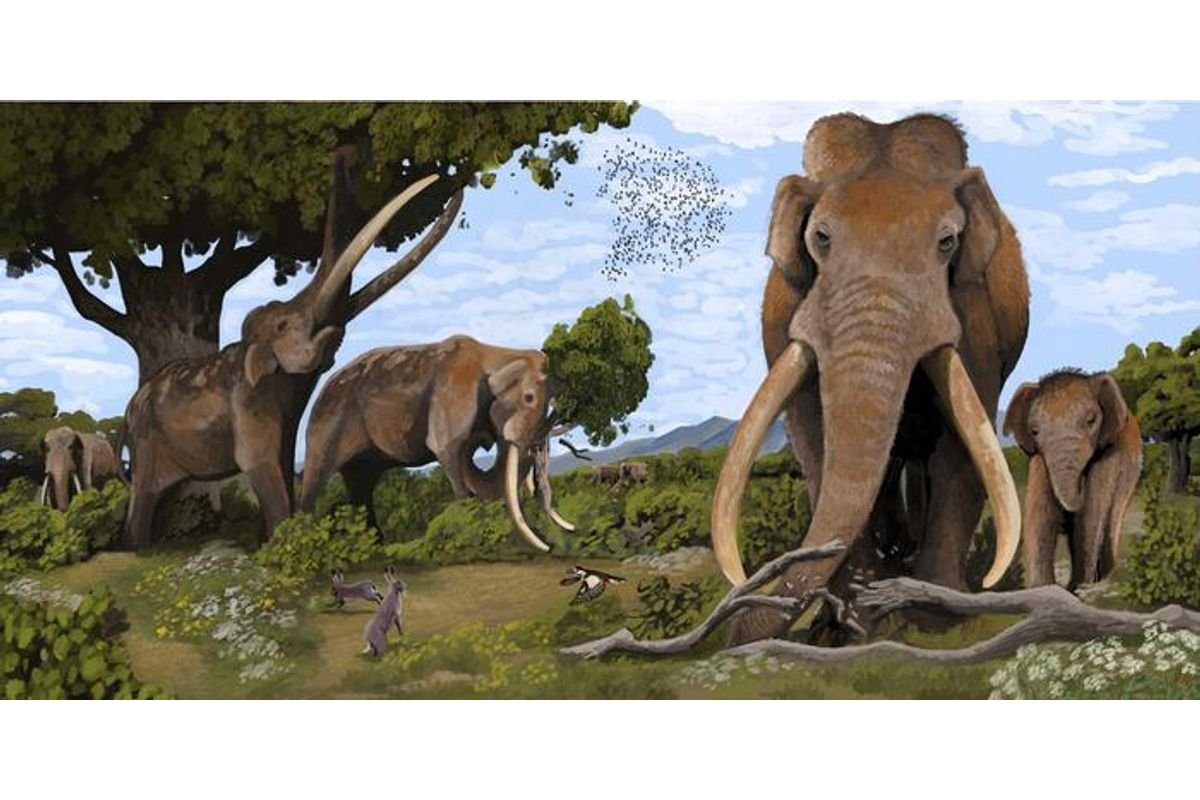
Neanderthals Hunted Straight-Tusked Elephants as They Traveled Across Europe 125,000 Years Ago

About 125,000 years ago, the site of Neumark-Nord was a vibrant lakeshore that provided resources for Neanderthals. Today, however, it is a notable excavation site in northern Germany that has offered an array of fossilized evidence from the last interglacial period, including the remains of over 70 straight-tusked elephants.
During this time, Neanderthals actively hunted these elephants for food and tools. Thanks to the plethora of fossil evidence at the Neumark-Nord site, researchers are gaining a better understanding of what life was like on this lakeshore.
A new study, published in Science Advances, examines teeth from four of the elephants from this excavation site and reveals what the relationship between these animals and some of our early human ancestors was like.
“What we see at Neumark-Nord is not a picture of mere survival, but of a population that understood its environment and interacted with it actively and in complex ways over a period of at least 2,500 years,” said study author Sabine Gaudzinski-Windheuser, professor of prehistoric and protohistoric archeology at JGU and head of the institute at MONREPOS, in a press release.
Read More: This Elephant Lived in Europe for 700,000 Years — Could It Live There Today?
Analyzing Straight-Tusked Elephant Teeth
Using an innovative method that combines isotopic and protein analyses, an international research team examined the fossilized teeth of four elephants found at Neumark-Nord. The analysis reviewed traces of carbon, oxygen, and strontium, along with palaeoproteomics (proteins).
From the results, the team determined the elephant’s diet, sex, and migration patterns. The strontium isotope showed that the elephants traveled to different regions of Europe over several years.
“Thanks to isotope analyses, we can trace the movements of elephants almost as if we had a travel diary that has been preserved in their teeth for more than one hundred thousand years,” said Elena Armaroli, a postdoctoral researcher at the University of Modena and Reggio Emilia (UNIMORE) in Italy and the study’s first author, said in a press release.
How Far Straight-Tusked Elephants Roamed
From the analysis, the research team determined that three of the four elephants were male and one was female. Of the three males, two had isotopes that differed from those at the excavation site, leading the team to believe that they likely ranged over a much larger territory than the female elephant, similar to behaviors seen in modern-day elephant species.
“Some of the elephants we studied were animals that did not stay in just one area,” said Federico Lugli, associate professor at UNIMORE and corresponding author of the study, in a press release.
“Their teeth show that they traveled very long distances — up to 300 kilometers — before reaching what is now Neumark-Nord. This allows us to reconstruct their home ranges and understand how these animals used the landscape,” Lugli added.
An Ideal Gathering Place
Other evidence found at Neumark-Nord indicates that Neanderthals utilized the area for its many resources, including water and plant goods such as acorns and hazelnuts, according to the press release. The study authors even call out an area in which Neanderthals likely butchered and cleaned animals for consumption. They may have even collected fat from larger mammals.
If the Neanderthals that lived in this region knew it well, then it’s possible they knew that every so often, straight-tusked elephant populations migrated to Neumark-Nord, the analysis revealed. This could mean that the elephants weren’t always readily available as a food source, so hunting one would take cooperation.
“The concentration of remains and the isotope profile of the animals suggest that Neanderthals did not kill the elephants merely when a favorable opportunity arose. Everything points to organized hunting in which even such enormous prey animals could be deliberately targeted. For this, Neanderthals must have known the landscape well, cooperated, and planned,” Armaroli said.
While the research team revealed more of what life was like at Neumark-Nord back then, there is still more that this analysis could not reveal. The team is continuing their research with a genetic study on the elephants found at the site. Perhaps it will shed more light on how these two ancient species interacted.
Read More: Neanderthals Hunted and Ate Straight-Tusked Elephants
Article Sources
Our writers at Discovermagazine.com use peer-reviewed studies and high-quality sources for our articles, and our editors review for scientific accuracy and editorial standards. Review the sources used below for this article: