
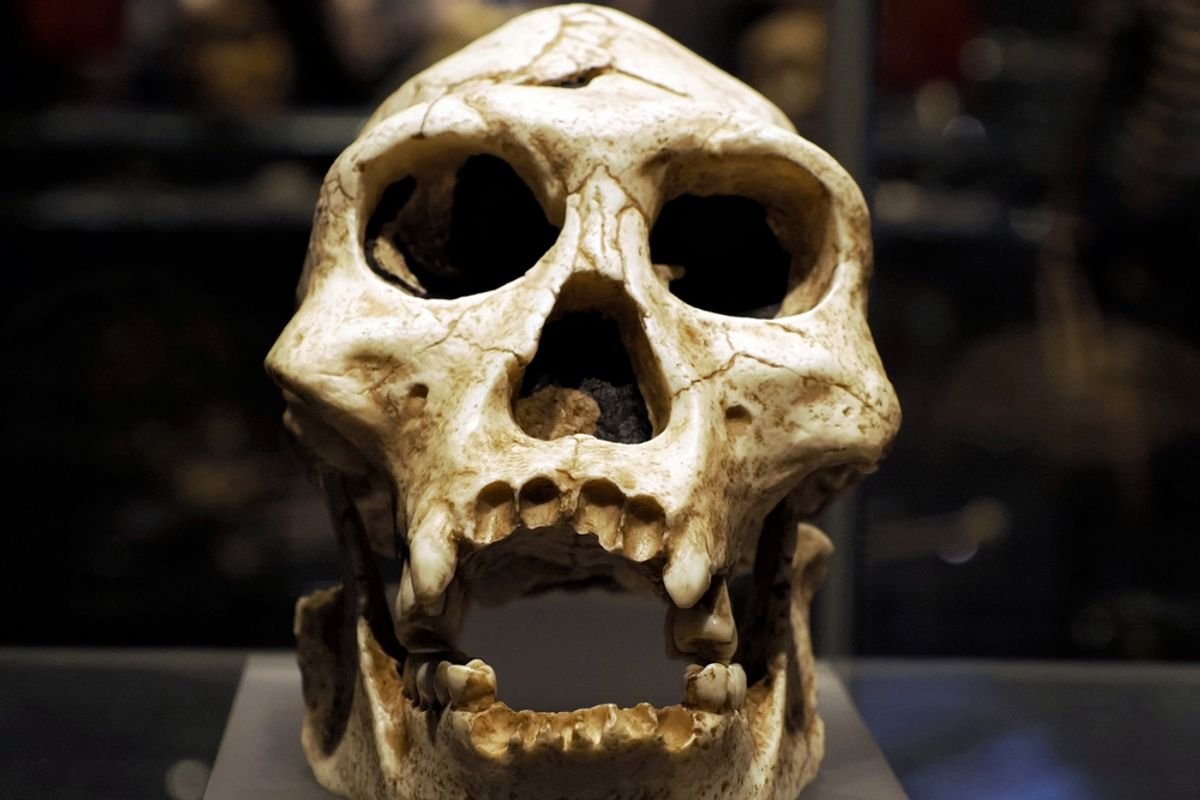
Neanderthals Boasted Larger Jaws Than Humans Due to a Tiny Difference in DNA

Whenever people think of Neanderthals, they probably picture a caveman in dire need of a haircut. However, there’s more to the quintessential Neanderthal look, especially in their faces.
Features like sizable noses, protruding brow ridges, and strong lower jaws gave them a distinct appearance. But since the Neanderthal genome is 99.7 percent identical to the human genome, how were their faces so different from ours?
A new study published in the journal Development has cracked part of the code for Neanderthal faces by examining their genome. While the Neanderthal and human genomes overlap in many places, a tiny sliver of Neanderthal DNA plays a special role in the growth of their large lower jaws. This key difference now explains at least one reason why Neanderthal faces stand apart from our own.
Read More: How Much Neanderthal DNA do Humans Have?
Unlocking the Neanderthal Genome
In 2010, the first draft of the Neanderthal genome was sequenced using 21 ancient bones from Vindija Cave in Croatia. This breakthrough opened up new possibilities in the field of evolutionary genetics, allowing scientists to compare Neanderthal genes with human genes. It also finally confirmed that many humans possess Neanderthal genetic ancestry due to interbreeding between the two groups around 50,500 to 43,500 years ago.
Both the Neanderthal and human genomes are made up of roughly 3 billion letters (or bases) of DNA. The order of these letters specifies which amino acids will be implemented in a protein structure, and it also dictates how certain genes are activated.
The researchers involved with the new study aimed to locate the specific part of the Neanderthal genome that affects their jaw size. Sifting through 3 billion letters, though, is like trying to find a needle in a haystack, as described in a press release on the study. Luckily, the researchers had a plan to make their search much less strenuous.
A Special Sequence
To tackle the challenge of finding the right section of the Neanderthal genome, the researchers looked to a specific region related to the Pierre Robin sequence, a rare birth defect that causes the lower jaw of individuals to be disproportionately small.
“Some individuals with Pierre Robin sequence have large deletions or DNA rearrangements in this part of the genome that change face development and limit jaw formation. We predicted that smaller differences in the DNA might have more subtle effects on face shape,” said author Hannah Long, a geneticist at the University of Edinburgh.
They found that the Neanderthal and human versions of this genome region, only around 3,000 letters in length, had just three single-letter differences. There are no genes present in this region, but it does regulate how and when a specific gene called SOX9 — involved in the process of face development — activates.
A Colorful Look at Neanderthal Genes
The researchers set their sights on the unique Neanderthal letters and their influence during development in the embryo. They inserted Neanderthal and human versions of the region into the DNA of zebrafish — which have transparent, easily observable embryos — and programmed the zebrafish cells to produce different colors of fluorescent protein based on which version was active.
As they watched the zebrafish embryos develop, the researchers noticed that both the human and Neanderthal regions were active in cells associated with lower jaw formation, with the Neanderthal region being much more active.
“It was very exciting when we first observed activity in the developing zebrafish face in a specific cell population close to the developing jaw, and even more so when we observed that the Neanderthal-specific differences could change its activity in development,” said Long.
The researchers also placed extra SOX9 genes inside the embryos to see if the increased activity in the Neanderthal region would change the shape and function of the adult jaw. In doing so, they ultimately found that the cells related to jaw development occupied a larger area.
Now that the researchers have pinpointed the reason that Neanderthals have larger lower jaws, they’re considering how various parts of the genome are related to other facial features.
Read More: Neanderthal vs Homo Sapiens: How Are Neanderthals Different From Humans?
Article Sources
Our writers at Discovermagazine.com use peer-reviewed studies and high-quality sources for our articles, and our editors review for scientific accuracy and editorial standards. Review the sources used below for this article: