
Mysterious Metallic Cloud Triggered the Strange Dimming of a Distant Star

In September 2024, astronomers noticed something peculiar. A star not too dissimilar to our sun suddenly lost its brightness, appearing 40 times dimmer than normal. There was no obvious explanation.
“Stars like the sun don’t just stop shining for no reason,” Nadia Zakamska, professor of astrophysics at Johns Hopkins University, said in a statement. Adding, “dramatic dimming events like this are very rare.”
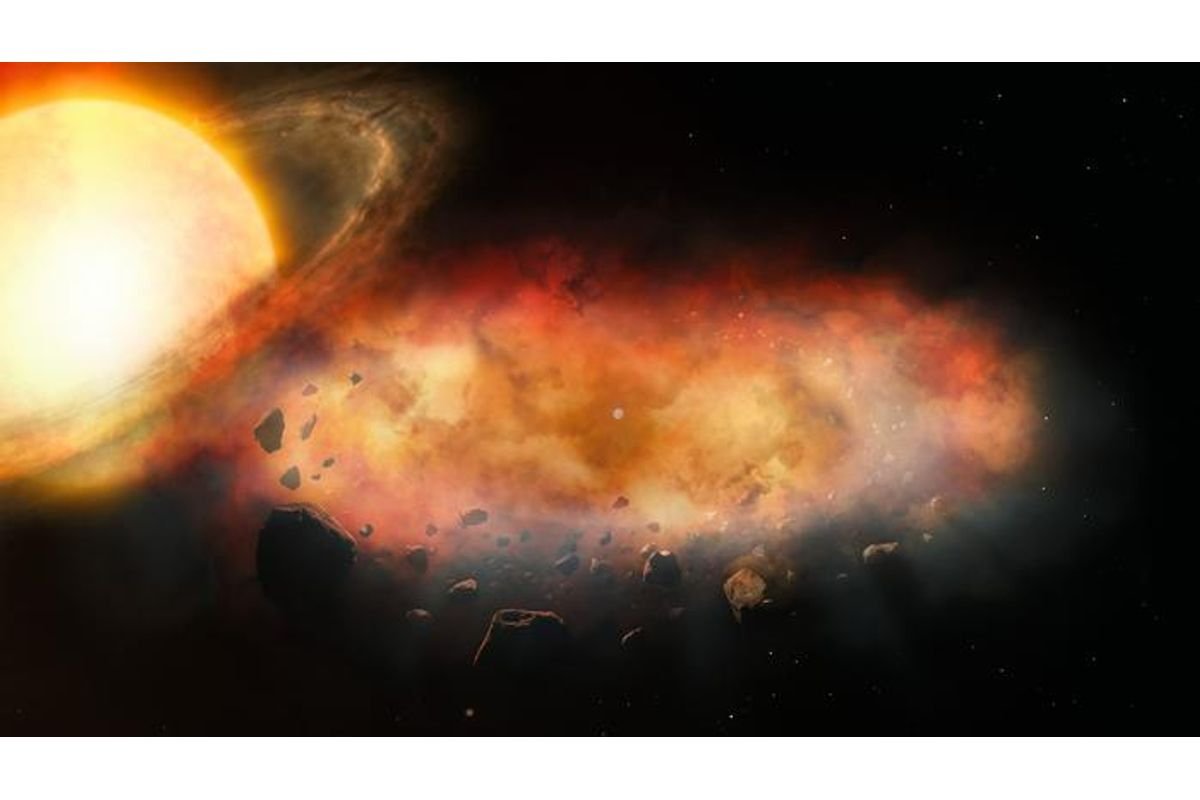
If that is the case, what was behind this strange occurrence? New research published in The Astronomical Journal points the finger at an extraordinarily large cloud of gas, dust, and metallic particles. According to researchers, this giant body of metallic winds passed by the star J0705+0612 — an event that temporarily concealed it from view, causing it to appear significantly darker for 8.5 months.
Read More: The Universe’s Mysterious Little Red Dots Are Young Black Holes
A Massive Cloud with Metallic Winds and an Observing Ghost
In a new paper, Zakamska and team have determined the size and composition of the cloud. The researchers have also calculated its distance from its host star (J0705+0612), which lies 3,000 light-years from Earth. This information was obtained via observations collected by the Gemini South telescope, the Apache Point Observatory, and Magellan Telescopes, plus historical data on J0705+0612.
According to the team’s estimates, the cloud sits in the outer stretches of the planetary system, some 1.3 billion miles (14 astronomical units, or au) from J0705+0612. It has a radius of approximately 65.1 million miles (0.7 au).
The cloud contains winds composed of dust and vaporized metals (elements heavier than helium), including calcium. Researchers were able to work this out using the Gemini High-resolution Optical SpecTrograph (GHOST) instrument, a highly sophisticated spectrograph that uses wavelengths to determine the presence of various chemical elements.
“The sensitivity of GHOST allowed us to not only detect the gas in this cloud but to actually measure how it is moving,” said Zakamska. “That’s something we’ve never been able to do before in a system like this.”
Rather than orbiting the star itself, the cloud appears to be linked to an additional object that orbits J0705+0612 — a planet or brown dwarf, or even a low-mass star that is strong enough to prevent the cloud from dispersing. For this, it needs a mass at least a few times that of Jupiter.
Whatever the mystery object turns out to be, the fact that the cloud orbits a secondary object, and not the host star, is notable and incredibly rare in itself, according to researchers.
Where Exactly Did This Disk Come From?
It might be assumed that the disk comprises remnants from the planet system’s formation period. However, it shows an infrared excess, a feature more often seen in the disks of young stars, not in mature ones like J0705+0612, which is thought to be more than two billion years old.
A more likely explanation is that it was created during a collision between two planets in the outer stretches of the star’s planetary system. The impact would have caused mass ejections of dust, rock, and other detritus, which are now thought to form the basis of the cloud.
“It’s a vivid reminder that the universe is far from static — it’s an ongoing story of creation, destruction, and transformation,” said Zakamska.
Regularly Occurring Eclipses
A deep dive into archival data reveals it’s not the first time J0705+0612 has experienced a dimming event. There are two more on record — one in 1937 and one in 1981, putting the 2024 dimming event near enough on schedule.
This suggests an eclipse period of 16,000+/- 2 days, or 43.8 years. The eclipse itself lasts about 8 months.
Read More: Violent Space Rock Smashups Caused a Dusty Wreck in a Nearby Planetary System
Article Sources
Our writers at Discovermagazine.com use peer-reviewed studies and high-quality sources for our articles, and our editors review for scientific accuracy and editorial standards. Review the sources used below for this article: