
Mysterious, Ghostly Blue Lights Called Will-o-the-Wisp May Just be Methane Bubbles

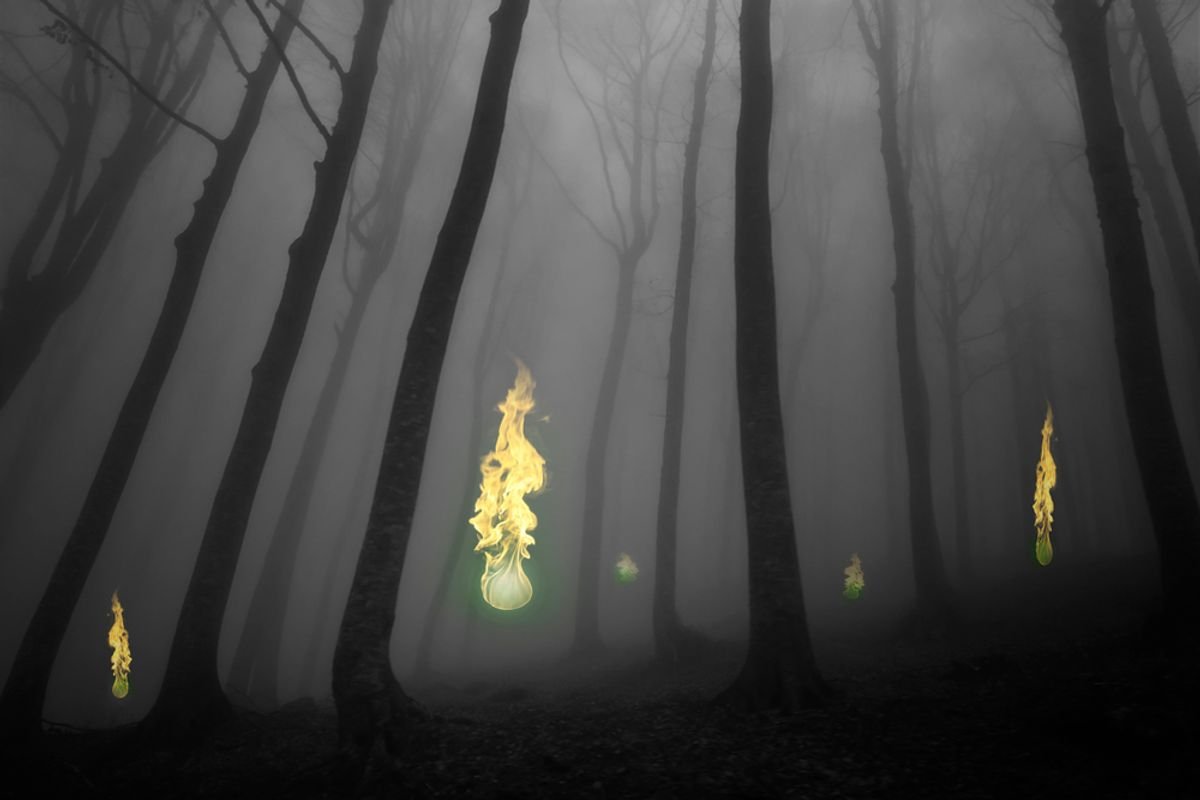
For centuries, will-o’-the-wisp has puzzled scientists and travelers alike. According to folklore, it is the product of faeries, demons, and spirits. More recently, scientists have attributed will-o’-the-wisp, otherwise known as ignis fatuus, meaning “foolish flame” in Latin, to more earthly origins. However, questions remain over how exactly these ghostly blue lights intermittently occur.
Now, researchers writing in the Proceedings of the National Academy of Sciences (PNAS) have proffered a more evidence-based solution to this age-old conundrum – methane bubbles spontaneously igniting in a process called microlightning.
Flaming Blue Will-O’-The-Wisp or Methane Bubbles?
While previous generations may have turned to supernatural explanations, there is now a strong consensus within the scientific community that links the flickering blue light to methane released by organic matter as it decays. It is thought that the methane ignites when it interacts with oxygen in the air, producing a “cool flame.”
However, it is not fully understood how exactly the methane ignites in the first place, as the energy required to trigger this process is too high an amount to occur naturally. Previous attempts to explain this have looked to phosphine or static electricity, but these remain unproven.
Instead, the researchers, writing in PNAS, looked to a phenomenon investigated in an earlier study (published in Science Advances), which shows that tiny water droplets can accrue charge that is then released spontaneously — a process known as microlightning.
“Microlightning between methane microbubbles offers a natural ignition mechanism for methane oxidation under ambient conditions,” the researchers explained in the PNAS study.
“This discovery supports a long-suspected link between electrified interfaces and spontaneous cool flames, and it provides a physically grounded explanation for the occurrence of ignis fatuus,” the study authors continued.
Read More: Early Accounts of Whales and Manatees May Have Inspired Mermaid Folklore
Methane Microbubble Makers
To test the hypothesis, the researchers constructed a microbubble generator that generated methane-air bubbles and blasted them into a pot of water. Using high-speed imaging, the team observed “brief, localized flashes” lasting less than a millisecond, which they explain are “consistent with electrical discharges.”
The reason the microbubbles were able to accumulate charge is thanks to the curved boundary that exists between the gas and the liquid — the greater the curve, the greater the electric field at the boundary or “interface.” A discharge occurs when two microbubbles with opposite charges approach one another, which, in turn, can cause the gas to ignite a “cool flame” (the faint blue luminescence characteristic of will-o’-the-wisp).
“These discharges initiate nonthermal oxidation of methane, producing luminescence and measurable heat under ambient conditions,” the researchers explained in the study.
The team tested the reaction of regular old air bubbles and found that they, too, trigger flashes.
This, they say, suggests that the reaction is the result of interactions between two oppositely charged particles and is not due to the gas itself, although methane did appear to enhance the intensity of the reactions and increase the frequency.
According to the researchers, these results could be the missing piece of the puzzle and help explain how methane in marshlands and wetlands is able to produce blue luminescence spontaneously.
“For centuries, faint blue flames known as ignis fatuus or will-o’-the-wisps have danced above marshes, cemeteries, and wetlands,” they explained in the study.
Adding: “Our findings offer a scientific basis for ignis fatuus and reveal a general mechanism by which electrified interfaces can drive redox reactions in natural environments without the need for external ignition sources.”
Other Explanations for Will-o’-the-Wisp
But this is not the only explanation recently put forward. Researchers writing in the peer-reviewed Brazilian journal Quim Nova argue that will-o’-the-wisp may be “extinct,” pointing to the fact that there have few, if any, reliable sightings in modern times.
Instead, the paper states, old-fashioned torches carried by travellers could have acted as a source of ignition and “the abandonment of fire in favor of night lightning may hold the secret to this mystery of ignis fatuus’s extinction.”
Read More: Old Wives’ Tales to Predict Weather: What’s Based in Science and What’s Just Folklore?
Article Sources
Our writers at Discovermagazine.com use peer-reviewed studies and high-quality sources for our articles, and our editors review for scientific accuracy and editorial standards. Review the sources used below for this article: