
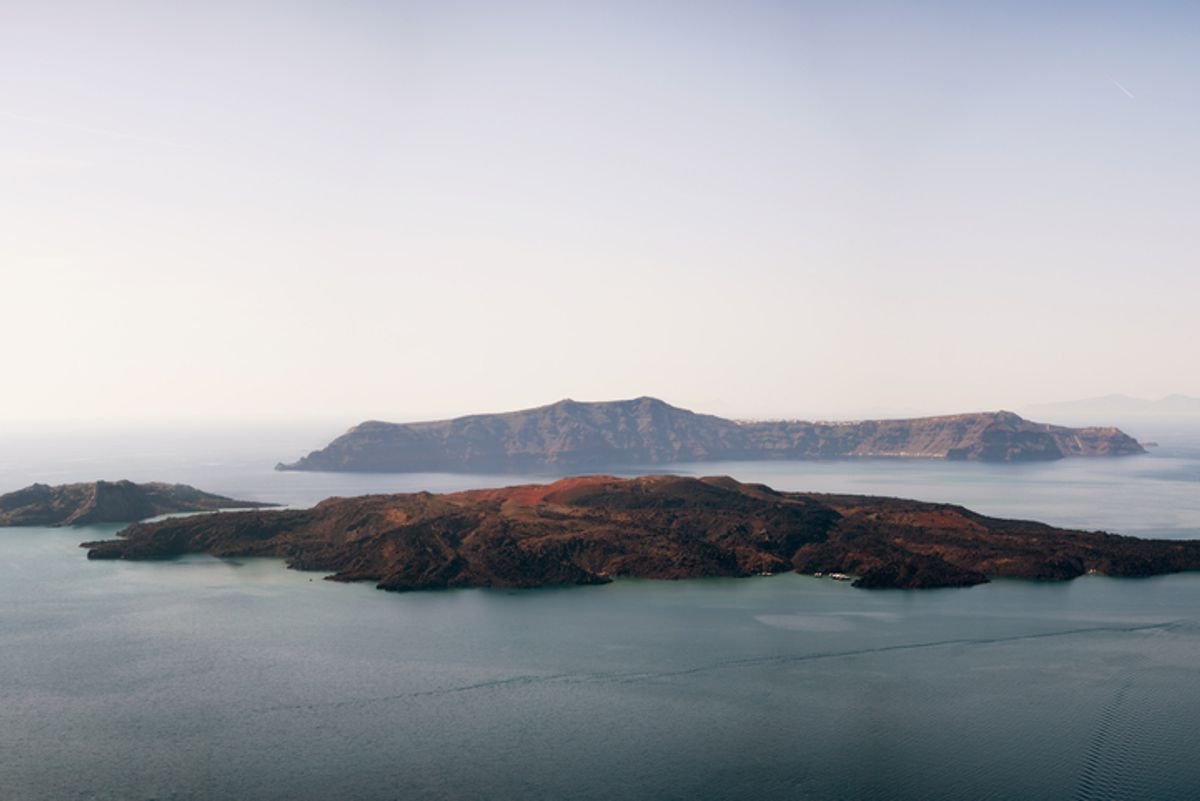
Moving Magma Under Santorini Lifted the Island and Caused Thousands of Earthquakes

In early 2025, the Greek island of Santorini was in the news due to the presence of massive earthquakes. The island was plagued with over 28,000 earthquakes in the span of weeks, with some reaching a magnitude of more than 5.0. These earthquake swarms were particularly concerning to residents and scientists alike because their origin was unknown. Were they caused by tectonic shifts or volcanic activity?
A new study, published in Nature, finally has the answer. Thanks to the use of sensors with the assistance of a new AI model, researchers were able to complete a geological analysis of the earthquakes and found that the seismic event was the fault of nearby volcanoes and their moving magma.
“Through close international cooperation and the combination of various geophysical methods, we were able to follow the development of the seismic crisis in near real time and even learn something about the interaction between two volcanoes,” said Jens Karstens, marine geophysicist at GEOMAR, in a press release. “This will help us improve the monitoring of both volcanoes in the future.”
Read More: Tiny Bubbles Within Magma Reveal Secrets of Volcano Eruptions
What Caused the Santorini Earthquakes?
Santorini is part of the Hellenic volcanic arc, an area that often sees a high level of geological activity. Along with sitting on top of multiple fault zones, the island is also in close proximity to Kolumbo, an active underwater volcano.
Although the main event occurred in 2025, the pieces were already being put into place in July of 2024. At this time, magma travelled upwards and settled in a shallow reservoir beneath Santorini. This resulted in Santorini being lifted a few inches higher than it normally sits.
A few inches may not seem like a lot — and it definitely wouldn’t have been noticeable to those living there — but it was enough to begin a chain reaction of magma flow that would result in the 2025 earthquakes. As magma continued to rise and shift underneath the island, the seismic events in the area became more frequent and more intense.
“The seismic activity was typical of magma ascending through the Earth’s crust. The migrating magma breaks the rock and forms pathways, which causes intense earthquake activity,” said Marius Isken, a geophysicist at the GFZ Helmholtz Centre of Geosciences, in the press release.
As the magma eventually moved out of the reservoir, Santorini settled back down to its usual place, and the earthquakes subsided.
Volcanoes Fueled a Hidden Hydraulic System
The subtle rise and fall of Santorini observed by the research team revealed a previously undiscovered hydraulic connection between the island and its neighboring volcanoes.
This discovery was made possible thanks to the innovative combination of techniques and analysis used by scientists to understand the Santorini seismic event. Researchers combined information from earthquake monitoring stations and underwater sensors placed near Kolumbo, as well as a newly developed AI model created to help with locating earthquakes.
By using all of these methods, the team was able to map and reconstruct what was happening deep underground in real time and with precise detail. What was revealed was that, during the Santorini earthquakes, around 300 million cubic meters of magma rose from deep within the Earth’s crust and settled about 4,000 meters (about 13,000 feet) beneath the ocean floor.
Researchers hope to continue to use these cutting-edge monitoring methods to understand more about earthquakes and the relationship between Santorini and its volcanic landscape.
Read More: Mounting Pressure in the Tintina Fault Could Mean Dangerous Earthquakes
Article Sources
Our writers at Discovermagazine.com use peer-reviewed studies and high-quality sources for our articles, and our editors review for scientific accuracy and editorial standards. Review the sources used below for this article: