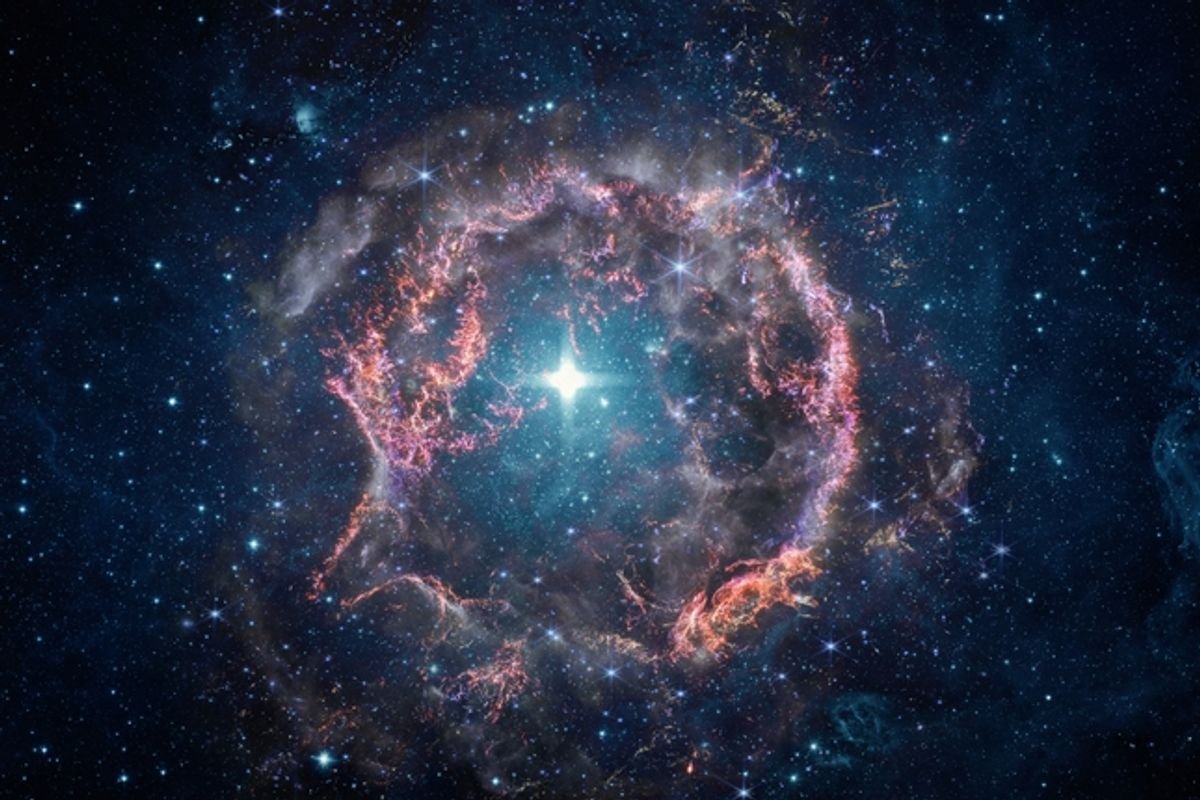
What is the most pristine star in the known universe? Researchers using the Sloan Digital Sky Survey-V (SDSS-V) data and observations on the Magellan telescopes at Carnegie Science’s Las Campanas Observatory in Chile may have just spotted it.
Publishing their findings in Nature Astronomy, the research team, including Alexander Ji from the University of Chicago and Juna Kollmeier, a Carnegie astrophysicist, reviewed data from SDSS second generation (now in its fifth generation) and believe the most pristine star is SDSS J0715-7334. It lies about 80,000 light-years from Earth and may have been pulled into the Milky Way over time. The team notes that the star likely formed a few billion years after the birth of the universe.
“These pristine stars are windows into the dawn of stars and galaxies in the universe,” Ji said in a press release.
Red giant SDSS J0915-7334.
(Image Credit: Navid Marvi/Carnegie Science)
What are Pristine Stars?
It is a common theory that after the Big Bang, the universe was composed of hot, soupy particles that eventually expanded and cooled. During this time, patches of neutral hydrogen gas formed. Some of these patches grew heavy and dense, eventually causing the material to collapse in on itself over hundreds of millions of years due to the gases’ gravity. These dense patches would go on to form the first stars, composed of pristine hydrogen and helium, according to the study.
The authors note that these stars likely burned hot and fast, dying young. However, before they died, the stars likely produced new elements and propelled them into the vastness of space, creating new stars that contained many of those elements.
“All of the heavier elements in the universe, which astronomers call metals, were produced by stellar processes — from fusion reactions occurring within stars to supernovae explosions to collisions between very dense stars,” said Ji in the press release. “So, finding a star with very little metal content in it told this group of students that they’d come across something very special.”
Read More: 87 Newly Detected Stellar Streams Map the Milky Way — And Could Illuminate Dark Matter
Why Finding Pristine Stars Is Important
Researchers look for these ancient stars, especially from the second and third generations, because they help reveal more information about how the universe first began and developed its structure.
“We have to look in our cosmic backyard to find these objects, because we can’t yet observe individual stars at the dawn of star formation. Since these stars are rare, surveys like SDSS-V are designed to have the statistical power to find these needles in the stellar haystack and test our theories of star formation and explosion,” Kollmeier said in the press release.
Identifying Pristine Stars
Data collected from SDSS’s five generations has already provided a wealth of information, including millions of optical and infrared spectra across the sky. From this data, Ji and team have identified stars with very few heavy elements.
Once identified, the team then used the Magellan telescope at Carnegie Science’s Las Campanas Observatory (Las Campanas) to capture high-resolution spectra of the stars. The results indicated that SDSS J0715-7334 was the most pristine.
“The ecosystem of telescopes at Las Campanas was critical to nearly every aspect of this breakthrough work, from the du Pont data collected as part of SDSS-V’s Milky Way mapping efforts to the Magellan observations that showed exactly how special SDSS J0715-7334 really is,” said Michael Blanton, director and Crawford H. Greenewalt Chair of the Carnegie Science Observatories, in the press release.
As Ji and the team gather more information about these stars using advanced equipment and data from Las Campanas and SDSS, he hopes to inspire the next generation of astronomers to look up at the heavens.
“Training the next generation of astronomers is critical to the future of our field. And building excitement about the practice of science by undertaking projects like this is a great way to ensure that curious-minded young learners can see themselves in astrophysics,” Ji concluded in the press release.
Read More: Mysterious Metallic Cloud Triggered the Strange Dimming of a Distant Star
Article Sources
Our writers at Discovermagazine.com use peer-reviewed studies and high-quality sources for our articles, and our editors review for scientific accuracy and editorial standards. Review the sources used below for this article: