
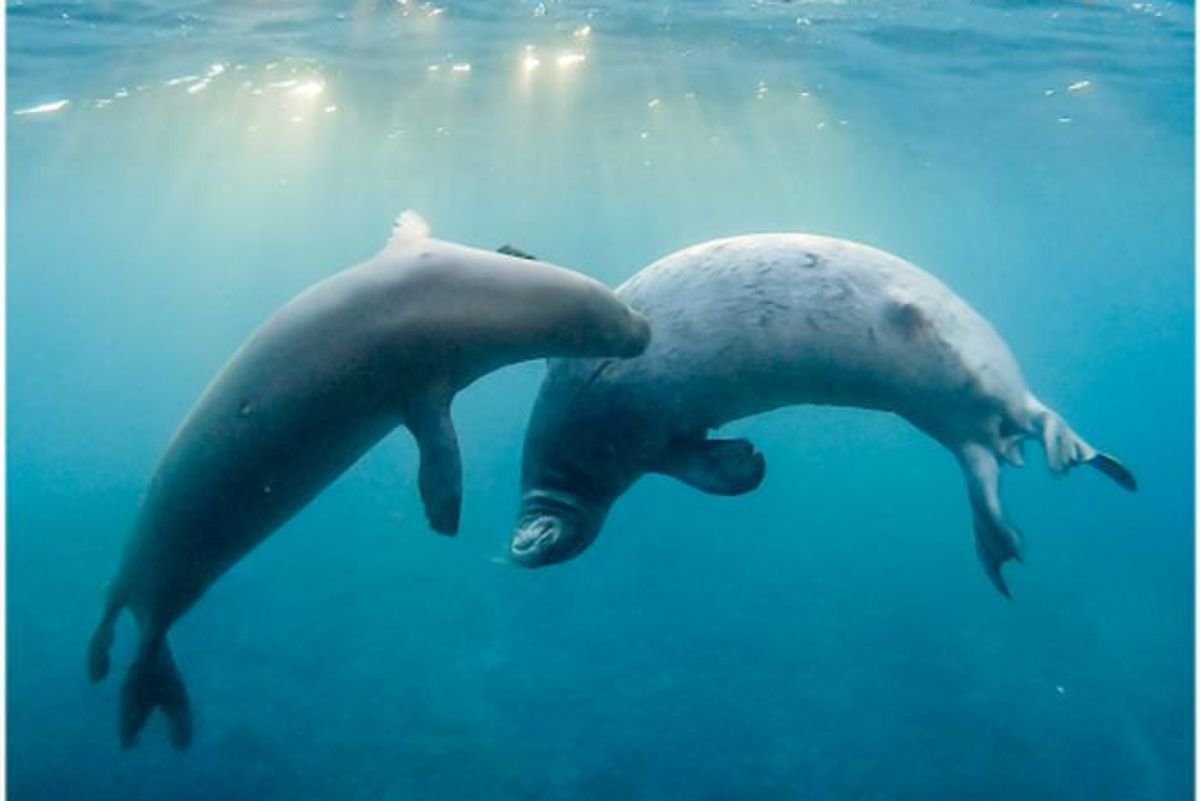
Monk Seals May Be Stringing Sounds Together Like Sentences

Despite their tranquil appearance, Hawaiian monk seals have plenty to say underwater. A new study published in Royal Society Open Science found that the endangered mammals produce 25 distinct underwater calls — 20 never heard before — and link their sounds into sequences, a communication strategy unseen in any other seal species.
Researchers also discovered a new foraging call used while hunting, suggesting the seals use sound not only to socialize but to survive. The study sheds light on a soundscape that has remained unheard until now.
“We discovered that Hawaiian monk seals — one of the world’s most endangered marine mammals — are far more vocal underwater than previously known,” said Kirby Parnell, lead author of the study, in a press release. “By analyzing over 4,500 hours of recordings from across the Hawaiian Archipelago, we identified more than 23,000 vocalizations representing at least 25 distinct call types.”
Read More: Orcas Imitate Human Speech as a Way to Communicate With Us
Endangered Hawaiian Monk Seals Rely on Sound
The Hawaiian monk seal (Neomonachus schauinslandi) is Hawai‘i’s only native marine mammal and one of the rarest seals on Earth. Fewer than 1,600 remain in the wild, making every new discovery about their behavior critical for conservation.
“This research provides the first comprehensive description of free-ranging Hawaiian monk seal underwater sound production, an important step toward understanding how they use sound for critical life-history events,” said Lars Bejder, co-author of the study, in the press release.
“Because their vocalizations overlap with the same low-frequency range as many human-generated sounds (e.g., vessel noise), this work also helps us evaluate how ocean noise may affect communication, reproduction, and behavior in this endangered species,” Bejder continued.
Using Passive Acoustic Recorders to Decode Seal Communication
Researchers placed passive acoustic recorders at five key habitats, spanning from Moloka‘i to the remote Northwestern Hawaiian Islands, to capture the full range of monk seal sounds. Over thousands of hours of recordings, the team identified 25 call types, six times as many as previously known for seals in human care.
In addition to the astonishing number of calls, the recordings revealed that monk seals can link sounds in sequence, forming what the researchers describe as combinational calls — a level of vocal complexity not previously documented in any seal species.
They also detected a new, high-pitched sound, nicknamed the Whine, produced while foraging, suggesting that monk seals may use vocalizations not just for mating or socializing, but also for hunting. This marks the second time any seal species has been recorded vocalizing while in pursuit of prey.
“We were surprised by the sheer diversity and complexity of monk seal vocalizations,” said Parnell. “The discovery of combinational calls, where seals link multiple call types together, suggests a previously unknown level of complexity in pinniped acoustic communication. Finding a new call type — the Whine — associated with foraging behavior was also unexpected and suggests that monk seals may use sound not only for mating or socializing, but possibly for foraging purposes as well.”
Listening In Could Help Protect Hawai‘i’s Seals
The new findings give scientists a baseline for understanding how monk seals use sound in the wild, and how human noise might interfere with it. By using passive acoustic monitoring, researchers can now track these elusive seals across the Hawaiian Islands without disturbing them, identifying where and when they’re most active.
Next, the team plans to connect specific calls to behaviors like foraging, breeding, and social interactions, and to develop automated systems that can detect their vocalizations in real time.
Read More: Could Translating Whale Songs Help Us Find Aliens?
Article Sources
Our writers at Discovermagazine.com use peer-reviewed studies and high-quality sources for our articles, and our editors review for scientific accuracy and editorial standards. Review the sources used below for this article: