
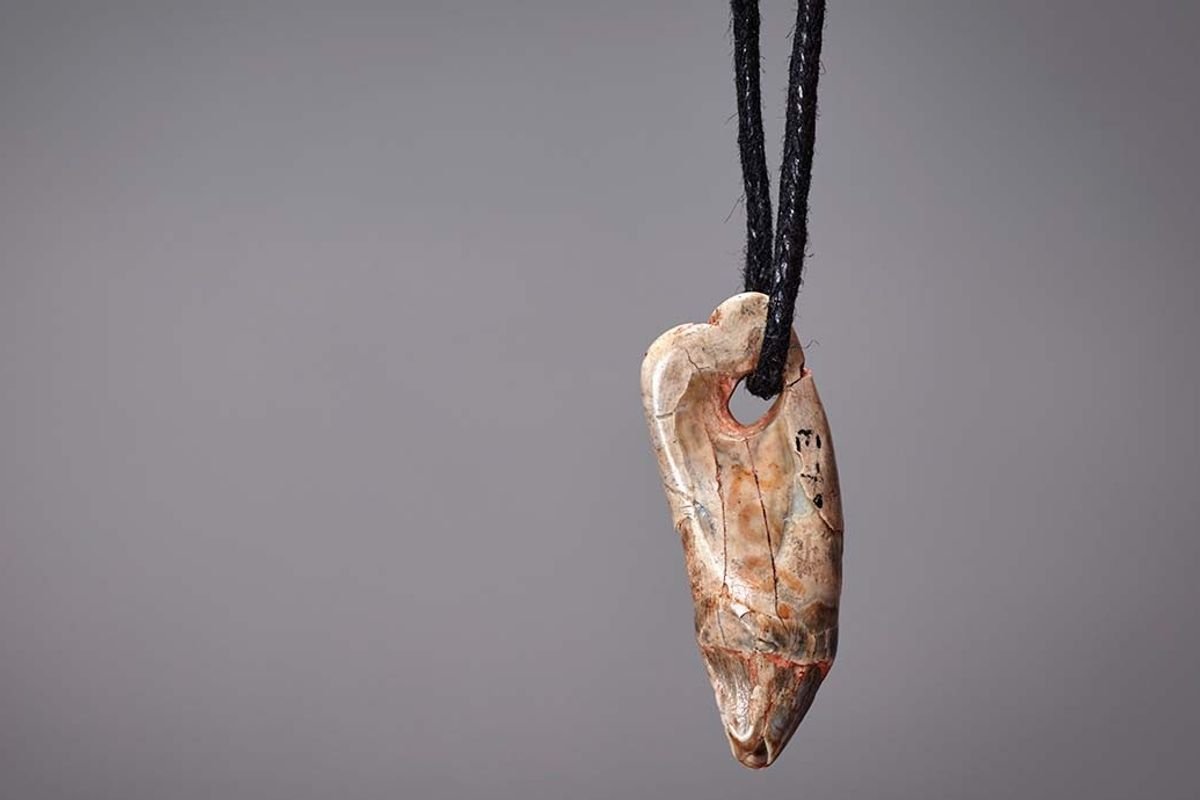
Modern Humans Made Seal Tooth Pendants Around 15,000 Years Ago, Hinting at Complex Culture
When the archaeologists who excavated Kents Cavern in Devon, England, began digging back in 1865, they decided to do things a bit differently. Documenting the depth and location of the artifacts that they unearthed (a relatively radical approach at the time), the team ensured that their discoveries would be studied for centuries to come.
Now, around 160 years after the start of those excavations, a new study in Quaternary Science Reviews has analyzed an artifact from the site: a long-overlooked seal tooth pendant that, according to the study authors, offers important insights into the human inhabitants of Britain from the Upper Paleolithic around 15,000 years ago, not to mention their art, travel, and trade.
“This pendant dates to a time when there was a flourishing of engraving and other artistic [behavior] in Europe,” said Silvia Bello, a study author and a researcher at the Natural History Museum in London, according to a press release. “Upper Paleolithic humans seem to be creating objects not just for practical purposes, but aesthetic ones as well.”
Read More: Hominins Made Bone Tools 1.5 Million Years Ago, Hinting At Abstract Thought
The Trip From Sea to Land

(Image courtesy of The Trustees of the Natural History Museum)
When archaeologist William Pengelly and his team arrived at Kents Cavern in 1865, they opened a window into the lives of ancient humans in Britain. More than 62 miles away from the coast, the cave was home to both Homo neanderthalensis and Homo sapiens, who occasionally occupied the cave over thousands of years.
A recent increase in interest in Kents Cavern has highlighted an artifact that was once identified as the tooth of a beaver, badger, or wolf. Surrounded by sediment that was deposited around 15,000 years ago, the tooth was buried when H. sapiens occupied the cave — a period that coincided with an increase in marine mammal artifacts across archaeological sites in Europe.
Imaging the artifact and applying a handful of zoological and archaeological techniques, the study authors sought to piece together its past. According to their results, it’s likely that the tooth, which was eventually turned into a pendant and worn extensively, was collected at a faraway coast and then transported or traded to Kents Cavern.
“It’s just speculation, but I think this seal tooth pendant might have had some formal purpose — perhaps to show the social identity of the pendant’s owner. It could be an indication that the person, or group they were part of, was familiar with the sea and maybe used to live near the coast,” Bello said in the release. “We’ll never know for sure, but it provides a fascinating glimpse into the past.”
Collecting and Creating the Pendant
Comparing the tooth with specimens from modern mammals, the study authors surmised that it was taken from an adult gray seal. Whether the seal died naturally or at the hands of an ancient human isn’t clear, though it is likely that removing the tooth from the mammal’s mouth would’ve taken a lot of work, thanks to the large roots that secure seal teeth within their skulls.
Once removed, the tooth was worked, in one way or another, into a smaller, thinner shape, and a hole was added, probably with the point of a piece of flint, as indicated by the scrapes on the tooth’s surface. According to the team, this would’ve been a difficult process that might have required practice, patience, and skill.
The shape of the hole hints that the tooth was transformed into a pendant and suspended from a cord.
“The pendant was probably worn for many years, because it’s become smooth through wear and repeated polishing,” Bello said in the release. “A long period of use would also explain why the neat circular hole became more oval-shaped, as the cord gradually wore away at the tooth’s interior.”
The Future of Seal Tooth Studies?
According to the team, additional analysis could uncover more clues about the tooth and its past.
“If we could carry out isotope analyses or ancient DNA studies in the future, we could help to map where this seal came from and where it might have been collected,” Silvia said in the release. “This would give us a much better idea of where these humans were [traveling].”
That study could also reveal more about the Kent Cavern site and the cultural complexity of its inhabitants.
“As we continue researching the [artifacts] from Kents Cavern, we’ll also build up a better idea of the culture and [behavior] of the people that lived there,” Bello concluded in the release. “Even after more than a century of study, there’s still plenty more we’re yet to discover from this site.”
Read More: 500,000-Year-Old Elephant Bone Hammer Reveals Clever Tool-Making Skills of Early Humans
Article Sources
Our writers at Discovermagazine.com use peer-reviewed studies and high-quality sources for our articles, and our editors review for scientific accuracy and editorial standards. Review the sources used below for this article: