
Millions of Endangered Species Samples Could One Day Be Stored in Colossal’s Biovault

Colossal Biosciences, known for its ambitious de-extinction projects, has announced a new project that will eventually secure frozen samples from thousands of species. The Dallas-based biotechnology company is poised to break ground with the Colossal BioVault and World Preservation Lab, a cryopreservation facility to be installed inside Dubai’s Museum of the Future.
The Colossal BioVault looks to support biodiversity by preserving the genetic material of endangered species, involving the collection and storage of millions of samples. According to the company, these samples will be used for long-term conservation research and could someday help restore populations of lost species.
“Thanks to the visionary leadership of the UAE, Colossal is now creating the world’s first Colossal BioVault: an unprecedented global resource, a modern-day Noah’s Ark for protecting and restoring life on our planet,” said Ben Lamm, Co-founder and CEO of Colossal, in a statement.
Confronting a Biodiversity Crisis
Colossal, which made news in 2025 with its dire wolf and woolly mammoth de-extinction projects, announced that the BioVault in Dubai is a nine-figure initiative built to preserve samples from up to 10,000 species. The initiative will initially prioritize the world’s 100 most imperiled species.
More than 1 million species are threatened with extinction currently. The current rate of extinction is thought to be somewhere between 100 and 1,000 times higher than the background extinction rate (the natural rate at which species have been going extinct throughout most of Earth’s history, barring major extinction events), according to an editorial in Nature.
“We are losing species at an alarming rate, and the world urgently needs a distributed network of global BioVaults — a true backup plan for life on Earth,” said Lamm in the release.
Read More: Endangered Mountain Gorillas See Rare Twin Birth in Congo’s Virunga Park
Saving Endangered Species
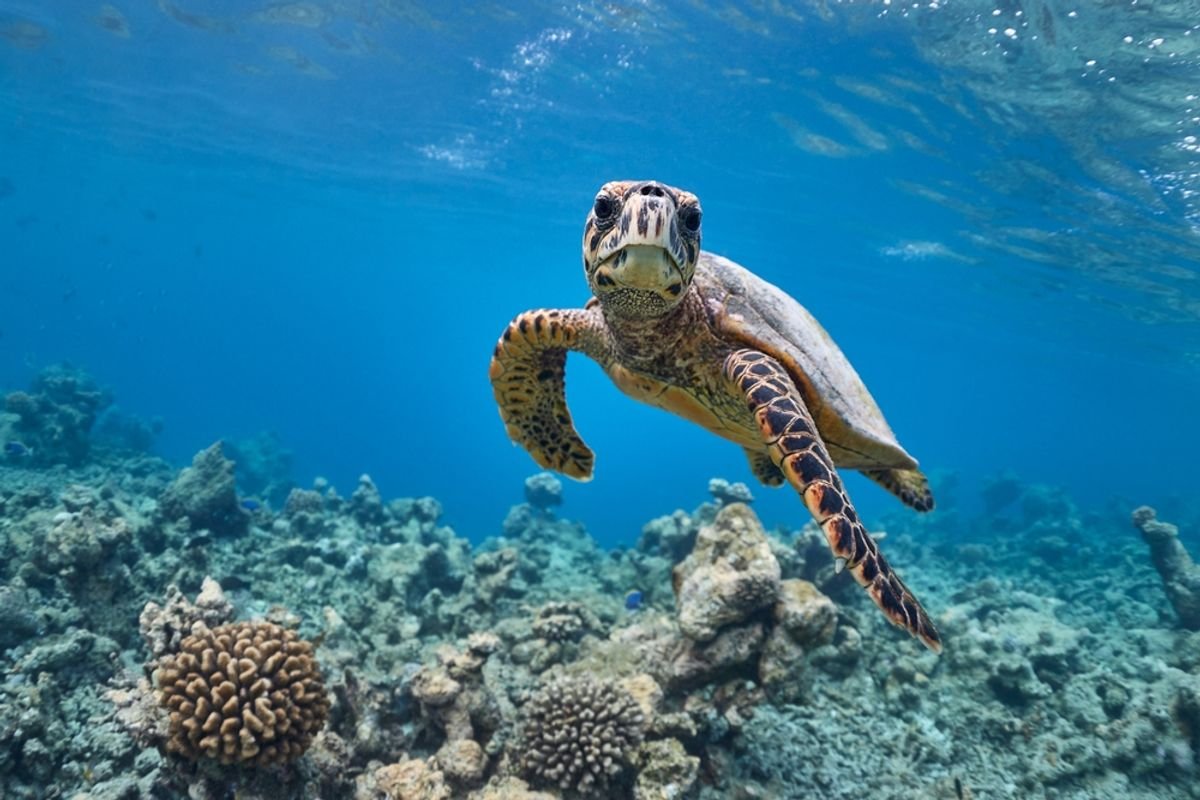
The Colossal BioVault will also focus on species that are endangered in the United Arab Emirates. One species that urgently needs protection in the region is the hawksbill sea turtle, spread out across tropical and subtropical waters worldwide; along the Persian Gulf, hawksbill turtles inhabit nesting sites at beaches in Iran, Kuwait, Oman, Qatar, Saudi Arabia, and the UAE.
Climate change is taking a toll on these turtles in several ways, the most worrisome being climate-related shifts in sex ratios; if a turtle’s eggs incubate below 81.86 degrees Fahrenheit, the turtle hatchlings will come out as male. But if incubation temperature exceeds 88.8 degrees Fahrenheit, the hatchlings will be female. Since consistently high temperatures will lead to more females being born, scientists are concerned that climate change could give rise to all-female turtle populations, according to the National Ocean Service.
A January 2026 study published in the National Library of Medicine analyzed 17 hawksbill turtles from four nesting islands near southern Iran and found that populations displayed low genetic diversity. The authors stressed that conservation plans for each nesting site are essential, stating that “the loss of one could result in the loss of an entire genetic lineage.”
The Rise of Biobanking
News of the Colossal BioVault comes as scientists and conservationists are committing to biobanking, an effort that aims to indefinitely preserve living cells from wildlife.
Similar projects have emerged in recent years; in 2023, conservation nonprofit Revive & Restore announced plans to biobank U.S. endangered species. This project will collect samples from animals in the wild and captive breeding programs, and then freeze cell lines and tissues for long-term storage.
Revive & Restore announced that it has partnered with the U.S. Fish and Wildlife Service to target the endangered species that will be biobanked. According to the nonprofit’s website, several species have already been cryopreserved, including the Mexican Wolf, the Sonoran pronghorn, the Florida bonneted bat, and Preble’s meadow jumping mouse.
As for the Colossal’s conservation objectives, the company plans for the BioVault in Dubai to be the first in a global network of BioVaults that will span across multiple countries. According to Colossal, the Dubai exhibit will set a precedent as a “living laboratory,” engaging citizen scientists by allowing the public to watch scientific preservation work in real time.
Read More: European Wildcats Are Slowly Making a Comeback in the Forests of Central Europe
Article Sources
Our writers at Discovermagazine.com use peer-reviewed studies and high-quality sources for our articles, and our editors review for scientific accuracy and editorial standards. Review the sources used below for this article: