
Methane from Lunar Landers May Contaminate Ancient Organic Molecules at the Moon’s Poles

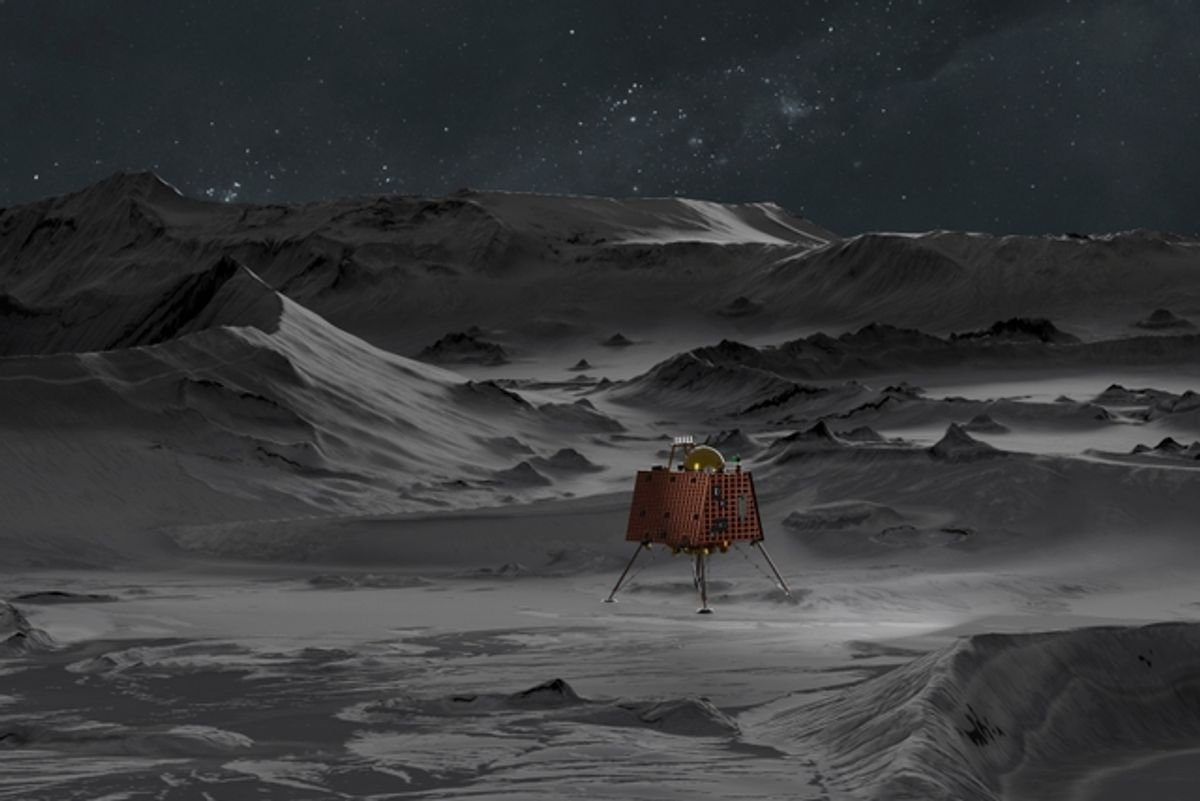
As more lunar landers start to aim for the moon, they may contaminate craters that hold clues to the origin of life. When spacecraft land on the moon, the exhaust methane they emit spreads out to the lunar north and south poles. This contamination could hinder the search for prebiotic organic molecules, key building blocks of life believed to be trapped within icy craters.
A recent study published in the Journal of Geophysical Research: Planets has modeled how exhaust methane moves on the moon for the first time. The findings reveal that exhaust methane from lunar spacecraft eventually settles at the lunar poles; in the process, over half of the methane could end up contaminating regions that are critical to future missions in the search for prebiotic organic molecules.
Read More: The Moon Is Moving Farther From Earth Each Year, and Tides Are the Reason
Frozen Clues on the Moon
Space agencies around the world have their sights set on the moon’s north and south poles, hoping to uncover frozen lunar water in craters and obtain evidence of prebiotic organic molecules. Billions of years ago, these molecules were delivered to the moon and Earth by comets and asteroids.
Earth’s surface has changed so much throughout its history that the ancient molecules are most likely gone forever. However, on the moon, where the surface has remained largely unchanged for billions of years, molecules may be preserved in permanently shadowed regions.
“We know we have organic molecules in the solar system — in asteroids, for example,” said senior author Silvio Sinibaldi, the planetary protection officer at the European Space Agency, in a statement. “But how they came to perform specific functions like they do in biological matter is a gap we need to fill.”
Widespread Lunar Contamination
While the contamination of lunar samples has always been a concern, it could become a serious issue as interest in moon exploration reaches new heights. To understand how contamination on the moon might occur, researchers created a computer model based on the ESA’s Argonaut missions, which are planned to take place in the 2030s.
The computer model was built to determine what would happen to organic molecules generated from the combustion of a mixture of monomethylhydrazine (MMH) and mixed oxides of nitrogen (MON-3). The researchers focused on simulating the spread of methane from spacecraft exhaust during a landing at the moon’s south pole.
“We were trying to model thousands of molecules and how they move, how they collide with one another, and how they interact with the surface,” said lead author Francisca Paiva, a physicist at Instituto Superior Técnico in Portugal. “It required a lot of computational power. We had to run each simulation for days or weeks.”
The model showed exhaust methane reaching the lunar north pole in under two lunar days. Within seven lunar days (the equivalent of about 7 months on Earth), more than half of the total exhaust methane had settled at the poles: 42 percent at the south pole and 12 percent at the north pole.
Hopping to the Lunar Poles
The researchers explain that because the moon’s thin atmosphere contains barely any other molecules to bump into, methane molecules are able to move freely across the landscape. The molecules are energized by sunlight, but when they reach areas that are colder (like the poles), they slow down and get trapped.
“Their trajectories are basically ballistic,” Paiva said. “They just hop around from one point to another. We showed that molecules can travel across the whole moon. In the end, wherever you land, you will have contamination everywhere.”
This means that no matter where a spacecraft lands, methane will inevitably migrate to the lunar poles. However, the researchers suggest that colder landing sites may better corral exhaust molecules than warmer ones.
They also stress that more research is needed to know the effects of contamination on permanently shadowed regions; there’s a chance that they may just settle onto the icy surfaces without tainting the material underneath.
Read More: Terrestrial Particles Travel to the Moon by Hitchhiking Along Earth’s Magnetic Field Lines
Article Sources
Our writers at Discovermagazine.com use peer-reviewed studies and high-quality sources for our articles, and our editors review for scientific accuracy and editorial standards. Review the sources used below for this article: