
Meet the Sea Walnut — A Cannibalistic Jelly Currently Invading Venice’s Lagoon

Don’t be fooled by this harmless, cute-looking jelly bobbing around the waters of Venice’s lagoon. Comb jellies present some odd behaviors and characteristics, such as performing cannibalism and lacking a permanent anus.
Recently, this small and squishy marine creature, native to the east coast of North and South America, has made itself comfortable in a new habitat, spreading at a concerning rate and causing havoc on Italy’s local marine ecosystem.
A new study published in Estuarine, Coastal and Shelf Science by Italian researchers explored what drives the comb jelly’s expansion into the Mediterranean lagoon and found it perfectly adapted to the lagoon’s water temperature and salinity. The researchers estimate that climate change will only worsen their population boom, calling for immediate action to mitigate the comb jelly’s spread.
Comb Jellies Can Threaten Ecosystems
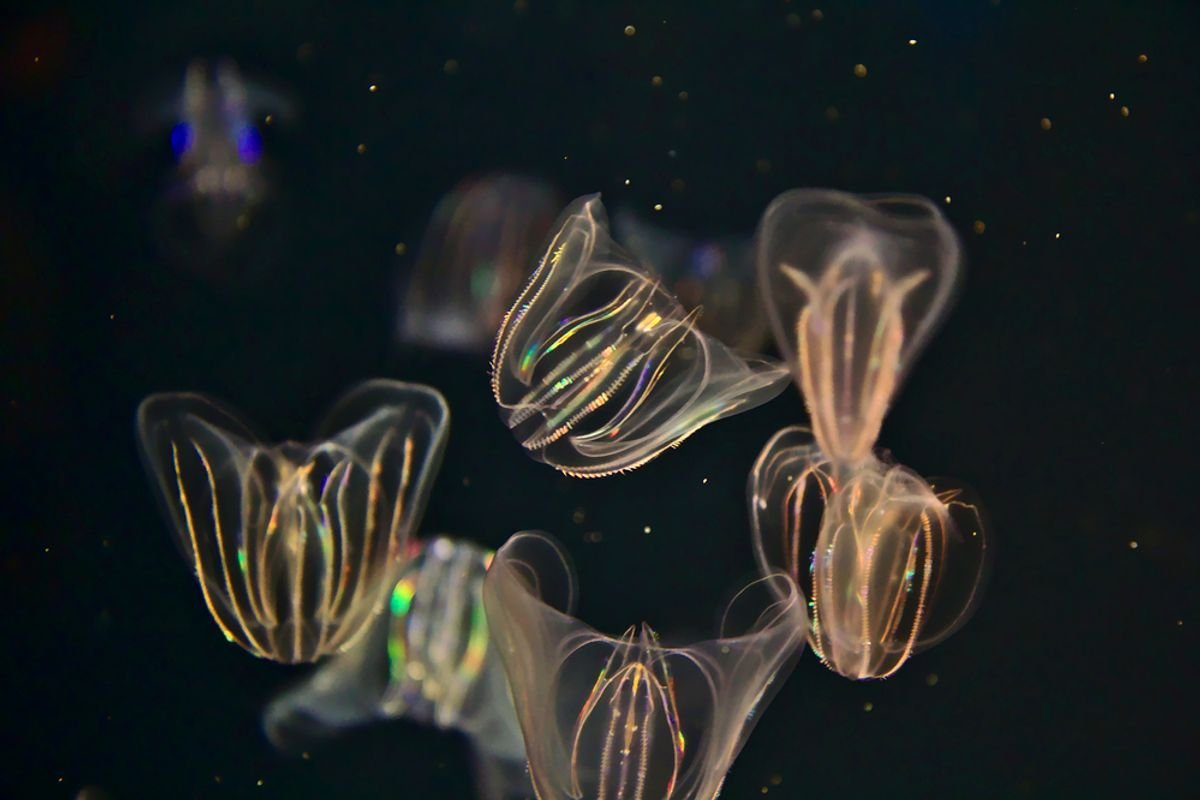
The comb jelly (Mnemiopsis leidyi), also known as the warty comb jelly or sea walnut, has a transparent body that can reach 3 to 5 inches and belongs to a group of stingless gelatinous animals called ctenophores, according to the Marine Biological Laboratory at the University of Chicago. Instead of stinging, they use colloblasts, microscopic sticky cells on their tentacles, to capture prey.
M. leidyi is famous for its stunning bioluminescence and glides gracefully through the water with the help of eight rows of cilia, microscopic hair-like paddles that beat rhythmically to induce motion. In fact, sea walnuts are the largest animals known to use cilia for movement.
Interestingly, M. leidyi is the only observed animal without a permanent anus. Its backend only sprouts when it needs to defecate.
Sea walnuts have a varied diet consisting of crustaceans, eggs, and fish larvae, which may make them a major destabilizer when introduced to new ecosystems.
Read More: Brainless Jellyfish Need Rest Like Humans, and Reveal Sleep’s Evolutionary Purpose
Why Venice’s Lagoon Is Ideal for the Invasive Jelly
The sea walnut’s impact on marine environments has already been studied in several regions, but how it fares in Mediterranean lagoons remains underexplored. The Italian research team observed M. leidyi and studied it in the lab for two years, discovering that the invader follows a seasonal pattern in which populations bloom in late spring and again in late summer.
They demonstrated that the jellies can withstand broad temperature changes, ranging from 50 to 90 degrees Fahrenheit, and salt concentrations between 10 and 34 parts per thousand, making the warm, shifting salinity levels of Venice’s lagoon an optimal habitat.
Overall, the findings suggest that ongoing climate change will further shift the lagoon’s conditions in favor of the sea walnut, leading to larger populations and even greater impacts on local marine species that fall prey to them. In their study, the researchers encouraged specialized monitoring of the invasive species in the lagoon, hoping this would reduce issues seen in the local fishing industry as well as across the broader ecosystem.
Sea Walnuts Can Resort to Cannibalism
According to the Smithsonian, the invasive story of the sea walnut began in 1982 when M. leidyi was accidentally introduced into the Black Sea through ships’ ballast water and quickly spread to the Caspian, Mediterranean, Baltic, and North Seas. There, the sea walnut contributed to severe fishery crashes, as populations grew exponentially without local predators to keep them in check.
In its native habitat along America’s east coast, other ctenophores, jellyfish, and fish prey on M. leidyi, helping keep population sizes more controlled, as described by the Global Invasive Species Database.
Another survival strategy, common in jellyfish and other gelatinous zooplankton, may also play into the sea walnut’s survival toolkit. According to a 2020 study in Nature Communications Biology, M. leidyi in the western Baltic Sea appear to maintain energy reserves in nutrient-poor habitats by cannibalizing their own larvae.
The sea walnut proves that nothing in nature is black and white — species can fascinate us with their beauty and quirky ways of life, while their invasive behavior can still threaten precious ecosystems.
Read More: Rare Giant Phantom Jellyfish and a Well-Preserved Whale Skeleton Spotted Off the Coast of Argentina
Article Sources
Our writers at Discovermagazine.com use peer-reviewed studies and high-quality sources for our articles, and our editors review for scientific accuracy and editorial standards. Review the sources used below for this article: