
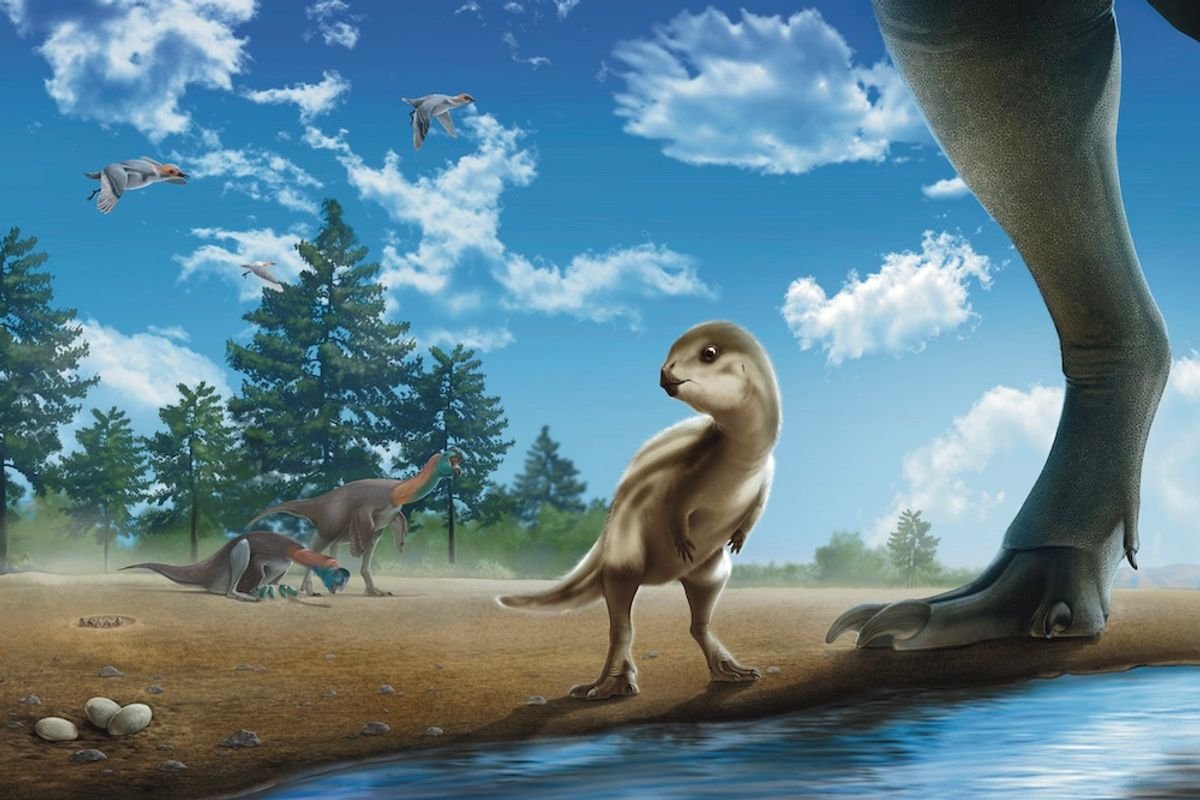
Meet Dooly, a Baby Dinosaur That May Have Been Fuzzy and Was Hidden in 113-Million-Year-Old Rock
A tiny dinosaur no bigger than a turkey — possibly cute, fluffy, and resembling a little lamb — is revealing just how much detail can be hidden inside a single block of rock. Meet Doolysaurus huhmini, a newly identified baby dinosaur from South Korea, named after “Dooly,” a mischievous green cartoon dinosaur that generations of children from Korea grew up with.
The fossil, discovered on Aphae Island, is the first new dinosaur species identified in the country in 15 years — and the first Korean dinosaur fossil ever found with preserved portions of its skull. That level of detail, revealed through micro-CT scanning, allowed researchers to see delicate features that would have been nearly impossible to uncover by hand. The findings were published in the Fossil Record.
“It was a truly exciting moment,” shared lead author Jongyun Jung with Discover. “As soon as we examined the CT data, we could clearly see a well-defined jaw and teeth. After processing the data, we confirmed that much more of the skull was preserved than expected. It really exceeded our expectations.”
Inside the Rock: A Hidden Baby Dinosaur Fossil
When the fossil was first uncovered in 2023, it didn’t stand out. Only a few long bones and vertebrae were visible on the surface, and the surrounding rock was too hard to easily remove without risking damage. That uncertainty is what led researchers to try something different.

Excavation of Doolysaurus.
(Image Courtesy of Jongyun Jung)
“Before scanning, we could only identify a few long bones and some vertebrae on the surface. The rock was extremely hard, and the bones were very small and fragile, so it was difficult to know what was preserved inside,” Jung told Discover.
Using micro-CT scanning, the team could peer inside the rock without breaking it open. The results quickly changed the scope of the discovery. Beyond the skull fragments, the scans revealed dozens of gastroliths — small stones the dinosaur swallowed to help grind food during digestion — along with more of the skeleton than anyone anticipated.
Read More: 90-Million-Year-Old Fossil Reveals a Fully Grown Dinosaur That Weighed Less Than 2 Pounds
What This Baby Dinosaur Was Like in Life
The dinosaur is estimated to be about two years old when it died. At that age, it was turkey-sized, but adults may have reached about twice that length.

Skeletal anatomy of a juvenile Doolysaurus.
(Image Courtesy of Janet Cañamar, adapted from Jung et al 2026.)
Its anatomy places it within a group of small, bipedal dinosaurs known as thescelosaurids, which lived during the mid-Cretaceous period, roughly 113 million years to 94 million years ago. These dinosaurs are thought to have been agile and, in some cases, covered in filament-like structures — giving them a fuzzy appearance.
The cluster of gastroliths suggests Doolysaurus was likely an omnivore, feeding on a mix of plants, insects, and possibly small animals.
They also hint at how the fossil formed. Because the stones were still tightly grouped, the body likely wasn’t scattered before burial, helping preserve more of the skeleton in place.
“Most of my research had focused on trackways, but I had always hoped to discover new dinosaur body fossils. This finding was incredibly rewarding in that sense,” Jung said.
Korea’s Missing Dinosaur Bones
South Korea is well known for its dinosaur footprints, nests, and eggs — evidence that dinosaurs were once widespread across the region. But actual skeletal fossils have been much harder to come by.
Doolysaurus helps begin to fill that gap. It also points to a practical challenge: many fossils may still be locked inside rock, unnoticed. Without tools like micro-CT scanning, they can be easy to overlook.
“I hope this discovery will be remembered as a starting point for more advanced research on dinosaur skeletal fossils in Korea. In this study, we applied various techniques such as micro-CT, and I hope that these approaches will continue to reveal new insights,” Jung explained to Discover.
With more fieldwork planned on Aphae Island and nearby regions, researchers are optimistic that this won’t be the last hidden fossil to come to light.
Read More: Unusually Small Dinosaur Fossil Helps Fill a 70-Million-Year Gap in Ornithopod Evolution
Article Sources
Our writers at Discovermagazine.com use peer-reviewed studies and high-quality sources for our articles, and our editors review for scientific accuracy and editorial standards. Review the sources used below for this article: