
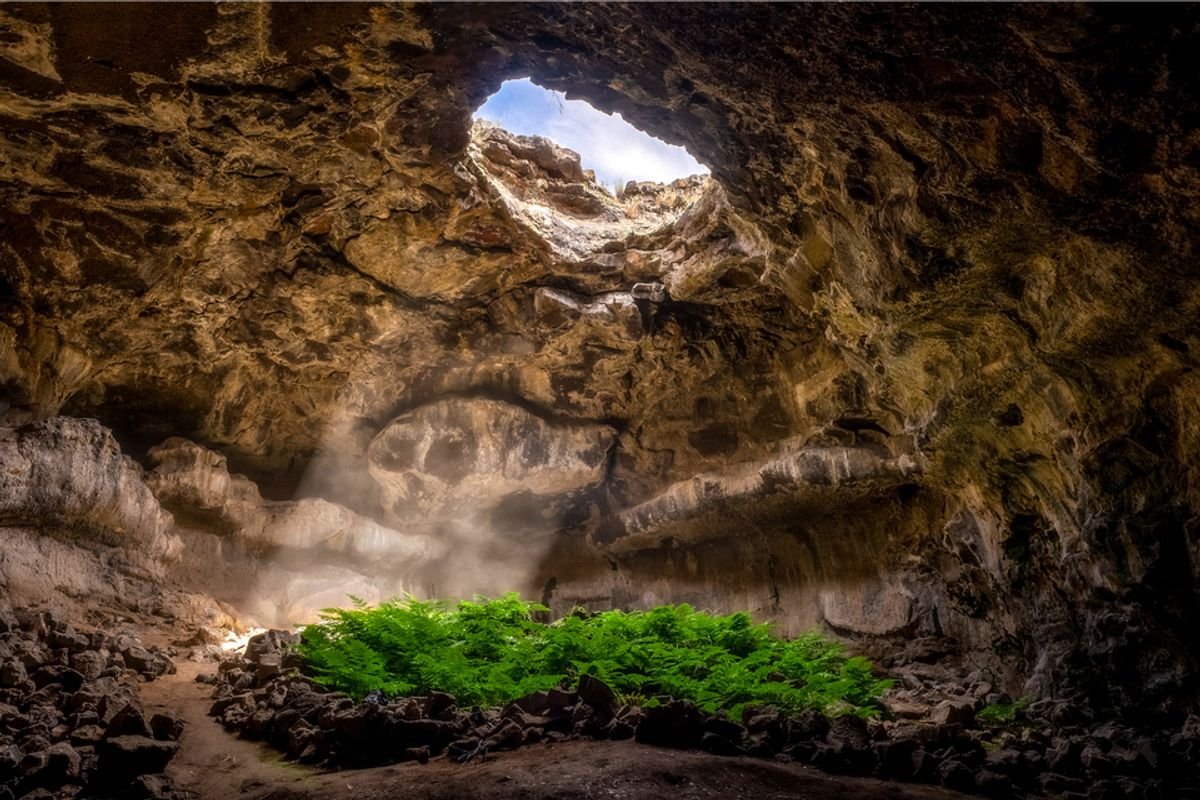
Mammoth Cave Was Once Home to Ancient Sharks — and the Evidence Is in the Walls

Clocking in at 426 miles, Kentucky’s Mammoth Cave is the world’s longest cave system. It’s a world chalked full of remnants of the past, one of the most important of which includes fossils from a range of marine species, painting a picture of what the world would have looked like 350 million years ago.
Most geologists in North America use the term “Mississippian” to describe the period between 358.9 and 298.9 million years ago, during which shallow seas covered much of the continent, leaving behind vast deposits of limestone and sandstone that are found throughout the Midwest today, according to the National Park Service (NPS).
In broader geologic terms, the Geological Society refers to it as the lower Carboniferous, a time when the climate was tropical with warm waters in Mammoth Cave, which is part of the reason researchers find such a great diversity of shark fossils, right before Pangea was starting to form and the land masses would come together to “squeeze out this marine basin.”
Read More: The Evolution of Sharks: What Were Ancient Sharks Like?
Why the Preservation of Sharks is So Unusual
Sharks are made of cartilage rather than bone, and while cartilage can fossilize, it only does so under specific circumstances, which is why we usually find only shark teeth rather than other parts of their bodies.
From the teeth, researchers can only guess at the size and shape of many ancient and extinct shark species. As a result, recent findings showing 40 different marine species and their relatives at Mammoth Cave are particularly impressive, according to the NPS.
The best specimens are usually preserved in very fine-grained sediments such as silt or mud, and they must be buried rapidly.
In the case of Mammoth Cave, the specimens, which include six new species as well as rare three-dimensional specimens, were preserved in a grainy material that was actually made of other skeletal animals like sea stars and shells, according to John-Paul Hodnett, a paleontologist with Maryland-National Capital Park and Planning Commission, who worked on the research.
“When cartilage is exposed to the surface, including sunlight and weather conditions like rain and snow, it doesn’t preserve, but in caves, there’s a naturally controlled erosional system with water slowly dissolving the matrix that surrounds the cartilage. As a result, the specimens come out much better preserved,” Hodnett told Discover.
Some of the New Species Identified in Mammoth Cave
Hodnett says that he was astounded at what they found in Mammoth Cave. He was hooked from the first fossil that was brought to his attention. It was called Saivodus striatus, a distant relative of modern sharks.
“The jaw was almost two feet long, larger than a Great White, which tells us that Saivodus was probably one of the biggest sharks of its age,” Hodnett told Discover. Larger teeth found in other parts of the world show that these sharks were huge.
There were a number of other unique fossils that researchers found, including Strigilodus tollesonae, a petal-toothed shark that resembled a bottom-dwelling sting ray with large pectoral fins, according to the NPS.
Researchers also identified two species of Ctenacanthus, which translates to “comb spine”—because they have these large spines on their dorsal fin. Each used its spiny fin to defend itself against the larger sharks that were also discovered. Another species, Glikmanius careforum, an extinct ctenacanth, a cartilaginous fish, was found in the cave wall.
“In this very narrow portion of the cave, there was basically the face of a shark preserved in the cave wall,” said Hodnett. He added that this was the first time we knew it was a jawed creature, with enough details in the teeth to show it was a different species of Glikmanius.
In the end, the findings show that sharks from this period came in all shapes and sizes, and they could be huge.
“Sharks have been experimenting with large sizes for 350 million years,” Hodnett said.
Read More: Giant 115-Million-Year-Old Shark Fossil Found in Australia Rewrites Evolution Timeline
Article Sources
Our writers at Discovermagazine.com use peer-reviewed studies and high-quality sources for our articles, and our editors review for scientific accuracy and editorial standards. Review the sources used below for this article: