
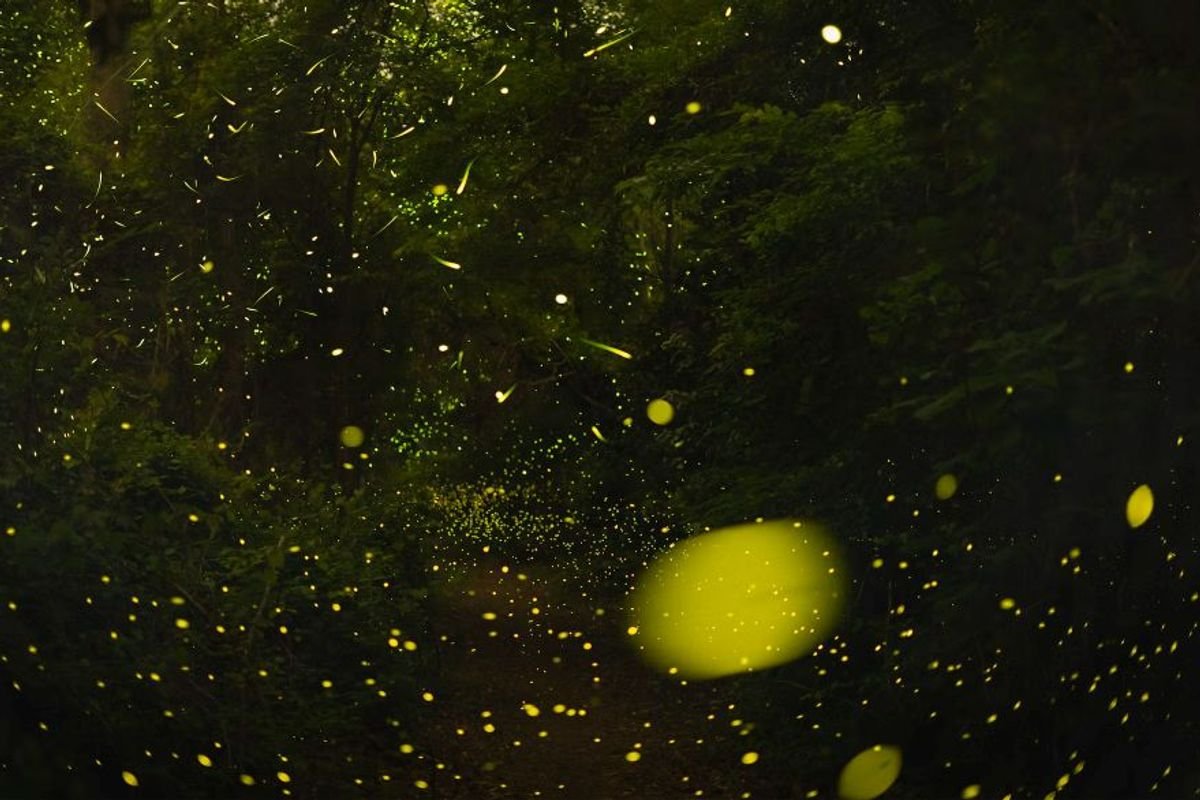
Male Fireflies Flash as One Every May in Congaree National Park, Inspiring Future Robotics
Fireflies are beautiful little creatures. Thanks to their bioluminescent abilities, those who grew up in rural, humid areas often feel nostalgic when they see these twinkling lights at dusk on a warm summer night.
And, this glowing ability is more than just beautiful; it’s beneficial, at least to the insects themselves. These pulsing flashes are how fireflies attract mates. While at first the flashing may seem random to the untrained human eye, fireflies have the unique ability to sync their flashing into the same pattern.
One of the best places to witness this phenomenon is Congaree National Park in South Carolina. Each May, thousands of male fireflies come together and put on a spectacular light show, synching their lights in perfect harmony. Fascinated by this ability, researchers from the University of Colorado Boulder (CU Boulder) wanted to understand how these insects could harmonize so perfectly. The results, published in a bioRxiv preprint paper, may one day inspire more advanced robotics.
“Even very small animals can solve surprisingly rich coordination problems,” Orit Peleg, an associate professor in the Department of Computer Science and the BioFrontiers Institute at CU Boulder and co-author of the preprint paper, told Discover.
Read More: Are We Really the Last Generation to Enjoy Twinkling Fireflies in the Summer?
Catching Male Fireflies

Dr. Owen Martin using a red light to catch fireflies in Congaree National Park
(Image Courtesy of Owen Martin)
The preprint study specifically looked at Photuris frontalis, a firefly species native to the eastern U.S., though according to Peleg, there are other species of synchronous fireflies in the U.S. as well.
“In the United States, the best-known examples are Photuris frontalis, Photinus carolinus (the Smokies synchronous firefly), and Photinus knulli (the Southwest synchronous firefly),” Peleg told Discover.
To understand P. frontalis and its synchronous abilities, Peleg and fellow researchers, including Owen Martin, spent several summers studying fireflies in the field. For their experiment, the team collected male fireflies in Congaree National Park and brought them into a tent that blocked out any light coming from the outside.
Once in the tent, the research team exposed a single firefly to a dim LED light that acted as an artificial firefly signal. Fireflies tend to flash anywhere from one to two times per second, Martin explained in a press release. So the team set the LED lights to flash between once per second and once every 300 milliseconds.
Syncing Firefly Flashes
From the results, the team noted that the fireflies would speed up their flashing to match the faster pulse or slow it down to match the slower one. If the LED light and the firefly light blinked at almost the same time, the firefly would change its tempo to match the LED.

(Image Courtesy of Nolan Bonnie)
The team also found that if the LED light blinked in a way that didn’t seem natural, the firefly would ignore it.
“What makes this especially interesting is that the LED does not simply ‘pull’ them in one direction. Depending on the timing, it can either speed up their next flash or delay it, which gives the fireflies a surprisingly flexible way to lock onto a rhythm,” Peleg told Discover.
According to Martin and Peleg, the way the fireflies communicated felt magical.
“For a whole season, I spent pretty much every night in the dark watching lights blink at a fixed frequency,” Martin said in the press release. “Then, occasionally, I’d get this magical experience where I’d see the firefly just start syncing with the light. I would wonder if I was just seeing things.”
Fireflies and Robotics
Based on their observations, the team then created a phase-response curve — a mathematical formula that shows how a light source affects a firefly’s flashing patterns.
“It took several field seasons to build the setup, collect enough clean measurements, and piece together the phase-response curve,” Peleg told Discover.
While there is still much to learn about firefly synchronization, the team believes that optical communication could impact robotics, including drones.
According to Peleg, this technology could help small robots move together through a cluttered environment, push objects simultaneously, or carry heavy loads. Thanks to the small bioluminescent creatures, we now have a better understanding of synchrony in nature.
“Beauty in nature can serve as information. The fireflies are sensing, responding, and coordinating with one another in real time. If we can understand that process, we may learn something not only about insects, but about collective behavior more broadly, from brains to robots to other living systems,” Peleg told Discover.
Read More: Flashing Light May Guide a Firefly to Mate, but Scent “Seals the Deal”
Article Sources
Our writers at Discovermagazine.com use peer-reviewed studies and high-quality sources for our articles, and our editors review for scientific accuracy and editorial standards. Review the sources used below for this article: