
Long-Necked Titanosaur Skeletons Have Surfaced at a Dinosaur Fossil Site in Transylvania
Transylvania may be known as the land of the vampires, but it’s also home to a remarkable assortment of dinosaur fossils. Around 70 million years ago, part of this region in Romania was separated from the mainland as an offshore island where rainfall was abundant. Flooded rivers on the island would carry animal carcasses to an area now referred to as the Hațeg Basin, where the remains of dinosaurs and other vertebrates can be found today.
A new study published in PLOS One describes one particular site in the Hațeg Basin — called K2 — that is incredibly rich in vertebrate fossils, containing more than 800 in an area of less than five square meters (just over 50 square feet). Embedded within K2 are fossils belonging to fish, turtles, crocodiles, mammals, and several dinosaurs.
Read More: Why Is the Isle of Wight Rich in Dinosaur Fossils?
Diversity on a Dinosaur Island

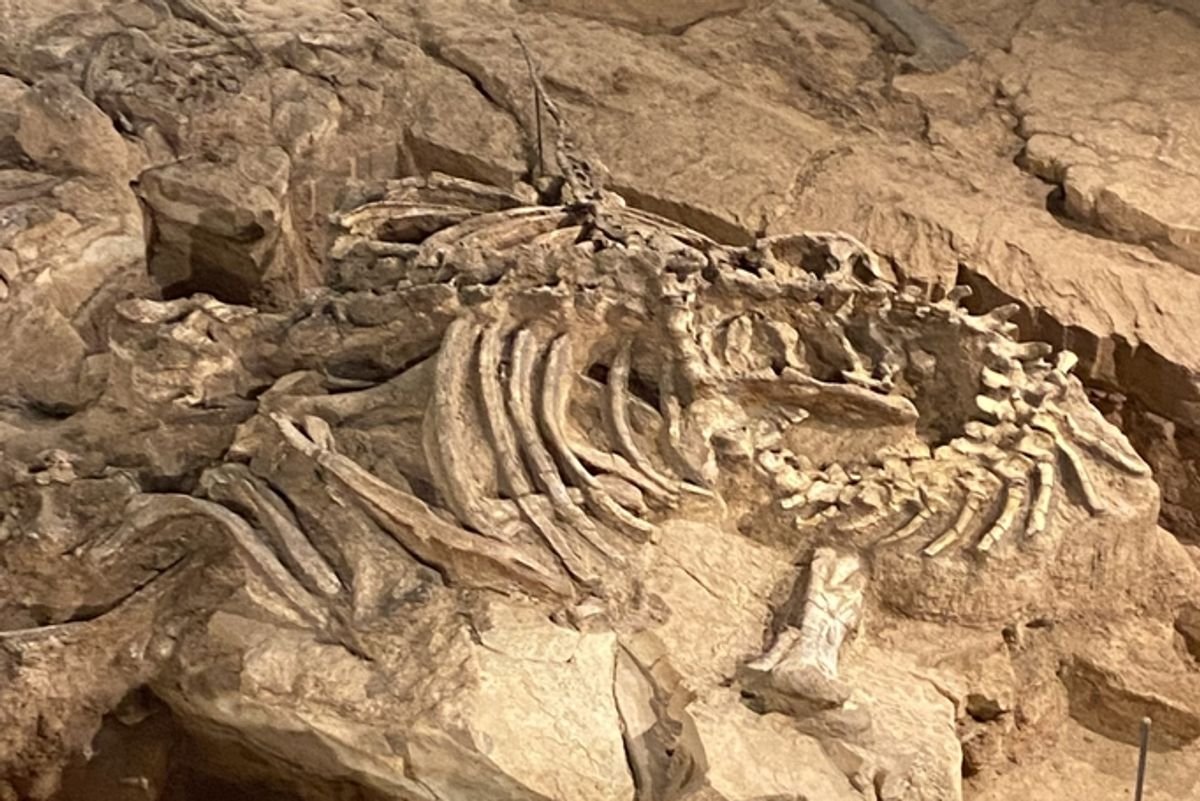
The Hațeg Basin in Transylvania is world-famous for its dinosaur remains, which have been unearthed from dozens of sites over the past century. Despite the high number of fossil localities, dinosaur finds are generally considered rare in the area. An exception is the newly discovered site, where researchers found more than a hundred vertebrate fossils per square meter, with the large dinosaur bones lying almost on top of each other.
(Image Credit: ELTE Eötvös Loránd University)
During the Late Cretaceous (around 100 to 66 million years ago), a diverse range of dinosaurs and other vertebrates inhabited Hațeg Island (now the Hațeg Basin). The island goes by quite the intriguing nickname today: the “Island of Dwarf Dinosaurs”.
The island was given this name because many dinosaurs that lived there were much smaller than their mainland counterparts. Scientists have suggested that this is a prehistoric instance of insular dwarfism, an evolutionary process that causes larger animals to shrink on islands as a result of limited resources.
Insular dwarfism can be seen in certain titanosaurs — a group of long-necked sauropods — that lived on Hațeg Island. For example, Magyarosaurus dacus was only about 20 feet long, while the mainland-dwelling Patagotitan could reach 121 feet in length.
However, not all dinosaurs on Hațeg Island were so diminutive. A February 2025 study in the Journal of Systematic Palaeontology found that larger titanosaurs that migrated to the island by way of temporary landbridges lived alongside smaller species.
One of the largest pterosaurs, Hatzegopteryx, also lived on the island, boasting a wingspan of 33 feet to 39 feet. This is considered a case of insular gigantism, in which smaller animals grow on islands due to reduced predation.
Washed Away by Floods
The dinosaurs that once roamed Hațeg Island left behind remains that paleontologists have been digging up for years. But in 2019, researchers involved with the new study came upon a particularly impressive treasure trove of bones preserved in layers of clay at the K2 site.
Dinosaur remains make up more than half (52 percent) of the fossil assemblage excavated at K2, with titanosaurs representing 62 percent of all dinosaur remains. After dinosaurs, turtle and crocodyliform fossils are the next most common remains.
The researchers say that K2 is so rich in fossils because of the subtropical climate on Hațeg Island 72 million years ago. The island was populated with rivers that flowed from elevated regions into a basin, and during heavy rainfall, both animal carcasses and living animals would get swept up by elevated floodwaters that moved to areas of lower elevation.
“Detailed study of the rocks at the K2 site indicates that a small lake once existed here, which was periodically fed by flash floods carrying animal carcasses. As the flow of the rivers slowed rapidly upon entering the lake, the transported bodies accumulated in the deltaic environment along the shore, producing this exceptionally high bone concentration,” said co-author Soma Budai, a researcher at the University of Pavia, in a statement.
Linking Ancient Ecosystems in Europe
The researchers uncovered not only isolated bones at K2, but also partial dinosaur skeletons. Their findings provided insight into two different herbivorous dinosaurs; one is a 6.5-foot-long, predominantly bipedal herbivore belonging to the Rhabdodontidae family, known for its stocky build and triangular skull, according to an article in the journal Fossil Record. The other is a titanosaurian sauropod dinosaur — the researchers say there hadn’t previously been any such well-preserved skeletons of this dinosaur in Transylvania.
Based on the researchers’ findings, K2 now contains the oldest known vertebrate accumulation in the Hațeg Basin. This means that the fossils will ultimately help them compare K2 to younger fossil sites in Transylvania and learn more about the ecosystems that dinosaurs occupied in what is now Eastern Europe.
Read More: 5 Massive Dinosaur Fossils and Where They Were Found
Article Sources
Our writers at Discovermagazine.com use peer-reviewed studies and high-quality sources for our articles, and our editors review for scientific accuracy and editorial standards. Review the sources used below for this article: